23 Startup Launch Directories Actually Worth Considering in 2026
Compare 23 startup launch directories by Domain Rating, price, backlink type, and DR per dollar. Find free, high-DR, and dofollow options for your next launch.
There are hundreds of places where you can submit and launch a startup.
Finding them isn't the difficult part.
The difficult part is deciding which startup launch directories are actually worth your time and money.
A typical list gives you 100, 200, or even 300+ directories. But when you're actually preparing a launch, you need answers to more practical questions:
Which startup directories are still active?
Which directories offer free submissions?
Which ones provide dofollow backlinks?
Which have strong domains?
How much does each submission cost?
Which directories are worth paying for?
Where should you start with a limited launch budget?
We wanted better answers to those questions.
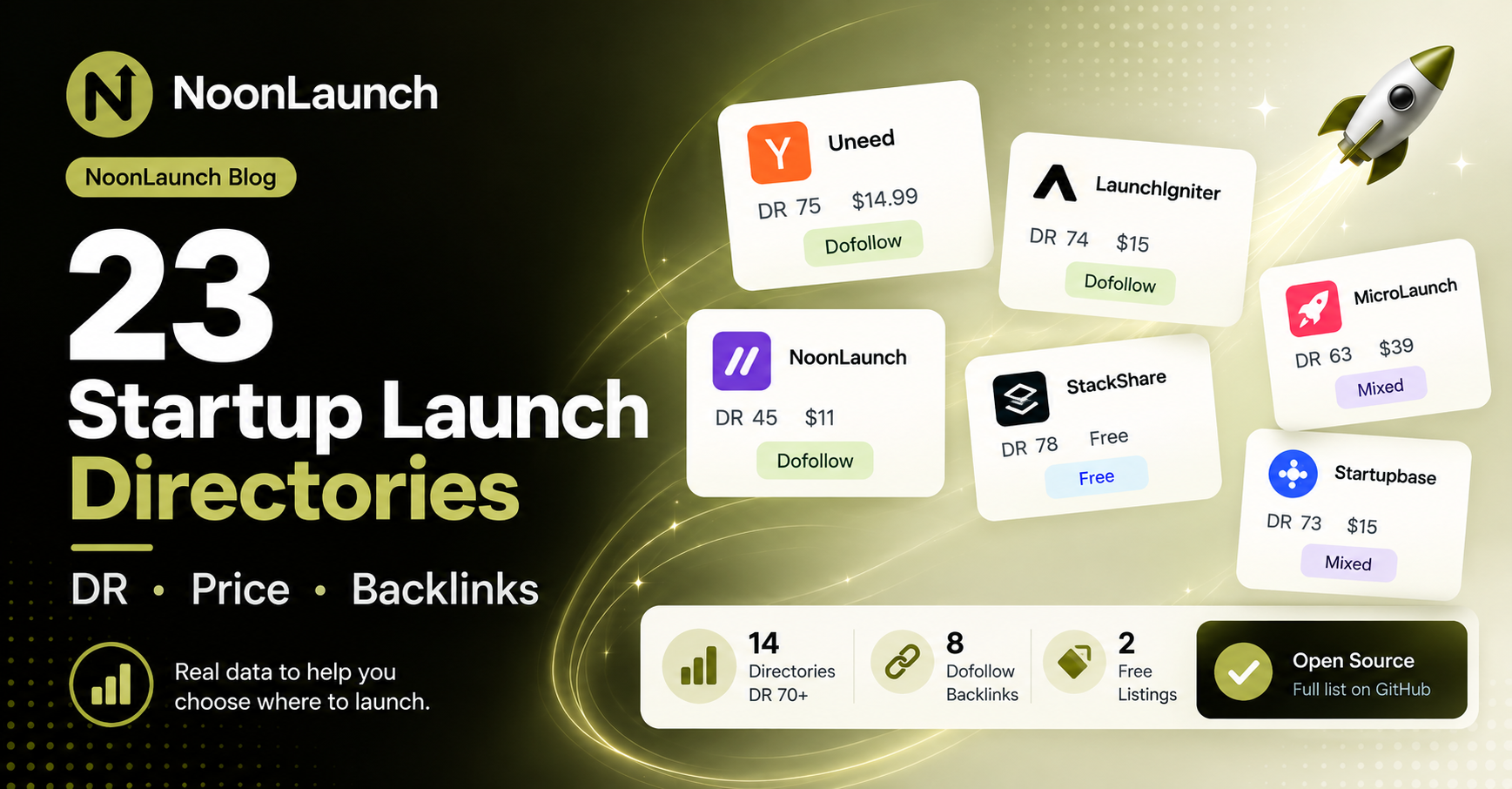
So we researched startup and product launch directories and built an open-source dataset tracking Domain Rating (DR), submission price, DR per dollar, backlink type, and submission options.
Instead of trying to create the biggest directory list possible, we applied a higher standard.
The result is 23 startup launch directories worth considering in 2026.
At the time of our latest check:
23 directories made the list
14 have a Domain Rating of 70+
2 offer free listings
21 have paid options
8 of the 17 directories where link policy could be measured showed dofollow links across sampled listings
2 showed nofollow links
7 had mixed link behavior
Data last refreshed: September 6, 2026.
Best Startup Launch Directories in 2026
Here is the complete comparison.
# | Directory | DR | Price | DR / $ | Backlink |
|---|---|---|---|---|---|
1 | Findly Tools | 81 | $29 | 2.8 | Not verified |
2 | StackShare | 78 | Free | ∞ | Not verified |
3 | Uneed | 75 | $14.99 | 5.0 | Dofollow |
4 | ToolFame | 75 | $14.99 | 5.0 | Mixed |
5 | LaunchIgniter | 74 | $15 | 4.9 | Dofollow |
6 | PeerPush | 74 | $39 | 1.9 | Dofollow |
7 | NickLaunches | 74 | $19 | 3.9 | Dofollow |
8 | Startupbase | 73 | $15 | 4.9 | Mixed |
9 | TinyLaunch | 73 | $39 | 1.9 | Not verified |
10 | Open-Launch | 72 | $12 | 6.0 | Mixed |
11 | Startup Fast | 72 | $19 | 3.8 | Mixed |
12 | TinyShelf | 71 | $19 | 3.7 | Mixed |
13 | Tiny Startups | 71 | $49 | 1.4 | Not verified |
14 | Launch Llama | 71 | $39 | 1.8 | Dofollow |
15 | MicroLaunch | 63 | $39 | 1.6 | Dofollow |
16 | IndieHunt | 62 | $19 | 3.3 | Mixed |
17 | LaunchVault | 55 | $9.99 | 5.5 | Mixed |
18 | StartupTrusted | 54 | $9 | 6.0 | Dofollow |
19 | 47 | Free | ∞ | Not verified | |
20 | NoonLaunch | 45 | $11 | 4.1 | Dofollow |
21 | DevHub | 39 | $9.90 | 3.9 | Nofollow |
22 | Shipyard HQ | 35 | $9.99 | 3.5 | Not verified |
23 | 31 | $49 | 0.6 | Nofollow |
A quick warning before using the numbers:
DR alone should never decide where you launch.
A DR 75 directory with the wrong audience can be less valuable to your startup than a DR 45 launch platform where relevant founders and potential customers actually discover your product.
DR, price, and backlink type are signals to help make a decision. They aren't a universal ranking of platform quality.
Findly Tools
DR: 81
Price: $29
DR / $: 2.8
Findly Tools currently has the highest Domain Rating in our tracked list.
At $29, it isn't the cheapest submission, but founders primarily interested in getting listed on stronger domains may want to consider it.
We weren't able to reliably determine the outbound backlink policy during our check, so don't assume you're buying a dofollow backlink purely because the domain has a high DR.
StackShare
DR: 78
Price: Free
StackShare is particularly interesting because it's both free and DR 78.
Unlike general startup launch platforms, StackShare is focused on developer tools and technology stacks.
That means it won't make sense for every startup.
But if you're building an API, database, infrastructure product, developer tool, or another technical product, it's one of the first free listings we'd consider.
Uneed
DR: 75
Price: $14.99
DR / $: 5.0
Observed link: Dofollow
Uneed combines a strong domain with a relatively low submission price.
There's also a free queue, while the paid option lets you skip the wait.
At $14.99 and DR 75, it currently has one of the stronger price-to-DR ratios among the directories we checked.
Our sampled listing links were also dofollow at the time of testing.
ToolFame
DR: 75
Price: $14.99
DR / $: 5.0
Observed link: Mixed
ToolFame has the same DR and listed price as Uneed in our current dataset.
The difference is backlink behavior.
Our sample showed mixed link behavior, meaning founders shouldn't automatically assume every listing receives the same type of outbound link.
LaunchIgniter
DR: 74
Price: $15
DR / $: 4.9
Observed link: Dofollow
LaunchIgniter is another interesting option around the $15 mark.
It combines DR 74 with dofollow links in our sample and a DR/$ score of 4.9.
For founders building a smaller group of paid directory submissions rather than submitting everywhere, this combination makes it worth considering.
PeerPush
DR: 74
Price: $39
DR / $: 1.9
Observed link: Dofollow
PeerPush has the same measured DR as LaunchIgniter but comes at a significantly higher price.
That doesn't automatically make it worse.
Directory value can come from exposure, community, launch mechanics, and referral traffic, not just backlinks.
NickLaunches
DR: 74
Price: $19
DR / $: 3.9
Observed link: Dofollow
NickLaunches sits in an interesting middle ground: DR 74, a $19 listing, and dofollow links in our sample.
It's worth comparing when building a shortlist of higher-DR launch platforms without moving into more expensive submissions.
Startupbase
DR: 73
Price: $15
DR / $: 4.9
Observed link: Mixed
Startupbase offers one of the better DR-to-price ratios in the list.
However, our checks found mixed backlink behavior.
Six of the eight listing links sampled were nofollowed.
That doesn't necessarily mean a paid listing will be nofollow. It means you should verify exactly what you're getting if backlink type is important to you.
TinyLaunch
DR: 73
Price: $39
DR / $: 1.9
TinyLaunch has a strong DR of 73, although its $39 price gives it a lower DR/$ score than several alternatives.
We couldn't reliably verify the link policy from the pages we checked.
Open-Launch
DR: 72
Price: $12
DR / $: 6.0
Observed link: Mixed
Open-Launch stands out on price.
At $12 with DR 72, it's currently the cheapest paid DR 70+ placement in our dataset.
That produces a DR/$ score of 6.0, one of the strongest among the paid options.
The project is also open source.
Startup Fast
DR: 72
Price: $19
DR / $: 3.8
Observed link: Mixed
Startup Fast provides another DR 70+ option below $20.
Our backlink test found mixed behavior, with two of eight sampled links nofollowed.
TinyShelf
DR: 71
Price: $19
DR / $: 3.7
Observed link: Mixed
TinyShelf is priced at $19 with a measured DR of 71.
The link policy was mixed in our sample, so founders purchasing specifically for backlink value should verify a comparable current listing first.
Tiny Startups
DR: 71
Price: $49
DR / $: 1.4
Tiny Startups is one of the more expensive DR 70+ options on our list.
Its $49 price results in a DR/$ score of 1.4.
That doesn't tell you whether its audience or exposure is worth $49. It simply means founders optimizing strictly for domain authority per dollar have cheaper options available.
Launch Llama
DR: 71
Price: $39
DR / $: 1.8
Observed link: Dofollow
Launch Llama rounds out the DR 70+ group.
Our sample found dofollow outbound links, which makes the listing more interesting for founders considering both product exposure and backlink value.
MicroLaunch
DR: 63
Price: $39
DR / $: 1.6
Observed link: Dofollow
MicroLaunch has a lower DR than the platforms above it, but DR isn't the whole story.
It's a product-launch platform rather than simply a static directory, so its value should also be judged on discovery and launch exposure.
Our sampled outbound links were dofollow.
IndieHunt
DR: 62
Price: $19
DR / $: 3.3
Observed link: Mixed
IndieHunt comes in at DR 62 and $19.
Our backlink testing found mixed behavior, so verify the exact listing type if SEO is a major reason you're considering it.
LaunchVault
DR: 55
Price: $9.99
DR / $: 5.5
Observed link: Mixed
LaunchVault is one of the cheapest paid options on the list.
Its DR is lower at 55, but the $9.99 price gives it a relatively high DR/$ score of 5.5.
StartupTrusted
DR: 54
Price: $9
DR / $: 6.0
Observed link: Dofollow
At $9, StartupTrusted is currently the cheapest paid listing in our dataset.
Its DR/$ score is 6.0 and our sample found dofollow links.
The lower DR means it shouldn't be compared directly with a DR 70+ directory based on price alone, but it may fit a budget-focused submission strategy.
Ramen.tools
DR: 47
Price: Free
Ramen.tools makes the list for a simple reason: it's free.
Free directories don't need to compete with paid listings on DR/$ because the financial cost is zero.
If the audience fits your product and submission doesn't take much time, free listings can be an easy addition to a broader launch.
NoonLaunch
DR: 45
Price: $11
DR / $: 4.1
Observed link: Dofollow
Yes, NoonLaunch is on this list.
Because you're reading this research on NoonLaunch, that deserves a clear disclosure.
We didn't give NoonLaunch a special position.
The open-source dataset is sorted by Domain Rating, which currently puts NoonLaunch at #20 with DR 45.
Its standard paid launch is $11, and our measured links are dofollow.
NoonLaunch focuses on weekly launches rather than a one-day leaderboard. Products also keep a permanent product page after launch.
This comparison isn't designed to tell you that NoonLaunch is automatically better than the other options. Use the same data to make that decision yourself.
DevHub
DR: 39
Price: $9.90
DR / $: 3.9
Observed link: Nofollow
DevHub is inexpensive at $9.90, but our sampled listing links were nofollow.
If you're considering it primarily to acquire a backlink, that's important.
If its audience can send relevant users to your product, a nofollow link doesn't automatically make the listing useless. It simply changes what you're paying for.
Shipyard HQ
DR: 35
Price: $9.99
DR / $: 3.5
Shipyard HQ is another sub-$10 option.
We weren't able to reliably determine its backlink policy, so we'd evaluate the platform based on audience and discovery rather than assuming SEO value.
Resource.fyi
DR: 31
Price: $49
DR / $: 0.6
Observed link: Nofollow
Resource.fyi currently has the lowest DR/$ score in our tracked list.
At $49 with DR 31 and nofollow links in our sample, it would be difficult to justify purely as a backlink purchase.
That doesn't mean it has no value.
Its value would need to come from referral traffic, discovery, or access to a relevant audience rather than direct SEO link equity.
Best Free Startup Directories
If you have no launch budget, free startup directories are the obvious place to start.
Two platforms in our current dataset offer free submission options:
StackShare — DR 78
StackShare has the highest DR among the free options we tracked.
It's particularly relevant for developer tools, APIs, databases, infrastructure products, and other technical startups.
Ramen.tools — DR 47
Ramen.tools is another free option worth considering.
Because there's no listing fee, the main cost is your time.
For founders with limited launch budgets, relevant free directories can be useful additions to a larger distribution strategy.
High-DR Startup Directories
If domain strength is one of your priorities, 14 of the 23 directories in our dataset currently have DR 70 or higher.
They include Findly Tools, StackShare, Uneed, ToolFame, LaunchIgniter, PeerPush, NickLaunches, Startupbase, TinyLaunch, Open-Launch, Startup Fast, TinyShelf, Tiny Startups, and Launch Llama.
But high DR doesn't automatically mean a better launch.
Before paying for a high-DR directory, check:
Whether your product fits its audience
Whether the product page is indexable
Whether your website link is dofollow or nofollow
How long the product page remains available
Whether the platform can provide actual discovery in addition to a backlink
A high DR should be one part of the decision, not the entire decision.
Best Startup Directories for Backlinks
If SEO is one of your launch goals, backlink type matters.
Among the directories where we could measure outbound link behavior, our samples found dofollow links from platforms including:
Uneed
LaunchIgniter
PeerPush
NickLaunches
Launch Llama
MicroLaunch
StartupTrusted
NoonLaunch
Other platforms showed mixed behavior, meaning some sampled links were followable while others were nofollowed.
And some showed nofollow links.
This is important because a DR 75 website doesn't automatically give your startup the SEO benefit of a DR 75 backlink.
You need to look at the actual link pointing to your website.
Cheap Startup Directories Under $20
You don't need a huge launch budget to submit your startup to several directories.
Some of the paid options in our dataset below $20 include:
Directory | DR | Price | Backlink |
|---|---|---|---|
StartupTrusted | 54 | $9 | Dofollow |
DevHub | 39 | $9.90 | Nofollow |
LaunchVault | 55 | $9.99 | Mixed |
Shipyard HQ | 35 | $9.99 | Not verified |
NoonLaunch | 45 | $11 | Dofollow |
Open-Launch | 72 | $12 | Mixed |
Uneed | 75 | $14.99 | Dofollow |
ToolFame | 75 | $14.99 | Mixed |
LaunchIgniter | 74 | $15 | Dofollow |
Startupbase | 73 | $15 | Mixed |
NickLaunches | 74 | $19 | Dofollow |
Startup Fast | 72 | $19 | Mixed |
TinyShelf | 71 | $19 | Mixed |
IndieHunt | 62 | $19 | Mixed |
This is where comparing the data becomes much more useful than simply having a huge list of URLs.
A founder with a $50 launch budget can build a shortlist based on audience, DR, backlink behavior, and price instead of randomly purchasing listings.
Best Startup Directories for SaaS Founders
SaaS founders shouldn't choose a launch platform based only on DR.
A SaaS launch can potentially benefit from several things at the same time:
Product discovery
Referral traffic
Early users
Founder feedback
Brand mentions
Search visibility
Backlinks
A permanent product page
For a SaaS founder, we'd prioritize relevance + discovery + permanent visibility + backlink quality over DR alone.
Developer-focused SaaS products may benefit from platforms such as StackShare, while broader SaaS products can consider general startup and product-launch platforms from the list.
The right combination depends on who you're trying to reach.
Dofollow vs Nofollow Startup Directory Backlinks
A high Domain Rating looks attractive, but the domain's DR isn't automatically transferred to your website because you purchased a listing.
The actual outbound link matters.
That's why we classify observed links as:
Dofollow: sampled listing CTAs were followable.
Nofollow: sampled listing CTAs contained attributes such as nofollow, ugc, or sponsored.
Mixed: different sampled listings produced different results.
Not verified: we couldn't reliably determine the policy.
Mixed results are particularly important.
Some directories may treat different listings or plans differently. Because our audit can't always determine which historical listing used which plan, you should verify a current listing from the tier you're considering.
A nofollow link doesn't automatically make a directory worthless.
You can still get referral traffic, users, visibility, and brand discovery.
It simply means you shouldn't purchase the listing expecting the same direct SEO link value as a confirmed followable link.
How Much Do Startup Directory Submissions Cost?
Prices vary significantly.
In our current dataset, options range from free submissions to $49 paid listings.
That means there isn't a single answer to how much you should spend on startup directories.
Your budget might be:
$0: Focus on free platforms relevant to your product.
Under $50: Pick several inexpensive directories rather than submitting everywhere.
$50–$100: Build a mix of high-DR, dofollow, and audience-relevant platforms.
$100+: Don't automatically keep buying more directory listings. At this point, compare directory submissions against other distribution channels where that budget could be spent.
The goal isn't to maximize the number of directories.
It's to maximize the useful exposure you get from the time and money you spend.
What Does DR per Dollar Mean?
We added DR / $ as a simple comparison metric:
Domain Rating ÷ Listing Price
For example:
A DR 72 directory costing $12 has a DR/$ score of:
72 ÷ 12 = 6.0
A DR 71 directory costing $49 scores:
71 ÷ 49 = 1.4
That doesn't mean the first platform is four times better.
DR/$ is not a quality score.
It's simply a quick way to compare paid options when you're deciding how to allocate a limited launch budget.
Audience relevance, actual traffic, backlink behavior, and product discovery can all matter more.
How We Selected These Startup Launch Directories
This list is deliberately smaller than many startup-directory lists.
That's intentional.
We wanted a higher standard rather than the largest possible number of links.
For each directory, we try to evaluate useful data such as:
Domain Rating
Current submission price
Free or paid submission
DR per dollar
Observed backlink type
Submission URL
Important conditions or notes
We also keep the underlying data open so that the methodology can be inspected rather than asking founders to trust a static ranking.
Startup Directories That Didn't Make the List
We think this is just as important as what did make the list.
We also track directories we've evaluated and deliberately skipped.
A directory might be excluded because of weak link economics, poor placement quality, submission restrictions, or because it doesn't fit the criteria for the main list.
Why track rejected directories?
Because otherwise every founder has to repeat the same research.
A curated list should be willing to say no.
Our goal isn't to publish:
“500 places to submit your startup.”
We'd rather maintain a smaller set of checked directories with useful data than add hundreds of URLs just to make the headline look impressive.
Open-Source Startup Launch Directory List
There's one unavoidable problem with articles like this:
They age.
A directory that's free today might cost $29 later.
Domain Rating changes.
Platforms shut down.
New launch platforms appear.
Dofollow links can become nofollow.
That's why the underlying data isn't locked inside this NoonLaunch article.
We published the research as an open-source GitHub repository:
Awesome Startup Launch Directories
https://github.com/mukund1158/awesome-startup-launch-directories
The repository contains the directory data, pricing, DR figures, backlink-policy evidence, and scripts used to maintain the list.
You can inspect the methodology, fork the dataset, suggest a correction, or open a pull request.
The project is released under CC0, so the data can also be reused in other projects.
Why Is NoonLaunch Included in Its Own Comparison?
Transparency matters here.
NoonLaunch maintains this research, and NoonLaunch itself appears in the dataset.
We could have put ourselves at the top.
We didn't.
NoonLaunch currently has DR 45, so that's where it appears when the dataset is sorted by DR.
There are no paid positions in the open-source ranking, and directories don't pay to move higher.
If NoonLaunch's DR increases, it moves up.
If another directory overtakes it, NoonLaunch moves down.
The underlying dataset and generation scripts are public on GitHub, so you don't have to take our word for it.
Which Startup Launch Directory Should You Choose?
There isn't one startup launch directory that's automatically best for every product.
Your choice should depend on what you're trying to achieve.
If you want free exposure, start with relevant free directories.
If you want backlinks, examine the actual outbound link policy rather than DR alone.
If you want customers, prioritize platforms whose audience matches your product.
If you have a small budget, compare the sub-$20 options before paying $39–$49 for individual listings.
If you're launching a developer product, prioritize platforms with a technical audience.
And don't depend entirely on directories.
A good startup launch can combine directories with communities, social media, content, direct outreach, partnerships, and other distribution channels.
The point of this list isn't to tell founders to submit everywhere.
It's to give you enough real data to decide where your launch is actually worth the effort.
Explore the open-source dataset:
https://github.com/mukund1158/awesome-startup-launch-directories
If you know a startup launch directory that meets the standard but isn't included, open a pull request.