Fazier Review 2026: Is It Worth Using for Product Launch?
If you are launching a SaaS product, AI tool, startup, or side project, you have probably come across Fazier while looking for alternatives to Product Hunt.
Fazier is a product discovery and launch platform built around a simple idea: give new products a place to launch, get discovered, collect community engagement, and remain visible after launch day.
But does Fazier actually help founders get customers, or is it mainly another startup directory with a leaderboard?
After looking at Fazier's own platform, its published numbers, product pages, public discussions from founders, and feedback available across the web, the answer is somewhere in the middle.
Fazier is useful. It is relatively easy to use, has a strong SEO angle, and can give an early-stage product additional exposure. But founders should not confuse being listed on Fazier with having a complete launch strategy.
Here is an honest Fazier review, including its strengths, weaknesses, pricing, customer feedback, and where it fits into a modern product launch strategy.
What is Fazier?
Fazier is a product launch and discovery platform where founders can submit startups, SaaS products, AI tools, side projects, and other internet products.
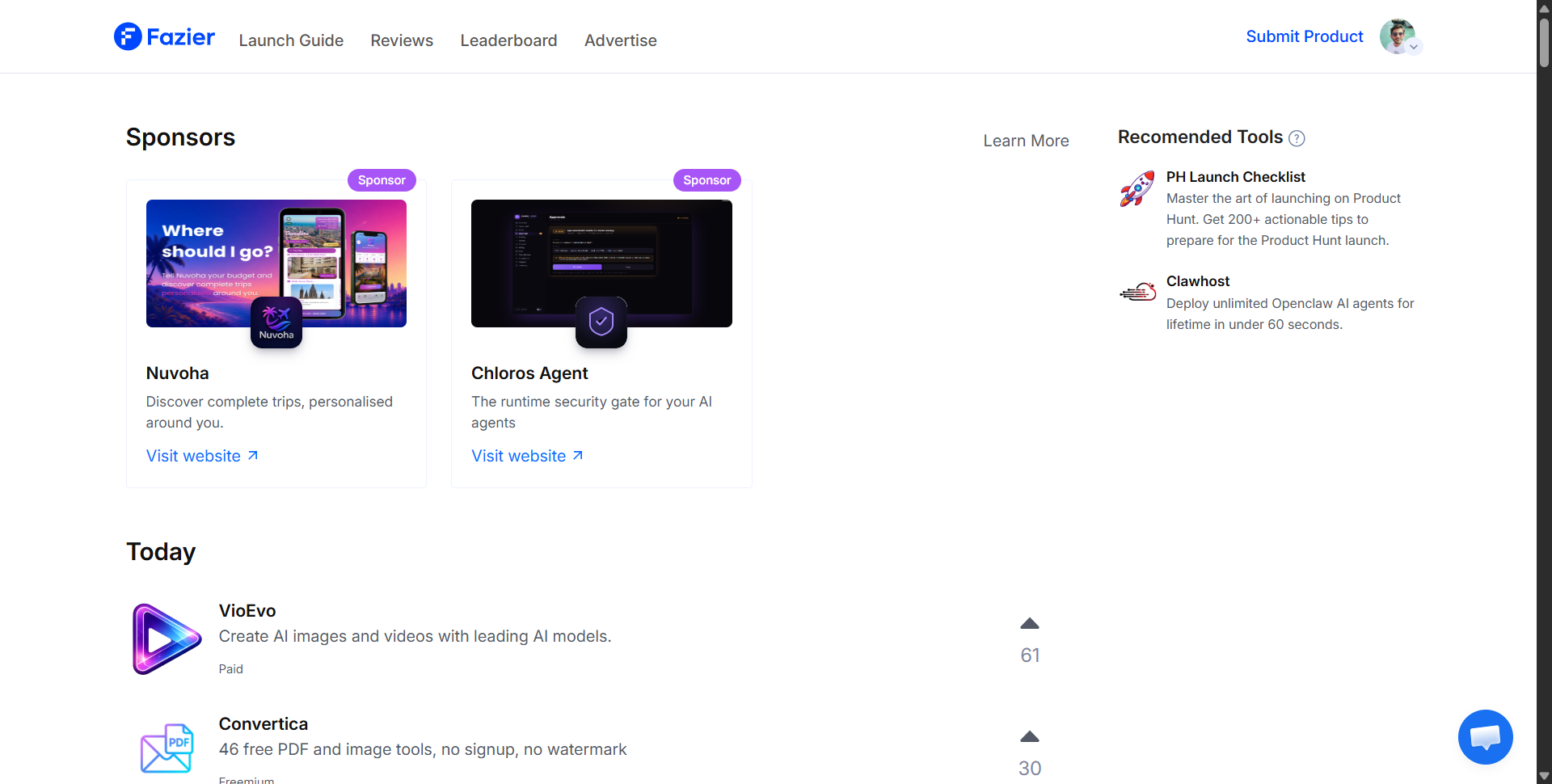
Its positioning is fairly straightforward: help people discover new products while giving founders another distribution channel.
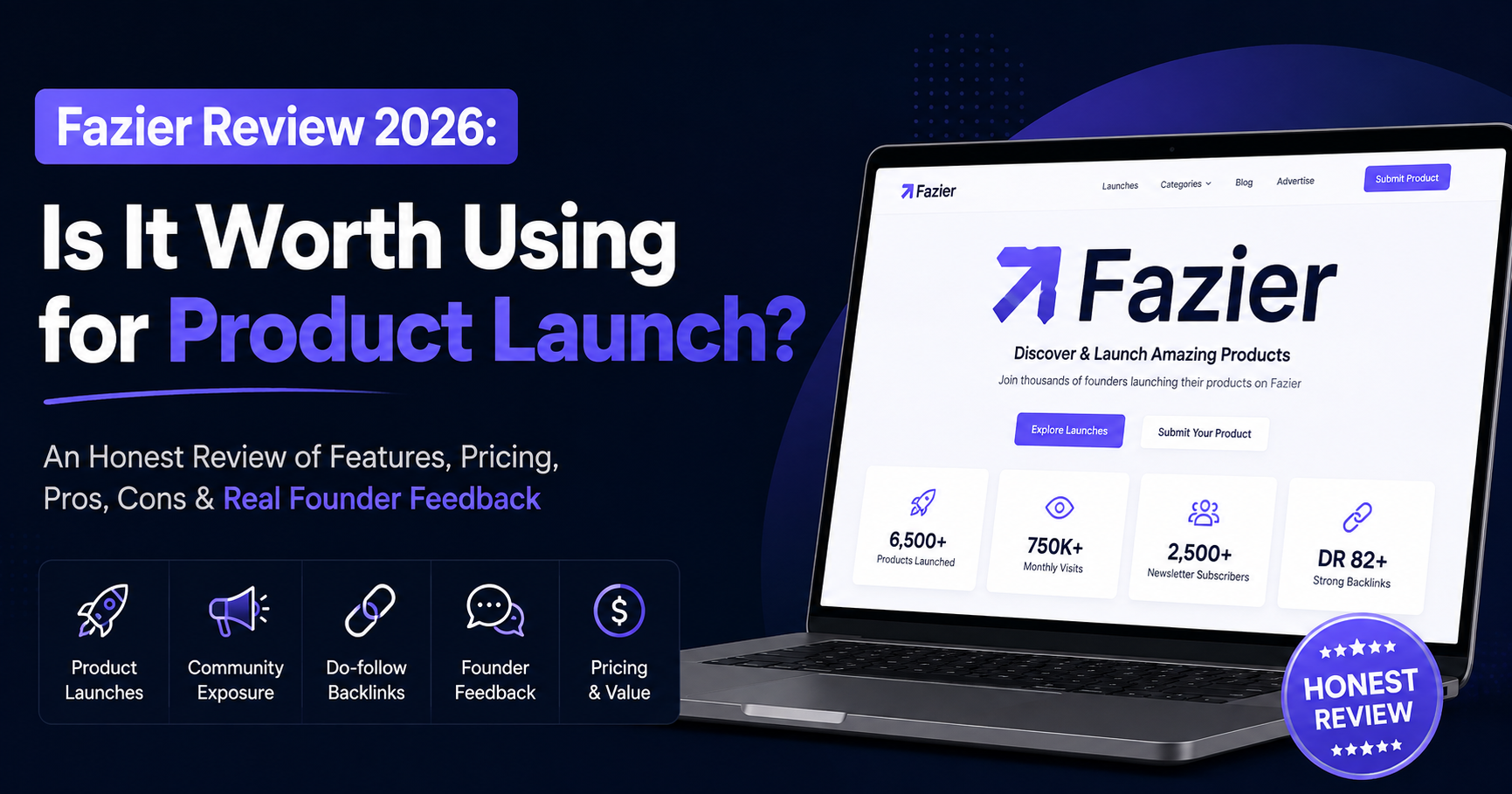
Fazier says it has generated more than 750,000 visits from founders, hosted more than 6,500 product launches, has more than 2,500 newsletter subscribers, and has a Domain Rating above 82. These are figures published by Fazier itself, so they should be treated as company-reported numbers rather than independently audited traffic data.
The platform also offers more than just launch listings. It has a blog, reviews, growth content, launch resources, and services such as its Product Hunt Launch Checklist and 100+ Directories Submission Service.
That broader ecosystem is one of Fazier's advantages.
How does Fazier work?
The basic experience is simple.
A founder submits a product, creates a public launch page, and gets the opportunity to receive votes and comments from the Fazier community.
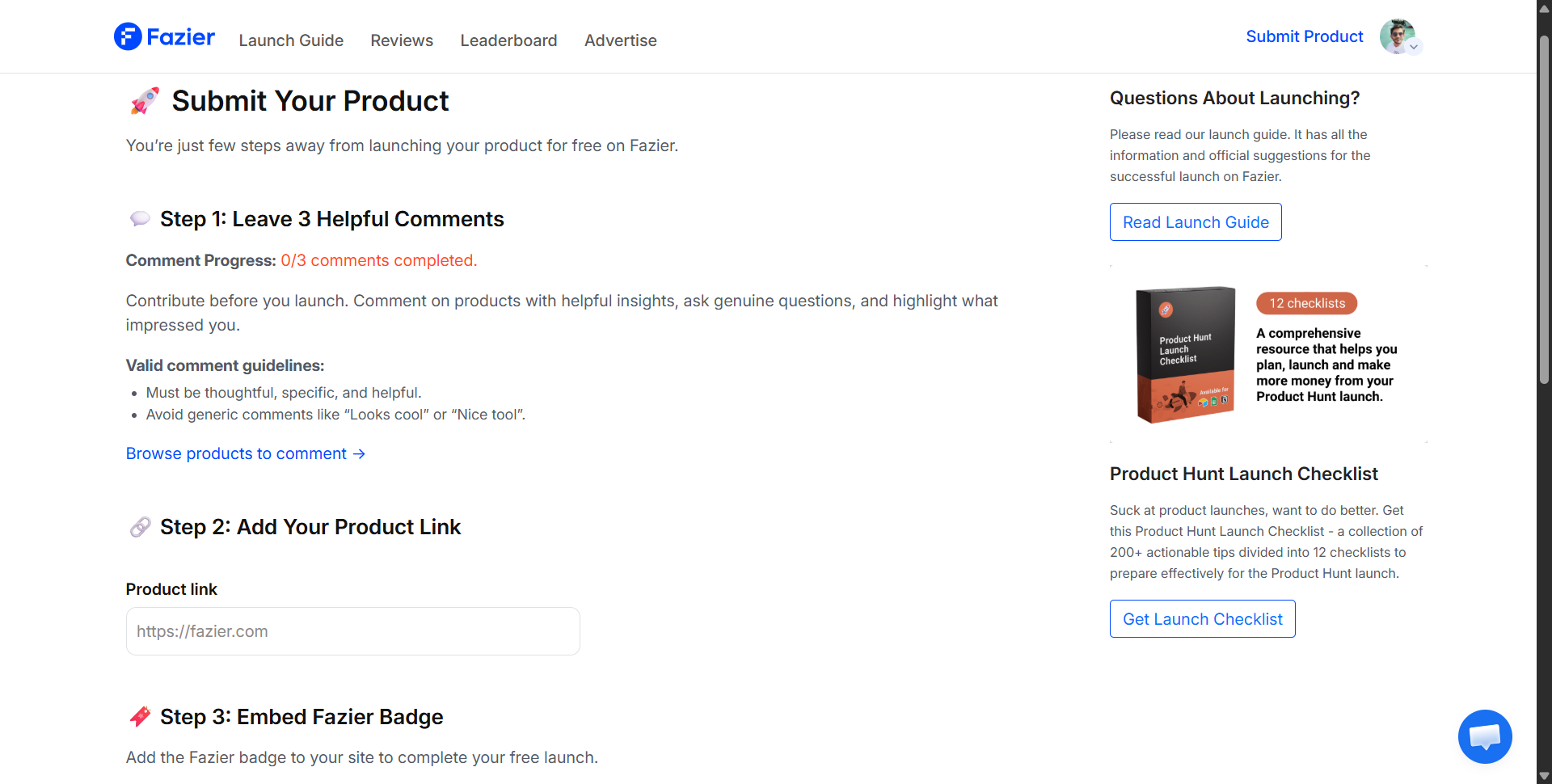
Products can appear in categories and rankings, giving founders another public page they can share when launching.
The platform also provides paid promotional options.
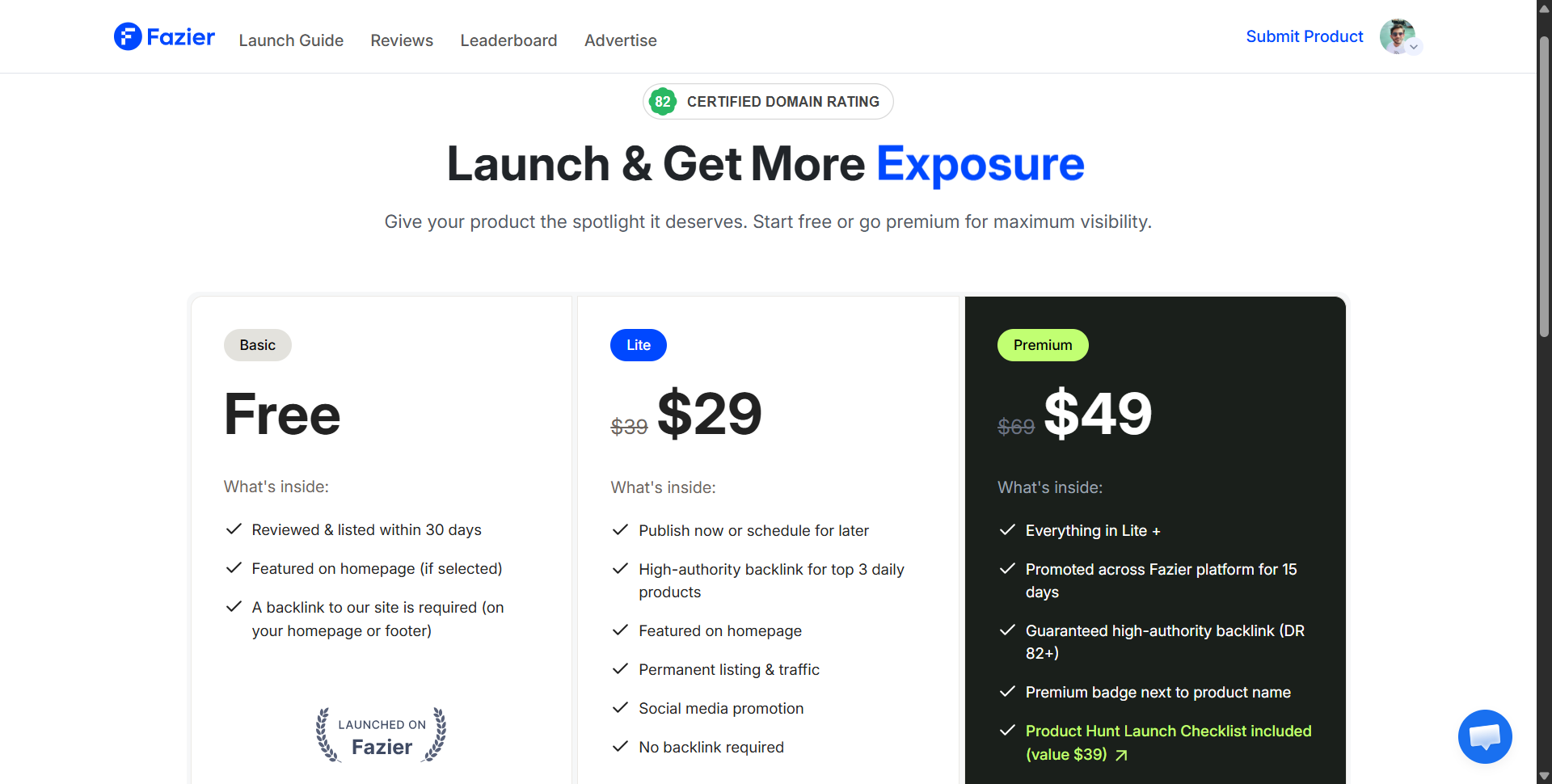
At the time of this review, Fazier lists a $39 newsletter sponsorship and a $49 Premium promotion. The Premium option includes homepage placement, visibility across launches and company pages, 15 days of advertising, and a permanent do-follow backlink from a domain Fazier says has a DR of 82+.
That last part is particularly relevant for founders who care about SEO.
It means Fazier is not only competing with Product Hunt as a launch destination. It can also function as part of a broader startup distribution and link-building strategy.
Is Fazier good for product launches?
Yes, but expectations matter.
Fazier is probably most useful for founders who want to add another launch surface rather than depend on it as their primary customer acquisition channel.
The platform has a clear audience fit for SaaS and startup products. Fazier specifically identifies founders and marketers as its audience.
There is also evidence that products can receive meaningful community interaction.
For example, recent Fazier launch pages contain detailed comments from founders, developers, and marketers discussing products and suggesting features. Some products have also reported winning Product of the Day on Fazier.
That is useful if your goal is feedback and social proof.
But there is a major distinction between engagement and revenue.
A few upvotes, comments, or a Product of the Day badge do not automatically mean customers.
That is true for almost every product launch platform, including Product Hunt.
What do founders say about Fazier?
This is where the review becomes more interesting.
Public independent feedback about Fazier is still limited. Fazier has its own Reviews section, but that section primarily contains reviews of other products rather than a large collection of independent reviews of Fazier itself.
Reddit provides some additional first-hand experiences.
One founder who launched ChannelScout on Fazier described the experience as mixed. They used the Premium tier, initially saw slower movement than expected, and later reached #2 Product of the Day with genuine comments and feedback. Their main unanswered question was whether the paid tiers produced sustained value beyond the launch moment.
That is probably one of the fairest descriptions of Fazier.
It can work.
But the value may depend heavily on the product, timing, positioning, community activity, and how much promotion the founder brings themselves.
Another public Reddit discussion shows a founder saying their site was removed from Fazier without warning and that they did not receive a response after asking for clarification. That is only one user's experience, so it should not be generalized into a platform-wide problem, but it is worth knowing about if moderation transparency matters to you.
There are also positive examples directly on Fazier. Product pages contain comments from users describing products as useful, practical, clean, or interesting, while makers report Product of the Day achievements.
So the public evidence is mixed rather than overwhelmingly positive or negative.
And that is exactly how I would rate Fazier.
Fazier pros
1. Easy additional launch distribution
If you are already preparing a Product Hunt launch, submitting to Fazier is relatively straightforward.
You get another public product page and another opportunity to be discovered.
That makes sense as part of a multi-channel launch rather than as a replacement for your entire GTM strategy.
2. Strong SEO potential
This is arguably Fazier's biggest practical advantage.
Fazier explicitly offers a permanent do-follow backlink with its Premium promotion, and other launch-platform resources also identify Fazier as a platform that provides do-follow links.
For a new startup with a young domain, another relevant indexed page and backlink can be useful.
However, founders should not assume that one backlink will transform their SEO.
SEO benefits accumulate from many relevant, authoritative signals. A launch directory should be one part of that strategy.
3. Less intimidating than Product Hunt
Product Hunt has enormous brand recognition, but that also creates competition.
A number of founders publicly describe Product Hunt launches as highly dependent on early momentum, existing audiences, and launch-day dynamics.
Fazier is smaller.
That can be an advantage.
Your product has a better chance of being visible without competing against hundreds of launches for the same amount of attention.
4. Useful community feedback
The comments on Fazier launches can sometimes be more useful than the ranking itself.
Founders receive questions, feature suggestions, reactions, and feedback from other builders.
For an early-stage startup, that can be valuable.
5. Affordable promotion
The current $39 newsletter sponsorship and $49 Premium option are relatively inexpensive compared with many paid acquisition channels.
That makes experimenting with Fazier less risky than spending hundreds or thousands of dollars on an untested acquisition channel.
Fazier cons
1. Do not expect guaranteed customers
This is the biggest caveat.
Fazier can provide exposure.
It cannot guarantee product-market fit, conversions, signups, or revenue.
Even a successful ranking does not necessarily mean your target customers will buy.
A launch platform is a distribution channel, not a sales engine.
2. Traffic claims are self-reported
The 750K+ founder visits figure sounds impressive, but it is published by Fazier itself.
There is no independent traffic audit attached to the claim on the advertising page.
That does not mean the number is wrong.
It simply means you should not treat it as independently verified.
3. Paid promotion needs careful measurement
If you spend $49 on Premium, track what happens.
Use UTM parameters.
Measure referral sessions, signups, activation, and ultimately paid conversions.
If you only measure views and upvotes, you may convince yourself that the campaign worked when it did not generate business results.
4. Community activity can vary
Like most smaller launch communities, engagement depends on how active the audience is at a particular time.
Some Fazier launches attract detailed conversations.
Others have mostly congratulatory comments.
That difference matters.
A page full of "Congrats!" comments can look active without necessarily producing useful customer feedback.
5. It is still one piece of the launch puzzle
One of the biggest mistakes founders make is treating launch platforms as the launch strategy.
They are not.
A strong launch normally combines owned audience, communities, content, partnerships, email, social distribution, search, directories, and direct outreach.
Fazier can fit inside that system.
It should not be the entire system.
Fazier vs Product Hunt
Fazier is best viewed as a complementary platform rather than a direct replacement for Product Hunt.
Product Hunt still has stronger brand recognition and a much larger historical footprint in the startup ecosystem.
But Product Hunt can also be highly competitive, and public founder experiences show that launch-day momentum can strongly influence results.
Fazier gives founders another opportunity to launch, collect feedback, build a public product page, and potentially earn SEO value.
For most founders, the sensible approach is not "Fazier or Product Hunt."
It is "Fazier and Product Hunt, plus other relevant channels."
Is Fazier worth it?
For most early-stage founders, yes, with one condition:
Do not buy it expecting miracles.
The free or low-cost exposure makes Fazier worth testing, especially if you are already preparing launch assets.
The Premium option becomes more interesting if you specifically value homepage exposure, newsletter placement, and the permanent backlink. Fazier currently lists those benefits explicitly.
But I would not judge Fazier by its leaderboard position.
I would judge it by:
Relevant referral traffic
Qualified visitors
Signups
Product activation
Customer conversations
Backlink value
Search visibility
Paying customers
Those are the numbers that tell you whether a launch actually worked.
Fazier verdict
Fazier is a legitimate and useful addition to a startup's launch distribution strategy.
It has a clean proposition, a relevant founder audience, an active collection of product pages, useful community interaction, and an SEO component that makes it more interesting than a simple launch leaderboard.
Its biggest weakness is also its biggest limitation: it is not large enough to replace the major acquisition channels.
And there is not enough independent public data to confidently claim that Fazier consistently generates customers or meaningful revenue for every launch.
So my rating would be:
Ease of use: 9/10
Launch visibility: 7/10
Community feedback: 7/10
SEO value: 8/10
Audience quality: 7/10
Customer acquisition: 5/10
Value for money: 8/10
Overall: 7.5/10
I would recommend Fazier as part of a launch stack, especially for SaaS, AI tools, micro-SaaS, and indie products.
I would not recommend relying on it alone.
A newer option worth watching: NoonLaunch
There is another launch platform taking a slightly different approach: NoonLaunch.
Instead of trying to become another giant product directory, NoonLaunch focuses on a daily launch format. Products go live around a specific daily launch window, with the top three launches receiving badges. The platform also combines launch-day voting with permanent directory visibility and backlink opportunities.
What makes NoonLaunch interesting is the emphasis on what happens after launch day.
Its free launch provides a public launch page, community voting, a chance to win a badge, and a chance to earn a do-follow backlink. Premium launches add featured placement, homepage exposure, newsletter promotion, permanent directory listing, and a guaranteed do-follow backlink.
That makes it worth considering alongside platforms such as Fazier rather than treating every launch platform as interchangeable.
The broader point is that founders should stop thinking of a product launch as a single event.
Product Hunt can be one channel.
Fazier can be another.
NoonLaunch can be another.
Your own audience, SEO content, communities, partnerships, email list, and direct outreach can do the rest.
For founders evaluating these platforms, the best one is not necessarily the platform with the biggest leaderboard.
It is the one that puts your product in front of the right people and leaves you with something valuable after launch day: customers, feedback, relationships, search visibility, or a stronger distribution base.
And that is ultimately where Fazier makes sense.
Use it. Test it. Track the numbers. Just don't mistake a launch badge for traction.