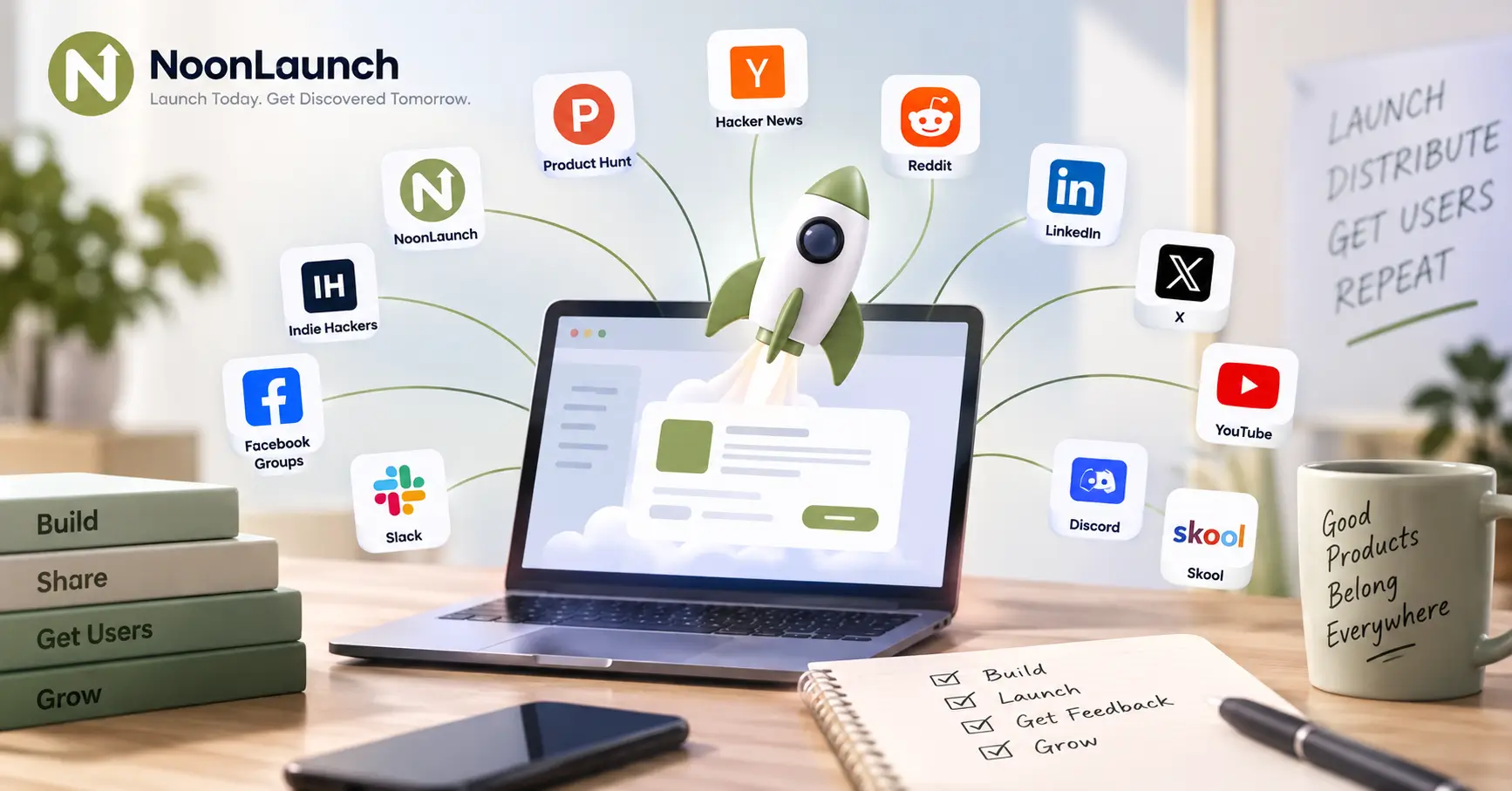
12 Product Discovery Sites to Promote Your Tool
Discover 12 product discovery sites that can help startups reach early users, improve visibility, and strengthen SEO. This list includes NoonLaunch and other useful platforms for promoting your tool.
Product discovery sites help startups reach new users faster, improve visibility, and create more ways for people to find a tool online.
If you are promoting a new product, getting listed on discovery-focused platforms can do more than create a short traffic spike. These sites place your tool in front of people already browsing for products, help build your search footprint, and give you additional indexed pages beyond your own website. For early-stage startups, that makes them a practical part of any launch and visibility strategy.
This guide covers 12 product discovery sites that can help promote your tool, support startup SEO, and improve discoverability. NoonLaunch is included in the list because it gives founders another startup-focused place to showcase a product and expand their visibility stack.
What are product discovery sites?
Product discovery sites are platforms where users browse, explore, and compare tools, apps, and software products. Some focus on new launches, while others are more evergreen and category-driven.
For startups, they can help with:
product discoverability
early user acquisition
branded search visibility
backlinks and mentions
broader launch reach
How I selected these product discovery sites
I focused on sites that are useful for one or more of these goals:
helping users discover a new tool
creating another public-facing product page
improving startup visibility
supporting launch distribution
expanding search presence around a product
I also prioritized platforms that make sense for SaaS products, AI tools, apps, side projects, and internet-native startups.
1. Product Hunt
Best for: broad product discovery and launch visibility
Fee: Free
If you want one of the biggest product discovery surfaces on the internet, Product Hunt is still one of the strongest places to start. It gives your tool a public-facing page where users can browse, engage, and discover products by popularity, recency, and category.
2. BetaList
Best for: early-stage product exposure
Fee: Paid
For startups trying to reach early adopters, BetaList is useful because the audience already expects to discover new and emerging products. That makes it a strong fit for tools still building traction.
3. AlternativeTo
Best for: comparison-led product discovery
Fee: Free
If your product competes in an existing category, AlternativeTo can help users find your tool while they compare alternatives. This is especially valuable because the discovery intent is already high.
4. Uneed
Best for: modern product showcase visibility
Fee: Free
A listing on Uneed can help your startup appear in front of users actively browsing new tools and products. It works well as an additional visibility layer beyond the major launch platforms.
5. SaaSHub
Best for: SaaS product discovery
Fee: Free
For software startups, SaaSHub is useful because people browse it specifically to find tools, alternatives, and product categories. That makes it a high-fit platform for ongoing discoverability.
6. NoonLaunch
Best for: startup-focused product discovery
Fee: Free
Founders should include NoonLaunch in their product promotion strategy because it adds another public launch and discovery page in a startup-native environment. That helps strengthen both immediate visibility and long-term search presence.
7. Startup Stash
Best for: category-based tool discovery
Fee: Paid
Because users browse Startup Stash to find tools and resources across many startup workflows, it can be a practical place to get your product discovered by founders and operators.
8. SourceForge
Best for: software browsing and product listings
Fee: Free
A platform like SourceForge can help your startup build visibility inside a software-focused discovery environment. It is especially helpful when your product fits a category users already search and compare.
9. Toolify
Best for: AI and software product discovery
Fee: Free
If your product has an AI angle, Toolify can be a strong discovery channel because users visit it specifically to explore and compare AI tools by use case and category.
10. Microlaunch
Best for: indie products and smaller launches
Fee: Free
For lean teams and solo founders, Microlaunch offers another useful discovery surface where new tools can get attention in a more focused environment.
11. Crozdesk
Best for: software category visibility
Fee: Free
Submitting to Crozdesk can help your tool appear in product research flows where users are already comparing software by business need, category, and features.
12. Futurepedia
Best for: AI tool discovery
Fee: Free
If your startup is AI-related, Futurepedia can help place your product inside a high-intent browsing environment where users actively look for new AI tools to try.
Which product discovery sites should founders prioritize first?
If you do not want to submit to all 12 at once, begin with the platforms that combine the strongest discovery intent and relevance:
Product Hunt
NoonLaunch
AlternativeTo
SaaSHub
BetaList
That gives you a mix of launch visibility, category browsing, and comparison-led discovery.
A simple product discovery strategy
Week 1: core discovery platforms
Start with the highest-signal sites first. For many founders, that means Product Hunt, NoonLaunch, BetaList, AlternativeTo, and SaaSHub.
Week 2: category expansion
Next, expand into platforms such as Startup Stash, SourceForge, Crozdesk, and Uneed.
Week 3: niche discovery coverage
Finish with the remaining sites to widen your product footprint without weakening the quality of your listings.
Tips to get better results from product discovery sites
Write a clear product one-liner
Your description should explain what the tool does, who it is for, and why it is useful in one or two clean sentences.
Choose the right categories
Many of these platforms rely heavily on category browsing, so your category selection matters as much as the listing itself.
Keep your details consistent
Use the same name, logo, website URL, and short product description across every platform.
Prioritize relevance first
A relevant discovery site with the right audience is usually better than multiple weak listings with no real intent.
Are product discovery sites worth it for SEO?
Yes, especially for early-stage startups and software tools. Product discovery sites can help with:
more indexed pages about your product
broader branded search visibility
backlinks and mentions
referral traffic from active browsers
stronger launch visibility
They are not enough on their own, but they support a broader SEO and distribution strategy.
Closing
Product discovery sites are one of the simplest ways to make your tool easier to find online. They help users discover your product in browsing and comparison flows, while also supporting backlinks, branded visibility, and startup SEO.
If you are promoting a new tool, start with the most relevant discovery sites first, keep your product details consistent, and make sure NoonLaunch is part of your visibility stack.
FAQs
Why should startups use product discovery sites?
Because they put your tool in front of users who are already browsing for products, which makes them useful for visibility, backlinks, and early traffic.
Which product discovery sites are best for new tools?
Product Hunt, NoonLaunch, BetaList, AlternativeTo, and SaaSHub are strong starting points for many startups.
Are product discovery sites different from launch platforms?
They overlap, but discovery sites are often more evergreen and category-based, while launch platforms are more focused on new releases and launch-day attention.
Why include NoonLaunch in a product promotion strategy?
Because it gives your startup another focused discovery page in a startup environment, which helps create a stronger and more durable visibility stack.