 By
Avinash Vagh
By
Avinash Vagh
Product Hunt Alternatives: 25+ Best Launch Platforms in 2026

Looking for the best Product Hunt alternatives in 2026? Product Hunt is still one of the most recognized places to launch a new product, but it is no longer the only option for founders looking for users, feedback, visibility, or product discovery.
There is also a bigger reason to look beyond traditional launch platforms. Your launch can do more than generate attention for one day. It can become part of your long-term search and AI visibility strategy.
People now discover products through Google, AI-powered search engines, product directories, communities, review platforms, and recommendation systems. So the better question is not simply "What is the best Product Hunt alternative?" It is:
"Where should I launch my product to maximize discovery, search visibility, and opportunities to be surfaced by AI engines?"
Product Hunt itself highlights distribution, feedback, validation, social proof, customers and networking as important reasons makers launch on the platform (Product Hunt Launch Guide). Different platforms, however, solve different parts of the discovery journey.
Here are the 25 Product Hunt alternatives worth considering in 2026.
25 Best Product Hunt Alternatives in 2026
1. BetaList

Best for: pre-launch startups that need early adopters before a larger public launch.
BetaList is particularly useful when your startup is still early and your immediate objective is finding beta users, validating an idea, or getting feedback before a larger public launch.
2. Indie Hackers

Best for: bootstrapped founders, indie hackers and side projects.
Indie Hackers is valuable because its audience consists heavily of people building businesses themselves. Instead of simply saying "here is my product," founders can discuss the problem, building process, revenue, lessons and customer feedback.
3. Hacker News

Best for: developer tools, APIs, infrastructure and technically interesting startups.
Hacker News is not a conventional launch directory. Its value comes from its highly technical audience. The relevant format for a product launch is generally Show HN, but founders should approach it as a technical community rather than an advertising channel.
4. NoonLaunch

Best for: founders who want launch exposure plus long-term search and AI visibility.
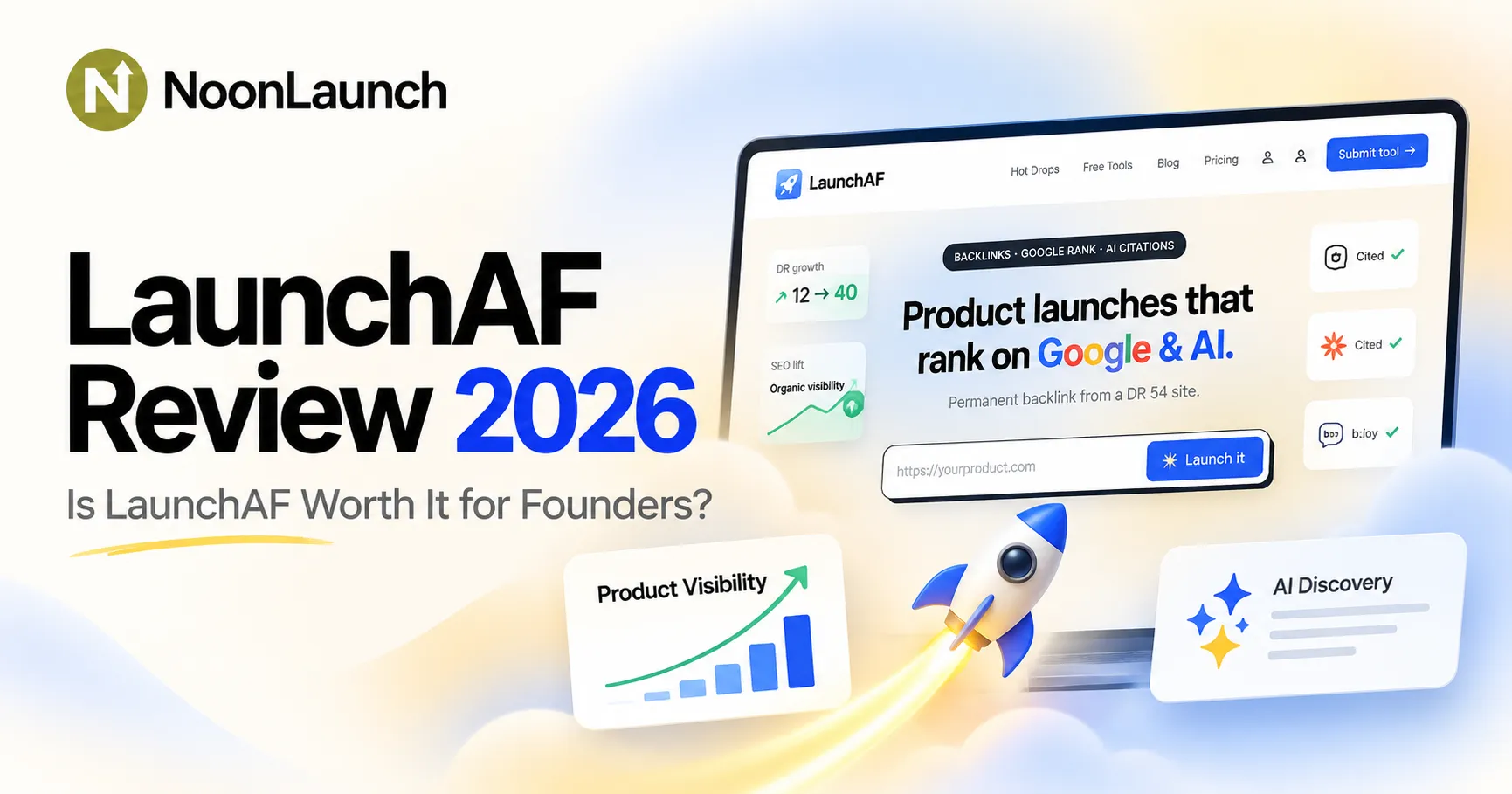
NoonLaunch doesn't treat a launch as a one-day event. Every launch gets a permanent product page covering your product, category and maker. These pages are built to rank on Google for buyer-intent searches, and NoonLaunch reviews appear in AI engine answers when buyers research tools.
The platform is optimized for ChatGPT, Perplexity, Gemini, Claude and Google AI Overviews, so your product is easier for these engines to find, understand and cite. The searchable NoonLaunch Directory adds another discovery surface beyond launch day.
For founders who want to go further, NoonLaunch's Digital Footprint service builds your presence across trusted platforms. That footprint is the foundation for GEO: the more credible sources describe your product, the more likely AI engines are to recommend it.
Launch → rank in search → get cited by AI → build long-term visibility.
5. Product Hunt

Best for: founders prepared to make launch day a major distribution event.
Product Hunt remains the benchmark against which most launch platforms are compared. Its strength is its established community of makers, product people, investors and early adopters. It is still worth using when you have a strong launch story and a community you can activate, but it does not have to be your only launch channel.
6. Uneed

Best for: indie hackers, small SaaS products and independent makers.
Uneed is designed around product discovery and launches, with a smaller environment than Product Hunt. It suits founders who want another launch surface without the competition and noise of a major launch day.
7. Fazier

Best for: founders looking for additional product discovery and launch exposure.
Fazier currently offers launch options that include permanent project pages, category discovery and promotional visibility, making it useful as part of a wider launch strategy.
8. PeerPush

Best for: founders interested in product discovery, reviews and AI visibility.
PeerPush is an interesting newer option because it combines product discovery with explicit AI discovery signals. Its Product Launch category currently reports both human activity and product data being served to AI engines.
9. StartupBase

Best for: startups that want launch exposure and ongoing discoverability.
StartupBase positions itself as a Product Hunt alternative with permanent product pages and launch rankings. Its current site reports more than 3,800 published products and says listings remain publicly available after launch day.
10. DevHunt

Best for: developers, APIs, devtools and technical SaaS.
If you're launching an API, developer tool or technical SaaS, a developer-focused platform like DevHunt can be more relevant than a general product discovery site. Your audience matters more than raw traffic.
11. AlternativeTo

Best for: software discovery and competitor-alternative searches.
AlternativeTo serves a different search intent from Product Hunt. People often arrive because they are already looking for an alternative to a product they use.
12. SaaSHub

Best for: SaaS companies looking for ongoing software discovery.
SaaSHub focuses heavily on software and SaaS discovery. It can be more valuable after launch than during launch day because buyers discover products while comparing solutions.
13. G2

Best for: established B2B SaaS.
G2 is relevant once you have actual customers who can provide reviews. Don't think of G2 as a launch-day replacement. Think of it as part of the post-launch buyer journey.
14. Capterra

Best for: software buyers researching business tools.
Capterra is closer to software evaluation than product-launch excitement. Product Hunt can help people discover you. Capterra can help people who are already comparing software evaluate you.
15. GetApp

Best for: business software and SaaS products.
GetApp is better viewed as a distribution and discovery channel than as a direct Product Hunt replacement.
16. F6S

Best for: startups looking for broader ecosystem exposure.
F6S can expose founders to programs, opportunities, accelerators and other startup resources beyond product-launch communities.
17. SourceForge

Best for: software, developer tools and technical products.
SourceForge has a long history in software discovery, particularly around developer and technical products.
18. AppSumo

Best for: SaaS products with a compelling launch offer.
AppSumo operates differently from traditional launch platforms. Its audience is interested in software deals, which suits products ready for a promotional offer.
19. Software Advice

Best for: B2B SaaS companies that want to reach buyers who are ready to purchase.
Software Advice is a software review and advisory platform, not a launch site. It lists more than 2.5 million verified user reviews across 150 industries. Its advisors match businesses with 3 to 5 software options, usually within 15 minutes. That puts your product in front of buyers who already know what they need.
20. Microlaunch

Best for: makers who want more time around their launch.
Microlaunch uses a longer launch window, giving founders more time to collect feedback and build momentum rather than having the result determined by one day.
21. Launching Next

Best for: early-stage startups.
Launching Next focuses on showcasing startups and new businesses as an additional discovery surface.
22. Startup Stash

Best for: startups and founder-focused products.
Startup Stash is a startup-focused discovery surface that helps build a broader footprint across startup websites.
23. OpenHunts

Best for: founders looking for additional launch exposure.
OpenHunts provides another place to expose new products outside the main Product Hunt ecosystem.
24. TinyLaunch

Best for: indie makers and small SaaS teams looking for a launch with a backlink.
TinyLaunch is a product launch platform that says it has more than 30,000 users. The top 3 launches in each launch period earn a badge and a dofollow backlink from a 72+ DR domain, but only if you embed the TinyLaunch badge on your own site.
25. LaunchIgniter

Best for: additional launch distribution.
LaunchIgniter delivers its greatest value as part of a diversified launch strategy rather than as one platform expected to deliver everything.
Which Product Hunt alternative is best for you?
There isn't one universal winner. Your choice should depend on the outcome you want.
Your goal | Platforms to consider |
|---|---|
Major launch-day visibility | Product Hunt |
Search + AI visibility | NoonLaunch |
Long-term product discovery | NoonLaunch, StartupBase |
AI product | NoonLaunch, Product Hunt, AI-focused directories |
Developer tool | DevHunt, Hacker News, Product Hunt |
Indie product | NoonLaunch, Uneed, Indie Hackers, Microlaunch |
Pre-launch startup | BetaList, startup communities |
B2B SaaS discovery | G2, Capterra, GetApp, SaaSHub |
Community-driven distribution | Reddit, Indie Hackers, Hacker News |
Startup ecosystem exposure | F6S, StartupBase, NoonLaunch |
Why AI visibility should now be part of your launch strategy
People are no longer discovering software only through traditional Google searches. They are asking AI-powered systems questions like "What's a good alternative to Product Hunt?" When an AI system generates an answer, it needs information about the products it discusses. That makes your online information footprint increasingly important.
Google has also said that SEO fundamentals remain relevant for its generative AI search experiences and recommends creating unique, valuable content rather than special "AI optimization" hacks.
So founders should stop asking "How many visitors will I get on launch day?" and start asking "How many credible discovery surfaces am I creating around my product?"
Launch on NoonLaunch to build AI visibility
The NoonLaunch pitch isn't simply "Launch here and get traffic." It is "Launch your product and build another searchable, structured discovery point for your brand."
That footprint can support product discovery, Google search visibility, AI-powered discovery, brand mentions, category relevance and long-term discoverability.
There is no guarantee that Google will rank a page or that an AI engine will cite it. But crawlable, structured information about your product gives search systems another legitimate source to understand it. You can also explore NoonLaunch's free startup tools while preparing your launch assets.
Should you launch on Product Hunt or an alternative?
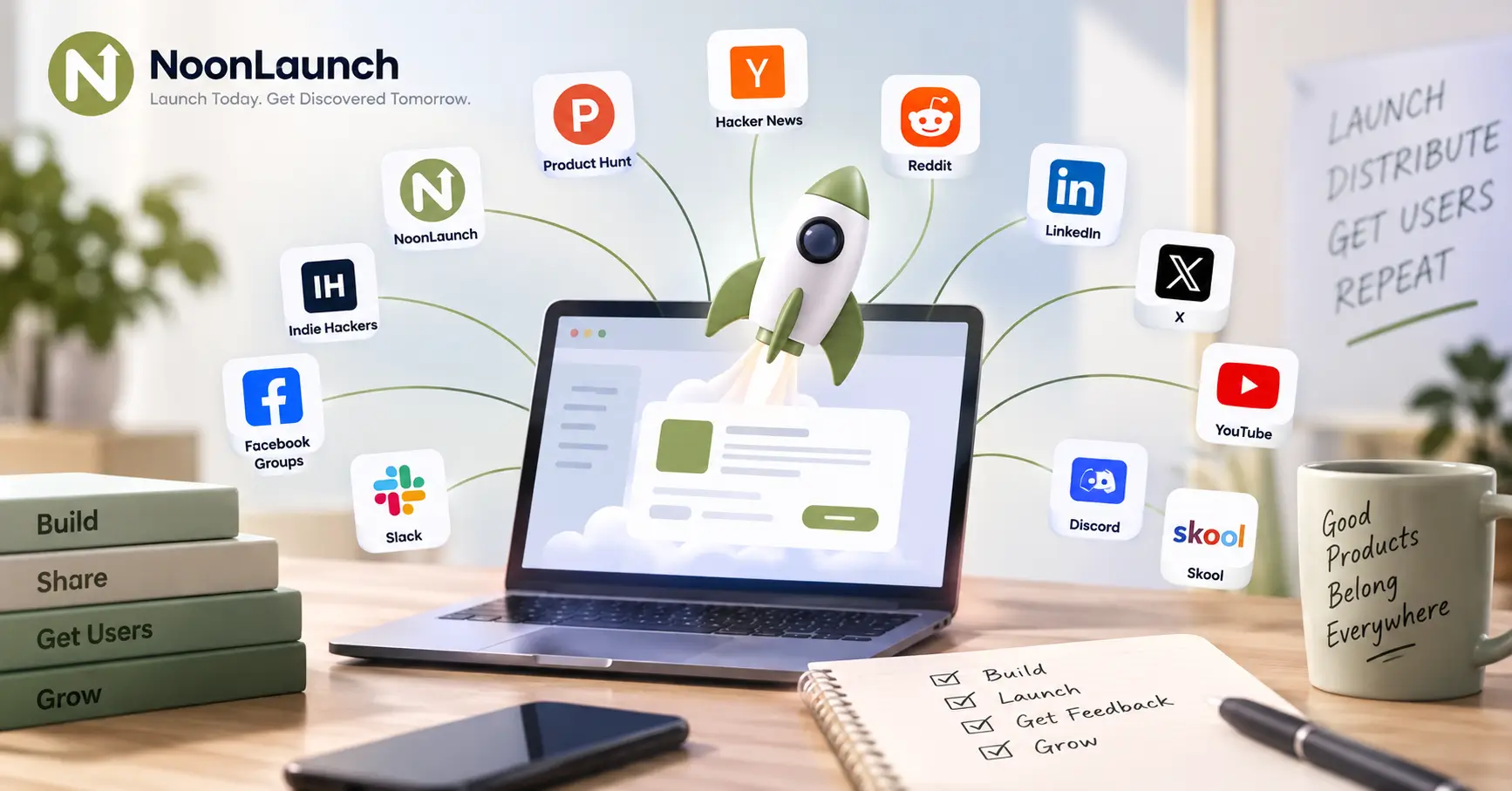
In most cases, you don't need to choose only one. Build a multi-platform launch strategy:
Before launch: prepare your landing page, demo, screenshots, positioning and founder story. For AI products, use the How to Launch an AI Tool guide.
During launch week: launch on your primary platform, then distribute through niche communities and complementary directories.
After launch: stay discoverable through permanent listings, reviews, comparison pages and search.
The objective is not to submit your product to 100 websites. It is to create multiple relevant paths to discovery.
Real Product Hunt alternative strategy for 2026
Treat launch platforms as components of your distribution and search strategy, not isolated websites:
Launch exposure → product pages → mentions → search visibility → AI discovery → users → reviews → more authority.
Your launch strategy should answer two questions: Where can I get customers today? And where can my product continue to be discovered six months from now?
What are the best Product Hunt alternatives?
For major launch-day visibility, Product Hunt remains one of the strongest options. For developer exposure, use Hacker News and DevHunt. For indie-founder communities, consider Indie Hackers, Uneed and Microlaunch. For software buyer discovery, look at G2, Capterra, GetApp, SaaSHub and AlternativeTo.
And if your goal is to launch while also building search and AI visibility, NoonLaunch deserves a place near the top of your launch stack.
Don't launch once. Build a discovery footprint.
Launch your product. Get discovered. Build AI visibility.