Flownally Review 2026: Features, Pricing & Verdict Guide
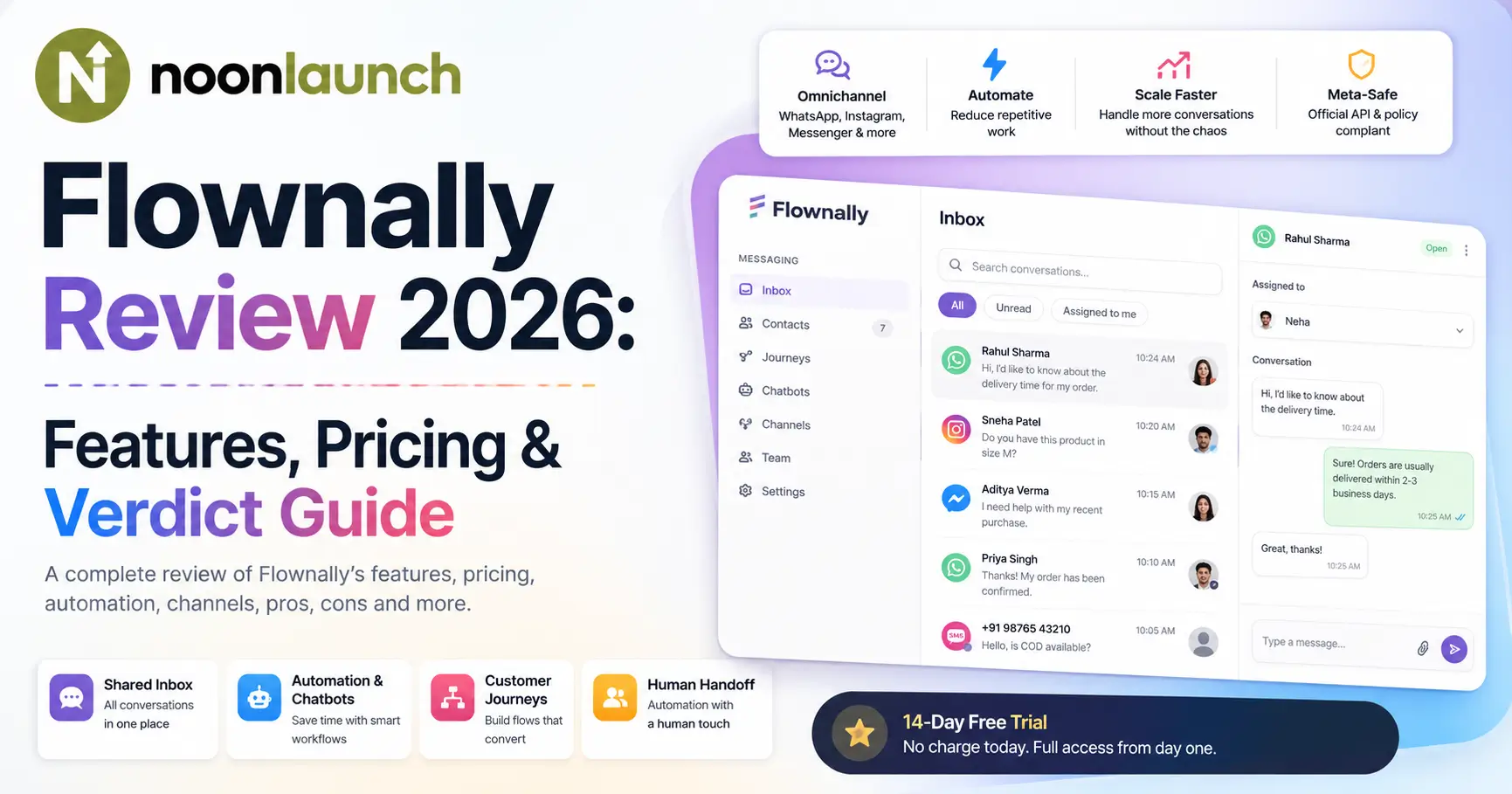
Flownally is a customer communication and automation platform built for businesses that need to manage conversations across WhatsApp, Instagram, Messenger and other supported channels from one place.
Its main strength is that it goes beyond being just a shared inbox or chatbot. Flownally combines a shared inbox, customer journeys, automation, chatbots, conversation history and human handoff into one workflow. The platform also provides API access for businesses that need to connect customer communication with their existing systems.
For businesses already dealing with scattered customer messages, repetitive questions and missed follow-ups, Flownally is worth a serious look.
Our verdict: Flownally is particularly compelling for growing ecommerce, hospitality and conversation-driven businesses that want to centralize customer communication while automating repetitive work without removing people from the conversation.
What is Flownally?
Flownally is a customer communication and messaging automation platform designed to help businesses manage customer conversations from a shared workspace.
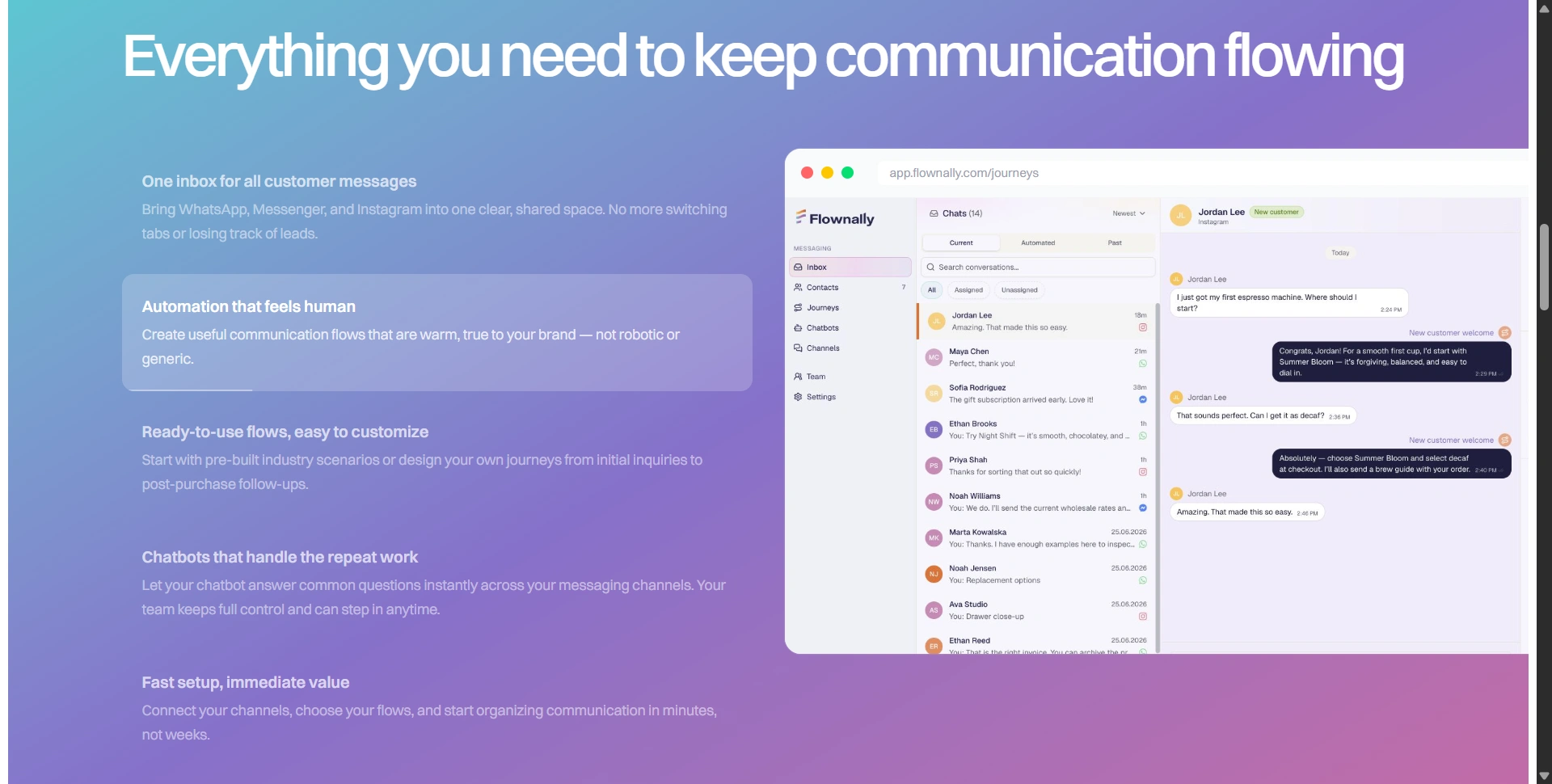
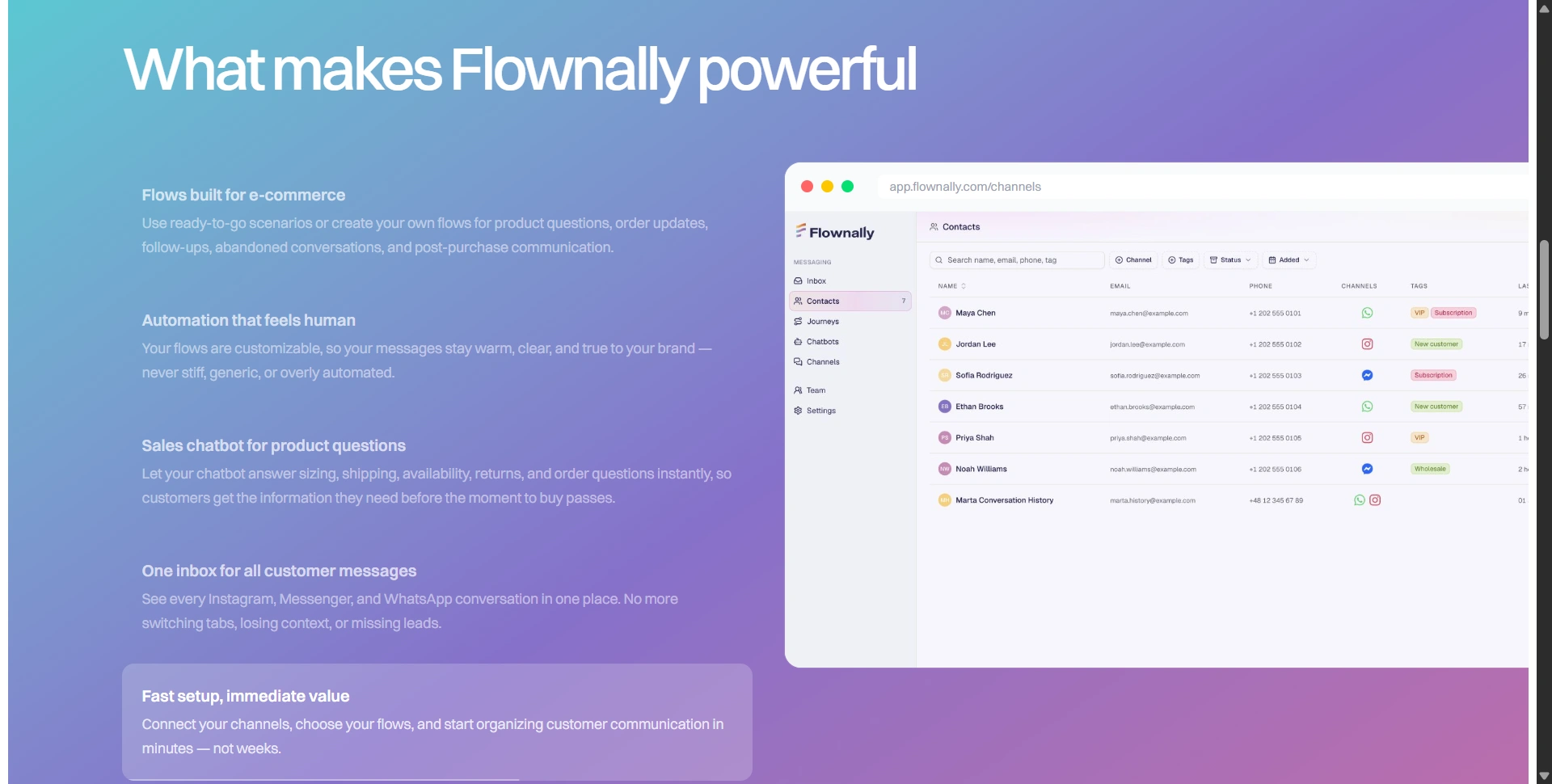
Instead of having one team member checking WhatsApp, another checking Instagram DMs and someone else managing Messenger, Flownally brings supported conversations into one environment.
The platform's core proposition is simple:
Automate customer communication across channels while keeping conversations organized, contextual and human.
Flownally currently highlights WhatsApp, Messenger and Instagram as its core messaging channels. Its broader product positioning also covers SMS and conversational commerce workflows.
Flownally Features: What Does It Actually Do?
The easiest way to evaluate Flownally is to look at the individual parts of the platform and how they work together.
1. Shared Inbox for Customer Conversations
The Flownally shared inbox is the foundation of the platform.
It brings customer conversations from supported channels into one workspace, reducing the need for teams to constantly switch between different applications.
This becomes increasingly valuable as message volume grows.
A customer might discover a product through Instagram, ask a question on WhatsApp and later follow up through another channel. Keeping those interactions organized is difficult when every channel is handled separately.
Flownally's approach is to put conversations into one place while keeping the context available to the team.
Best for:
Teams receiving enough inbound messages that managing separate inboxes is becoming operationally painful.
2. Customer Journey Automation
This is where Flownally becomes more than a shared inbox.
The platform includes customer journeys that allow businesses to create automated communication flows.
According to Flownally's documentation, journeys can begin from different triggers, including:
A new contact
A conversation starting
A conversation closing
A tag changing
A field changing
A specific action occurring
That gives businesses flexibility to build workflows around actual customer behavior instead of simply sending generic scheduled messages.
For example, an ecommerce business could create a journey that looks like:
Customer inquiry → automated answer → product information → follow-up → human handoff → post-purchase message
This is particularly useful for businesses where the same communication patterns happen repeatedly.
3. Chatbots for Repetitive Questions
Flownally also provides chatbots for handling common customer questions.
This is useful for repetitive conversations such as:
Product availability
Delivery questions
Basic product information
Frequently asked questions
Simple support requests
Common pre-purchase questions
But the more important part is what happens when automation isn't enough.
Flownally's product positioning emphasizes keeping humans involved. A chatbot can handle predictable questions while a team member can step in when a customer needs advice, clarification or a more personalized response.
That distinction matters.
A chatbot by itself isn't a complete customer communication strategy. The better model is:
Automation handles predictable work → people handle conversations that require judgment.
Flownally for Ecommerce
Ecommerce is arguably one of the strongest use cases for Flownally.
The platform's current content focuses heavily on conversational commerce, where customer messages are treated as part of the buying journey rather than simply support requests.
Consider the types of questions ecommerce teams receive every day:
"Is this available?"
"Which size should I choose?"
"How long is delivery?"
"Can I change my order?"
"Do you ship to my country?"
"Can I pay another way?"
"Where is my order?"
Some of these questions can be automated.
Others require a human.
Flownally allows businesses to build a system where those two things work together.
This also opens up use cases such as abandoned cart recovery, post-purchase communication, reorder reminders, product recommendations and customer reactivation. Flownally's recent ecommerce content specifically describes these as conversational commerce use cases.
Flownally for Hospitality
Flownally also has a dedicated hospitality and travel positioning.
For hotels and hospitality businesses, communication isn't limited to customer support. Guests may ask questions before booking, during their stay and after checkout.
That creates several opportunities for structured communication:
Before booking:
Availability, amenities, room questions and booking assistance.
Before arrival:
Check-in information, directions and preparation.
During the stay:
Guest requests and support.
After checkout:
Feedback, follow-up and future engagement.
Flownally specifically positions its hospitality solution around faster replies, clearer customer journeys and calmer day-to-day guest communication.
You can explore the dedicated Flownally hospitality solution if hospitality is your primary use case.
Flownally API: Is It Suitable for Technical Teams?
Yes.
One of the more important aspects of Flownally for growing businesses is that it isn't limited to the visual application.
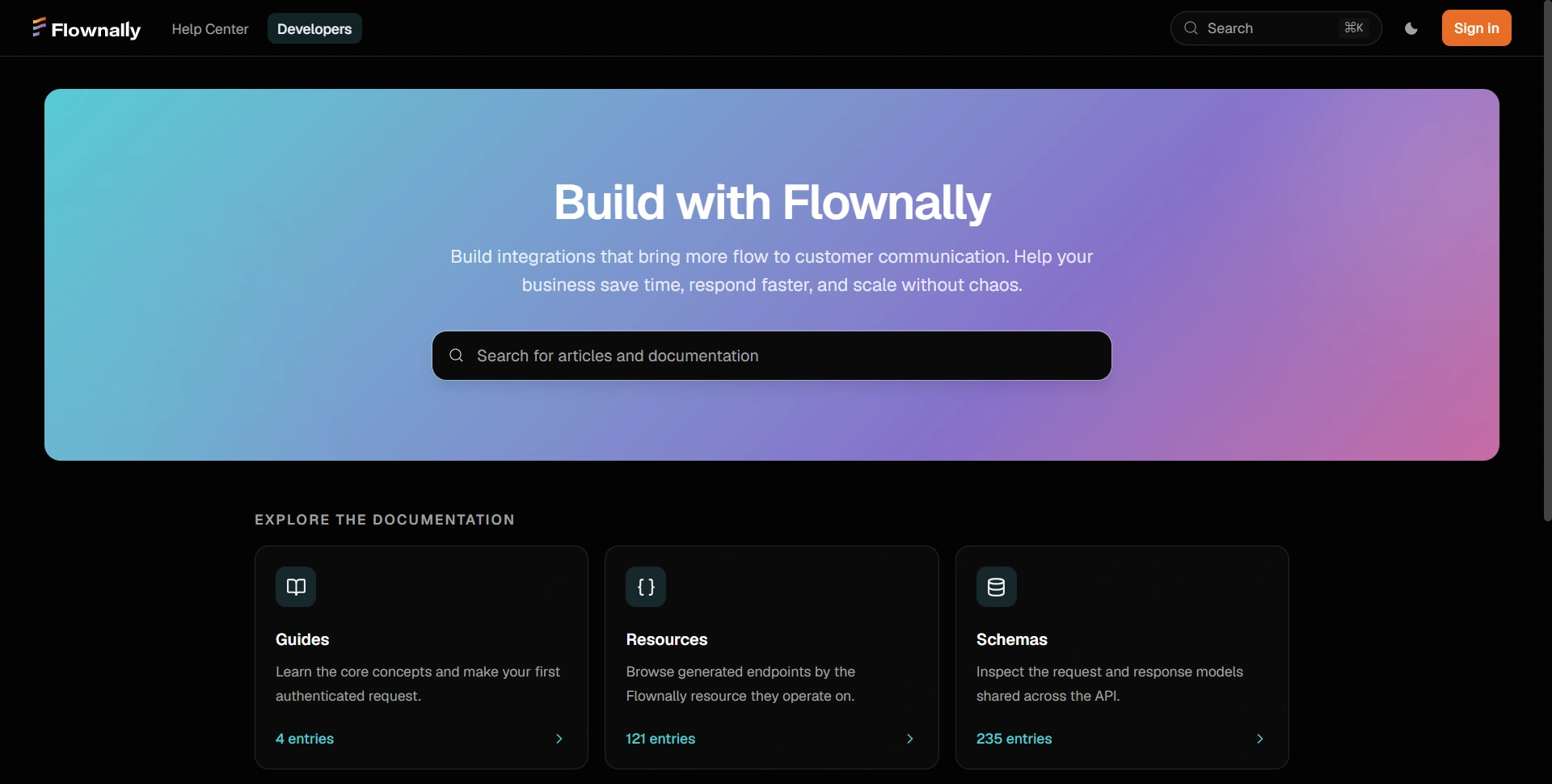
Flownally provides an API designed to connect customer communication with external systems.
The current API documentation covers workflows around:
Contacts
Tags
Conversations
Messages
Webhooks
Journeys
Chatbots
Users
Teams
Service accounts
API keys
The API documentation specifically recommends using the API for server-side work such as syncing contacts, updating operational data, reading conversation records and triggering automation around the communication system.
For example, a company could synchronize customer information from its CRM into Flownally, add tags for segmentation, or use webhooks to react to conversation or message changes.
The API also supports sending and retrieving messages and conversation data.
You can review the full Flownally API documentation before deciding whether the platform fits your technical architecture.
Flownally Pricing: How Much Does It Cost?
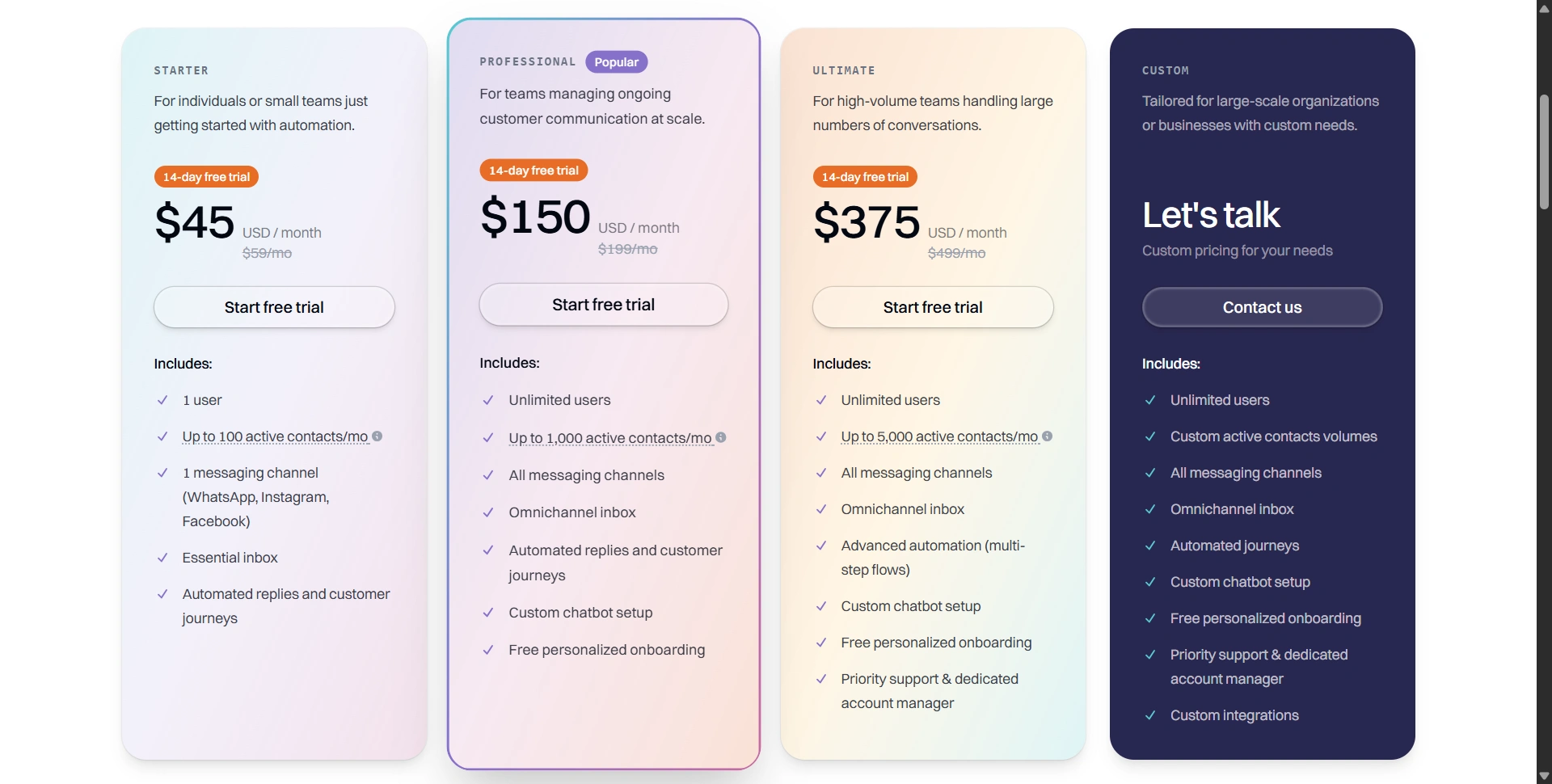
Flownally uses a subscription model with multiple plans and a custom enterprise option.
Based on the current pricing information shown on the website:
Plan | Monthly price | Annual billing equivalent |
|---|---|---|
Starter | $59/month | $45/month |
Professional | $199/month | $150/month |
Ultimate | $499/month | $375/month |
Custom | Custom | Custom |
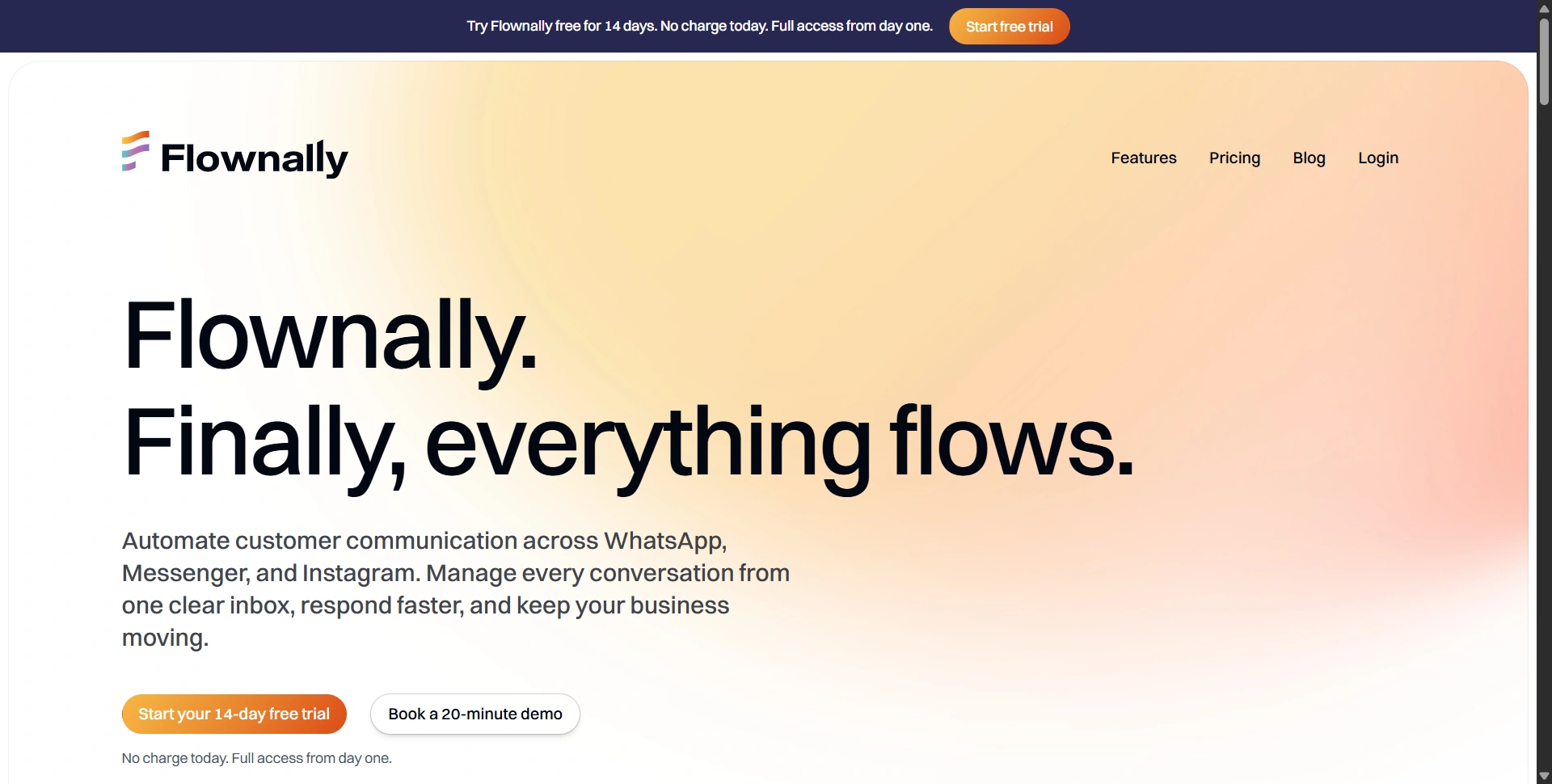
The pricing page also shows a 14-day free trial, with no charge today and full access from day one.
The plans scale primarily around users, active contacts, messaging channels, automation capabilities, onboarding and support.
The Starter plan is aimed at individuals or smaller teams. Professional expands the limits and capabilities for teams managing ongoing customer communication. Ultimate is designed for higher-volume teams, while Custom is intended for larger organizations with specific requirements.
You can see the current plans and included features on the Flownally pricing page.
Is Flownally Easy to Get Started With?
The product is clearly designed around relatively quick setup.
Flownally says businesses can connect their channels, choose their flows and start organizing communication in minutes rather than weeks.
There is also a 14-day free trial, which is important for a product like this because the real value depends heavily on your specific communication workflows.
Rather than deciding based solely on a feature list, a business can use the trial to test questions such as:
Can we connect our messaging channels?
Does the inbox fit our team's workflow?
Can we automate our most repetitive questions?
Can our team understand the journey builder?
Does human handoff work for our process?
Can we replace enough manual work to justify the subscription?
Existing users can access the application through the Flownally login.
Is Flownally Safe for Business Messaging?
Flownally says it uses official infrastructure across Meta channels and describes its approach as "Meta-safe."
That is an important part of evaluating any platform that automates messaging.
However, businesses should still follow the relevant policies and messaging requirements of the channels they use. Automation doesn't remove the responsibility to obtain appropriate permissions, use approved messaging mechanisms and communicate responsibly.
The more convincing part of Flownally's approach is that it isn't built around simply maximizing message volume.
Its product messaging emphasizes context, relevance and human handoff rather than sending as many automated messages as possible.
Flownally Pros and Cons
Flownally Pros
Unified customer communication
WhatsApp, Instagram and Messenger conversations can be managed from one shared workspace.
Strong automation capabilities
Customer journeys, triggers, chatbots and automated communication allow teams to reduce repetitive work.
Human handoff
Automation doesn't have to handle every conversation. Teams can step in when a customer needs a person.
Good ecommerce use cases
Abandoned cart recovery, product questions, post-purchase communication, reorders and conversational commerce are natural applications.
API availability
Technical teams can connect Flownally to their existing systems using API access and webhooks.
Free trial
The 14-day trial reduces the risk of evaluating the platform before committing.
Flownally Cons
It may be more than very small businesses need.
If one person receives only a handful of customer messages each day, a basic messaging application may be enough.
The value increases with communication volume.
The platform becomes more compelling as conversations, channels, team members and automation requirements increase.
Higher plans are a significant investment.
Professional and Ultimate pricing makes more sense when customer communication has a measurable business impact.
Setup still requires strategy.
Automation isn't automatically good simply because it exists. Businesses need to decide which conversations should be automated and where humans should take over.
Who Should Use Flownally?
Flownally makes the most sense for businesses where customer conversations are directly connected to sales, support or retention.
I'd particularly consider it if you're:
Running an ecommerce business
Managing a hotel or hospitality business
Selling high-consideration products
Receiving large volumes of WhatsApp messages
Managing Instagram and Messenger inquiries
Repeating the same answers every day
Losing track of customer follow-ups
Trying to recover abandoned carts
Building post-purchase communication
Managing a growing customer support/sales team
Looking to connect messaging with internal systems
For businesses like these, Flownally isn't simply another inbox. The real value is connecting inbox + automation + customer journey + context + human support.
Is Flownally Worth It in 2026?
Yes, for the right business.
If you're a solo business with very low message volume, Flownally may be unnecessary.
But if your team is already spending significant time answering repetitive questions, switching between messaging platforms and manually following up with customers, the economics become much more interesting.
The biggest reason to consider Flownally isn't any individual feature.
It's the combination.
You get a shared communication layer, automation, customer journeys, chatbots, conversation context, human handoff and API capabilities in the same ecosystem.
That makes Flownally particularly relevant for businesses where messaging is becoming an important part of the customer journey.
Wrap-up: Flownally Review 2026
Flownally is a strong option for businesses looking to turn scattered customer messaging into an organized communication system.
Its strongest capabilities are the shared inbox, customer journey automation, chatbots, cross-channel communication, human handoff and API.
The product is especially interesting for ecommerce and hospitality businesses because customer conversations can influence bookings, purchases, support and repeat business. Flownally's current product and content strategy is clearly built around these use cases.
The 14-day free trial also makes the buying decision easier: instead of trusting a feature list, you can connect your workflow and determine whether the platform actually reduces manual communication work.
If your business has outgrown manually managing WhatsApp, Instagram and Messenger conversations, and you want automation without completely removing humans from the customer experience, Flownally is worth trying in 2026.
Recommended for: Ecommerce, hospitality, growing customer-support teams, conversational commerce and businesses with high messaging volume.
Best starting point: Try the 14-day trial, build one useful customer journey, connect your highest-volume channel and measure how much repetitive work you can actually remove.