GetApp Review 2026: Is It Worth Listing Your SaaS There?
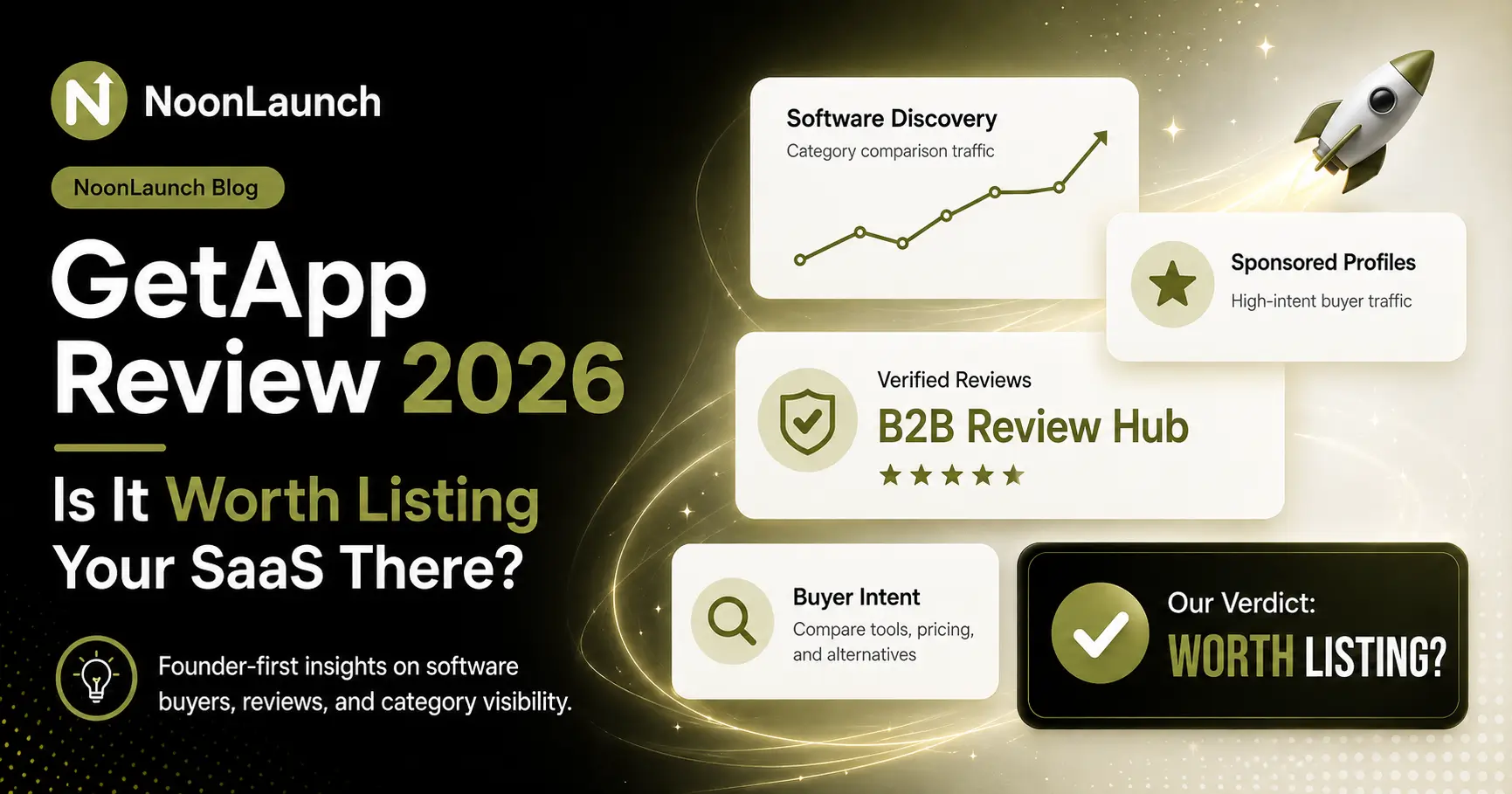
GetApp is a B2B software discovery and review marketplace where buyers compare software by category, features, pricing, ratings, integrations, and verified customer reviews.
For software vendors, GetApp is not a launch-day platform. Its value comes later in the buyer journey. A product profile can become a long-term discovery and evaluation page, while sponsored profiles can send high-intent buyers to a vendor-selected landing page.
In 2026, GetApp is part of G2 Digital Markets after G2 acquired GetApp, Capterra, and Software Advice from Gartner. Buyer activity across all four platforms is now being combined into G2 Buyer Intent.
Our verdict: B2B SaaS companies with a live product should establish an accurate GetApp presence and collect genuine customer reviews. Paid promotion is worth testing only when you understand your acquisition economics and can convert high-intent software buyers profitably.
What Is GetApp?
GetApp is a software marketplace designed to help businesses research and compare applications.
Its category pages organize products using ratings, features, pricing, integrations, and verified reviews. Product pages can include descriptions, screenshots, alternatives, and review breakdowns.
That makes GetApp different from Product Hunt or NoonLaunch. Launch platforms create discovery around a new product. GetApp is primarily for buyers who already know the type of software they need and are comparing possible solutions.
If you are still deciding where to launch, NoonLaunch's 19 startup launch platforms for new products covers the earlier distribution stage.
What Changed With GetApp in 2026?
The biggest change is ownership.
G2 agreed to acquire Capterra, Software Advice, and GetApp from Gartner in January 2026. The acquisition was completed in early 2026, and the three properties now sit within G2 Digital Markets.
GetApp still operates as its own software discovery website.
G2 announced in June 2026 that activity from G2, Capterra, Software Advice, and GetApp now flows into one Buyer Intent experience. Signals include reading reviews, viewing product pages, comparing vendors, researching competitors, and browsing categories.
How Does GetApp Work for Software Vendors?
GetApp lists software providers across its marketplace, including providers that do not pay for sponsored placement.
A product page can contain positioning, categories, pricing, features, screenshots, reviews, alternatives, integrations, supported platforms, and customer information.
Vendors can also pay for sponsored profiles.
GetApp's PPC terms explain that sponsored profiles can appear in paid placements and send buyers to a landing page selected by the vendor. Reporting can include clicks, average cost per click, monthly spend, and conversion tracking.
GetApp also supports pay-per-lead programs where qualified software buyer leads can be delivered to participating vendors.
The strategy is simple: build an organic evaluation presence first, then buy additional exposure if the economics work.
What Do You Actually Get From a GetApp Listing?
The first benefit is a third-party product page. A prospect researching your brand can find information about your software outside your own website.
Second, you can gain category discovery. A buyer searching for CRM, project management, AI, customer service, accounting, marketing, HR, or another software category can encounter products they did not know.
Third, GetApp provides comparisons. Visitors can compare products and evaluate ratings, pricing, features, integrations, and alternatives.
Fourth, reviews create social proof. GetApp says human moderators verify reviewers and use technology to check review quality, plagiarism, and generative AI.
Fifth, sponsored profiles can generate commercial traffic because GetApp visitors are often actively researching software for a business problem.
Who Should List Their Product on GetApp?
GetApp is best suited to B2B software with a clear category and identifiable business buyer.
SaaS companies are the strongest fit. CRM tools, project management software, marketing products, HR platforms, finance software, analytics tools, customer support products, ecommerce software, cybersecurity tools, developer products, and vertical SaaS can benefit.
AI software also fits when it solves a recognizable business problem.
GetApp becomes more useful once you have customers who can leave detailed reviews.
A pre-launch startup with no users should focus first on launching and validation.
How Do GetApp Reviews Work?
GetApp uses a moderated review process.
Its documentation says published reviews go through quality assurance and reviewers must meet authenticity standards.
Vendors may ask customers for reviews and offer nominal incentives, but incentives cannot depend on whether the review is positive or negative.
GetApp also offers a Reviews as a Service program for eligible vendors. It can invite a vendor's customers to review software, and those reviews may appear across GetApp, Capterra, and Software Advice.
Reviews are sorted by Most Helpful by default. GetApp says this considers depth, quality, recency of experience, and other signals, but not the star rating itself.
The takeaway is simple: ask real customers consistently, not only your happiest customers.
Is GetApp Free for Vendors?
GetApp lists both paying and non-paying providers, so a product does not need to be a sponsored advertiser simply to appear in the marketplace.
Paid promotion is different.
GetApp's PPC product requires a Sponsored Profile and an active campaign. Vendors pay based on click activity, with budget controls and conversion tracking.
GetApp does not publish one universal cost per click because pricing depends on category, campaign, bidding environment, and buyer demand.
There is also a pay-per-lead model for vendors that want qualified opportunities rather than only clicks.
For bootstrapped startups, begin with the profile and reviews.
Is Paid GetApp Promotion Worth It?
It can be, but only when your unit economics support it.
Before paying for sponsored placement, know your average contract value, demo or trial conversion rate, sales close rate, customer lifetime value, and acceptable acquisition cost.
Then test with a controlled budget. Measure qualified leads and customers rather than clicks.
If you still need low-cost launch distribution, use NoonLaunch's free Startup Launch Directories database before committing budget to paid acquisition.
Is GetApp Good for SEO and AI Search Visibility?
GetApp can support branded search visibility and broader product entity coverage.
A detailed third-party profile connects your brand with its software category, features, pricing, integrations, reviews, alternatives, and customer use cases.
That information can matter in AI-driven software research. G2 reported in 2026 that about half of B2B software buyers now start research with AI chatbots, while buyers continue visiting review marketplaces to compare products and validate decisions.
GetApp therefore matters less as a simple backlink opportunity and more as a structured source of third-party product information and customer sentiment.
No listing guarantees Google rankings or AI recommendations.
GetApp Pros and Cons
Pros:
Established B2B software marketplace
Organic and sponsored product visibility
Verified customer reviews
Category-based buyer discovery
Product comparisons and alternatives
PPC and pay-per-lead options
Buyer-intent value across the G2 ecosystem
Useful long-term evaluation presence
Cons:
Not designed for launch-day exposure
Review collection takes time
Competitive categories can be crowded
Sponsored traffic can become expensive
Paid pricing varies by campaign
A listing does not guarantee leads
Less useful before you have real customers
GetApp vs Capterra vs G2 vs NoonLaunch
GetApp, Capterra, and G2 now share the same corporate family, but buyers still encounter them as separate research destinations.
GetApp is strong for category browsing, product comparisons, pricing, and verified reviews. Capterra serves similar evaluation intent. G2 is heavily associated with reviews, comparison pages, Grid reports, and buyer-intent data.
NoonLaunch sits earlier in the journey. It is built for launching and discovering new products. Founders can use NoonLaunch to generate early visibility and establish another permanent product presence before review marketplaces become a major channel.
The sequence matters: launch, acquire users, collect customer proof, then expand across review marketplaces.
GetApp Review 2026: Final Verdict
GetApp is worth using in 2026 if you sell B2B software and want visibility while buyers compare solutions.
Start by making sure your product information is complete and accurate. Use the right categories. Keep features, integrations, pricing, screenshots, and positioning current. Then build a repeatable process for asking genuine customers for reviews.
Do not rush into sponsored PPC simply because competitors appear above you. Paid GetApp promotion makes sense when you can track high-intent clicks through to qualified leads and revenue.
For very early-stage founders, GetApp should not be the first distribution channel.
First launch the product. Get it in front of early adopters. Learn which messaging resonates. Build a customer base. Then use review marketplaces such as GetApp to strengthen evaluation-stage trust.
If you are still at that first stage, submit your product to NoonLaunch and create another permanent discovery surface for your startup.