SourceForge Review 2026: Is It Worth Listing Your Software There?
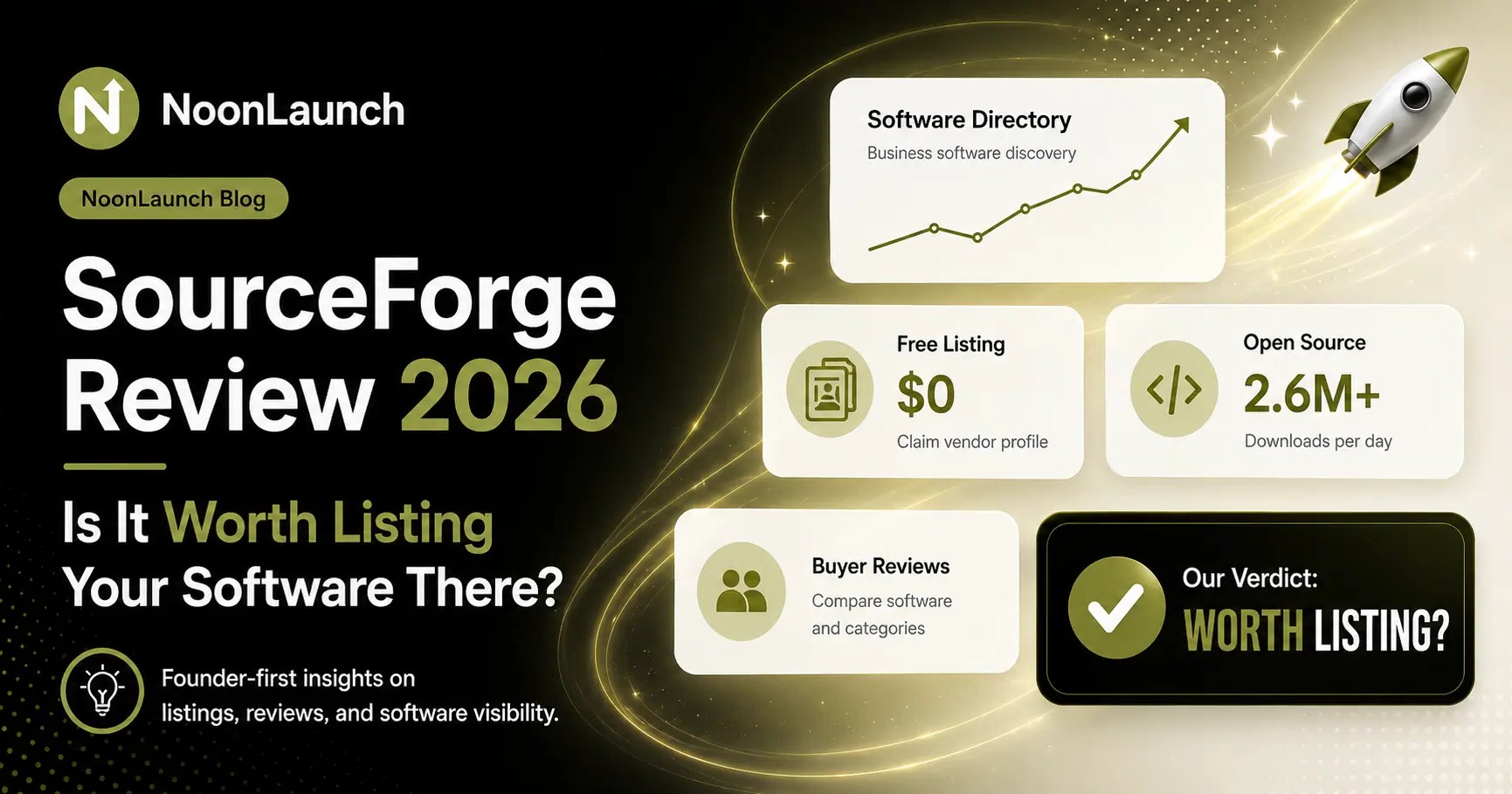
SourceForge is a software discovery, comparison, review, and open source hosting platform used by both business software buyers and developers. For founders, it offers two different opportunities: commercial software companies can claim a free business software listing, while open source projects can use SourceForge to distribute software and manage project resources.
SourceForge currently reports nearly 20 million monthly visitors, more than 119,000 business software titles, and more than 2.6 million open source downloads per day. Its business software directory lets buyers compare products by category, pricing, reviews, integrations, deployment, region, support, and other filters.
Our verdict: SourceForge is worth using in 2026 if you sell B2B software, SaaS, developer tools, or open source software. Start with the free business listing or open source project page. Paid vendor plans make more sense when buyer-intent data, category promotion, review generation, retargeting, or demand generation can justify the cost.
What Is SourceForge?
SourceForge was founded in 1999 and has evolved into a platform covering software discovery, business software comparison, reviews, downloads, and open source project hosting.
How Do You Get Listed on SourceForge?
Commercial B2B software vendors can have a Basic Business Software Listing without paying for an upgraded plan.
SourceForge says its directory is intended to cover commercially available B2B software and services. Products generally need to be publicly available to businesses, offered by the actual vendor, and fit at least one SourceForge software category.
SourceForge's current documentation says it is free for software vendors to claim, edit, and manage their software listing.
Once you have access, complete the profile with accurate categories, pricing, screenshots, features, integrations, and links.
Founders building a wider listing strategy can use NoonLaunch's free Startup Launch Directories database to find additional software directories and launch communities.
What Do You Actually Get From a SourceForge Listing?
The first benefit is a public software profile. It gives potential buyers another third-party page where they can research your product outside your own website.
Second, your product can appear inside relevant software categories. SourceForge organizes business software across thousands of use cases, which can place smaller companies beside better-known competitors.
Third, buyers can compare your software with other products. Comparison intent can be valuable because visitors are already evaluating solutions rather than casually browsing.
Fourth, customers can leave reviews. SourceForge supports verified user reviews and lets vendors respond publicly to feedback.
Fifth, vendors can use review activity to build social proof. SourceForge awards eligible products with recognition such as Leader and Top Performer badges when they collect enough positive reviews.
Who Should List Their Product on SourceForge?
SourceForge is particularly useful for B2B software companies.
SaaS founders are a strong fit because SourceForge attracts buyers who actively compare business software. CRM tools, marketing products, project management software, cybersecurity platforms, analytics products, HR software, finance tools, customer service platforms, ecommerce software, and vertical SaaS can all fit.
Developer tools are another natural fit because SourceForge already has a large technical audience.
Open source products have an additional use case. Instead of only creating a business software listing, developers can host project files, distribute releases through SourceForge's worldwide mirror network, publish release notes, and track downloads.
SourceForge is less useful for an idea or waitlist because business listings focus on publicly available software.
How Do SourceForge Reviews Work?
SourceForge lets software users submit product reviews and gives vendors tools for encouraging legitimate customers to participate.
Basic and upgraded vendors can use a unique review URL and suggested messaging to ask customers for reviews.
Upgraded vendors can also provide a customer list and have SourceForge send review invitation emails on their behalf.
Vendors can respond publicly to reviews, and SourceForge recommends professional, constructive responses.
Ask real users consistently for honest reviews instead of waiting until a sales conversation requires proof.
Is SourceForge Free for Software Vendors?
Yes. SourceForge has an unpaid Basic Business Software Listing.
Its paid offering begins with upgraded listing packages called Plus, Premium, Amplify, Precision ABM, and Enterprise. SourceForge does not publish standard prices for these plans on its public pricing page, so vendors need to contact the company for current pricing.
Plus includes features such as promotion in up to two categories, competitor-page promotion, higher SourceForge search visibility, customer review generation, unlimited website clicks, profile visitor data, interactive demos, downloadable marketing assets, and AI-search optimization.
Premium expands category promotion and adds buyer-intent data, Google Analytics support, Zapier integration, and a larger review-generation program.
Higher plans add retargeting, competitor intent data, buyer-intent APIs, 6sense integration, sponsored content, podcast exposure, and account-based marketing options.
For most early-stage founders, the free listing is the logical starting point.
Is Paying for SourceForge Promotion Worth It?
Paid SourceForge can make sense when your customer value is high enough to justify acquiring in-market software buyers.
Promoted products can appear more prominently in categories, alternative pages, comparison pages, competitor listings, and integration pages. Higher plans also expose buyer-intent information about companies researching your software, category, or competitors.
That is most useful for B2B companies with higher contract values and a clear sales process.
SourceForge does not publish fixed plan pricing publicly, so ask for the current cost, estimate how many qualified opportunities you would need to recover it, and track trials, demos, pipeline, and customers rather than impressions alone.
Is SourceForge Good for SEO and AI Search Visibility?
SourceForge can support search and AI visibility because software profiles create structured third-party information about products.
A listing can connect your brand with categories, features, integrations, reviews, alternatives, competitors, deployment options, and use cases. Comparison and category pages can also expose your product during competitor-oriented searches.
SourceForge now explicitly offers AI-search optimization as part of upgraded vendor plans and markets visibility across systems such as ChatGPT, Google AI Overviews, Gemini, Claude, Grok, and Perplexity.
Maintain accurate information across your website, launch pages, directories, and review platforms.
SourceForge Pros and Cons
Pros:
Free Basic business software listing
Nearly 20 million monthly visitors reported by SourceForge
Large software comparison directory
Verified user reviews
Category and competitor discovery
Comparison and alternatives pages
Review generation tools
Open source project hosting
File distribution and download mirrors
Paid buyer-intent and demand-generation tools
Cons:
Paid listing prices are not publicly displayed
Competitive categories contain established vendors
Reviews take time to build
Paid promotion does not guarantee customers
Buyer-intent features require upgraded plans
Less useful for pre-launch products
Open source hosting and business listings serve different goals
SourceForge vs G2 vs Product Hunt vs NoonLaunch
SourceForge and G2 both serve software buyers researching and comparing products. SourceForge also has a major open source development and download ecosystem, which gives it a broader developer role.
Product Hunt is built around concentrated launch-day visibility and maker-community engagement.
NoonLaunch operates in the launch and continuing discovery layer. Founders can launch for free, while the current Premium Launch adds featured placement, permanent directory visibility, newsletter exposure, and a dofollow backlink.
SourceForge Review 2026: Final Verdict
SourceForge is worth using in 2026 for most B2B software companies and especially useful for developer-focused or open source products.
Start with the free option. Claim your business software listing, verify your company, choose accurate categories, complete the profile, and begin collecting genuine customer reviews.
If you maintain an open source project, evaluate SourceForge separately as a distribution platform for releases, downloads, mirrors, project documentation, and community resources.
Do not upgrade to a paid vendor package simply because SourceForge has a large audience. Paid promotion is most useful when your product has enough customer value and conversion capacity to monetize high-intent software research traffic.
For many founders, the best sequence is simple: launch the product, earn users, collect reviews, then expand into buyer-focused directories where comparison intent is stronger later.
If your product is still preparing for its initial launch, submit it to NoonLaunch first, then add SourceForge as your software listing and review presence once the product is ready for broader buyer research.