StackShare Review 2026: Is It Worth Listing Your Developer Tool?
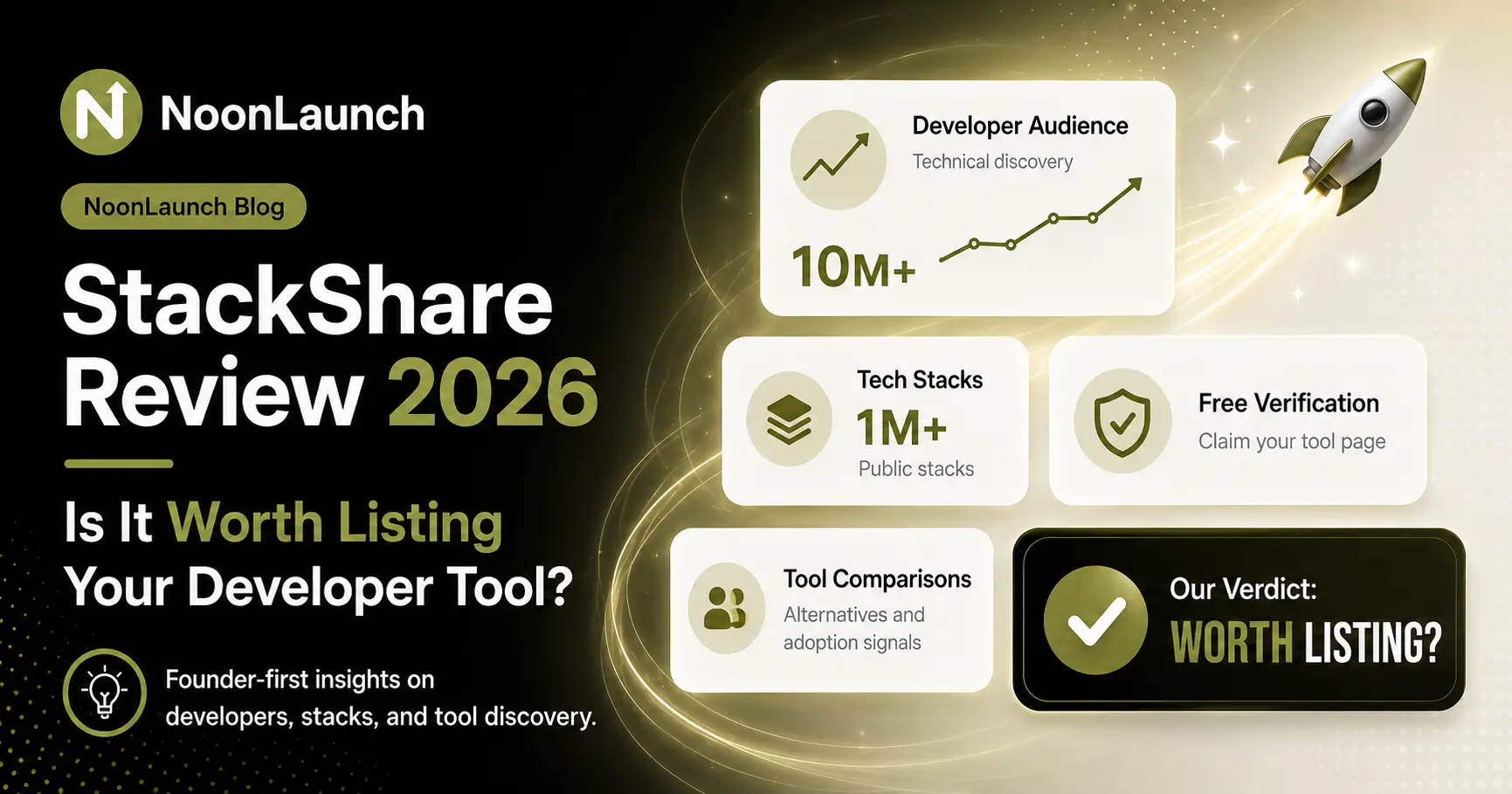
StackShare is a developer-focused technology discovery platform where engineers discover tools, compare alternatives, see which technologies companies use, and share the reasoning behind technology decisions.
For founders building developer tools, APIs, infrastructure products, databases, observability software, AI developer products, open-source projects, and technical SaaS, StackShare can be a valuable long-term discovery channel.
StackShare reports more than 10 million monthly developers, 50,000 developer tools, 1 million tech stacks, and 100,000 companies on its platform.
Tool makers can build a public product page, appear inside relevant categories and comparisons, collect community adoption signals, and claim their listing. Verification is free and gives official teams a verified badge.
Our verdict: StackShare is worth using when developers or engineering teams are part of your ICP. It is much less important for non-technical consumer products. Treat it as a developer discovery and credibility channel, not a one-day launch platform.
What Is StackShare?
StackShare is a community for discovering, comparing, and sharing the technologies used to build software.
Instead of organizing products only by broad software categories, StackShare focuses heavily on technology stacks.
Developers can see which programming languages, frameworks, databases, cloud platforms, monitoring products, AI tools, developer services, and business software other developers and companies use.
Users can compare tools side by side, explore alternatives and integrations, contribute pros and cons, follow tools, publish technology decisions, and share complete company stacks.
This makes StackShare different from a standard SaaS directory.
A developer researching a database, monitoring platform, API tool, or coding assistant is often trying to answer practical questions such as:
Which tool should we use?
What are the alternatives?
What do other engineering teams use?
How does this product fit into our existing stack?
Which companies already use it?
For developer-focused founders, that is valuable commercial intent.
What Changed With StackShare Before 2026?
Older StackShare reviews may describe StackShare Enterprise, its former paid technology-stack intelligence product.
That is no longer the main product founders should evaluate.
StackShare announced in August 2024 that it had joined FOSSA. FOSSA continued operating the public StackShare community while StackShare Enterprise was sunset.
For founders researching StackShare in 2026, the relevant opportunity is the public developer community and tool-discovery ecosystem.
That includes tool pages, comparisons, technology categories, company stacks, community adoption data, alternatives, integrations, and Stack Decisions.
What Do You Get From a StackShare Tool Listing?
The first benefit is a dedicated tool page.
Your page can explain what the product does, where it fits in the technology stack, its category, features, integrations, alternatives, adoption activity, and related community discussions.
Second, your product can appear in relevant technology categories.
StackShare covers application development, databases, infrastructure, DevOps, utilities, security, analytics, payments, artificial intelligence, developer productivity, API tools, monitoring, CI/CD, code review, and many other technical areas.
Third, StackShare creates comparison visibility.
Developers often visit comparison pages when they already understand their problem and are choosing between several technologies.
Someone comparing your product with a larger competitor is much more commercially interesting than a random visitor discovering your homepage through broad social traffic.
Fourth, community adoption can create visible proof.
Tool pages can show stacks using a technology, followers, votes, pros and cons, integrations, and other adoption information.
Fifth, StackShare can associate your tool with real company technology stacks.
Seeing that a product is used by recognizable engineering teams gives developers context that a normal software directory cannot provide.
Who Should List Their Product on StackShare?
StackShare is strongest for products purchased, evaluated, recommended, or implemented by developers and engineering teams.
Developer tools are the clearest fit.
This includes:
SDKs
APIs
coding tools
testing platforms
CI/CD products
code review software
deployment tools
developer productivity software
cloud infrastructure
observability platforms
databases
security tools
open-source projects
AI products can also be a strong fit when the primary user is technical.
AI infrastructure, coding agents, model APIs, agent platforms, developer frameworks, vector databases, LLM tooling, AI observability products, and similar technologies fit naturally into StackShare's developer ecosystem.
StackShare is less valuable for consumer applications, local businesses, ecommerce brands, lifestyle products, or SaaS products where developers have little influence over adoption.
How Do You Claim and Verify a Tool on StackShare?
If your product already has a StackShare page, an official team member can claim it.
StackShare supports verification using an email address associated with the product's official company domain.
For open-source projects, ownership can also be verified through GitHub when the person requesting verification has the appropriate repository permissions.
Once ownership is confirmed, the product receives a verified badge.
Verification helps developers see that the information on the page is being managed by someone officially associated with the product rather than an unrelated community member.
StackShare also states that verified tools may receive preferential visibility in search results and category listings.
Verification is free.
For founders, this means there is little reason to leave an existing StackShare profile unclaimed if your product is relevant to developers.
What Are StackShare Stacks and Adoption Signals?
One feature that separates StackShare from a normal directory is its emphasis on real technology stacks.
Developers and companies can publish the technologies they use across application development, data, infrastructure, DevOps, utilities, AI, and business workflows.
Tool pages can then show adoption information, while company pages show technologies used by particular organizations.
This matters because developers choosing between tools usually want more than marketing copy.
They want to know which companies use the technology, what other products appear beside it, which alternatives exist, how it integrates into the broader stack, and why another engineering team selected it.
StackShare also supports Stack Decisions.
These are posts where developers explain why they selected one technology over another or why they changed part of their stack.
For a developer-tool founder, this kind of context can be more convincing than a generic five-star testimonial because it explains the actual technical decision.
Is StackShare Free in 2026?
The public StackShare community remains free to access, and tool verification is free.
The former StackShare Enterprise product should not be confused with the public StackShare listing opportunity available today.
StackShare Enterprise was a separate commercial product focused on technology intelligence. It was sunset following StackShare's move to FOSSA.
StackShare does not currently publish a standard self-serve paid listing price for tool makers on its public community pages.
For most startup founders, the practical approach is therefore straightforward:
Create or find your product listing, claim it, verify ownership, complete the information, and evaluate the free discovery opportunity before considering any separate promotional arrangement.
Is StackShare Good for SEO and AI Search Visibility?
StackShare can support long-term discovery because it creates structured pages around tools, categories, alternatives, comparisons, integrations, adoption, and company technology stacks.
A developer searching Google for two competing technologies may encounter a StackShare comparison page.
Someone browsing a specific category may discover a tool they did not previously know.
Those pages create third-party associations between your product and the technical problems, categories, integrations, and competitors connected to it.
This can also contribute to a broader AI-search footprint.
AI search engines and assistants often rely on multiple sources when identifying what a software product does, what category it belongs to, and which alternatives exist.
However, no StackShare listing guarantees recommendations from ChatGPT, Perplexity, Google AI Overviews, or another AI system.
Do not evaluate StackShare only as a backlink source either.
StackShare does not publicly promise a particular dofollow backlink benefit for every tool listing.
Its stronger value comes from developer relevance, comparison intent, category association, adoption proof, integrations, and another credible source describing your product.
A well-maintained profile can also support branded searches when prospects want to verify whether your product is established, actively used, and relevant to a particular engineering category.
StackShare Pros and Cons
Pros:
Developer-focused audience
More than 10 million monthly developers reported by StackShare
More than 50,000 developer tools
Free tool verification
Verified badge for official teams
Tool comparison pages
Category and alternative discovery
Real company technology stacks
Community adoption signals
Pros and cons
Strong fit for developer and infrastructure products
Long-term discovery potential
Cons:
Less useful for non-technical products
Not primarily a launch-day platform
Visibility depends on relevance and adoption
New products can look weaker beside established tools
Community signals take time to build
No guaranteed traffic or leads
No guaranteed SEO rankings or AI citations
StackShare Enterprise no longer exists
StackShare vs Product Hunt vs NoonLaunch
StackShare, Product Hunt, and NoonLaunch solve different distribution jobs.
StackShare is strongest when developers are researching technologies, comparing tools, studying integrations, and examining real-world adoption.
Product Hunt is stronger for a concentrated public launch and broader maker-community attention.
NoonLaunch sits in the launch and ongoing discovery layer.
Founders can launch a product, compete for visibility, build social proof, and create a permanent product page.
For a developer tool, these channels can work together.
Launch publicly through relevant launch platforms.
Distribute the product through developer communities.
Create and verify your StackShare listing.
Document why developers should choose the product.
Encourage genuine users to share their technology decisions.
Then continue building adoption and third-party proof over time.
NoonLaunch's free Startup Launch Directories database can help identify additional distribution channels.
StackShare Review 2026: Final Verdict
StackShare is worth using in 2026 if developers or engineering teams are an important part of your market.
The biggest opportunity is not a temporary traffic spike.
It is establishing your product inside the developer research ecosystem.
List the tool in the correct category. Claim and verify the page. Keep your description, features, integrations, website, and product information accurate.
Make sure developers can quickly understand where your product fits in a technology stack, what problem it solves, and which alternatives it replaces.
If real customers use your product, encourage genuine adoption signals and useful discussions rather than artificial votes or manufactured activity.
StackShare should be a lower priority for products sold mainly to non-technical consumers or business teams with no developer involvement.
For developer-focused startups, however, it can become another durable discovery and credibility surface alongside GitHub, developer communities, software directories, comparison pages, launch platforms, review sites, and your own technical content.
If you are preparing the initial launch, submit your product to NoonLaunch and use StackShare afterward to strengthen long-term developer discovery.