The Audio Stuff Review 2026
Buying audiophile gear can be surprisingly difficult.
You might spend hours comparing headphones, DACs, amplifiers, speakers, and other hi-fi equipment, only to find that every review seems to tell a different story. One reviewer loves a product, another calls it overpriced, while manufacturer specifications tell you very little about how the product actually performs in a real system.
That is the problem The Audio Stuff is trying to solve.
The Audio Stuff is an independent audiophile research and product-discovery platform built around extended listening, reference-anchored comparisons, standardized scoring, buying guides, and practical audio tools. Instead of simply publishing another list of products, the platform attempts to create a consistent system for researching what audio gear is actually worth buying.
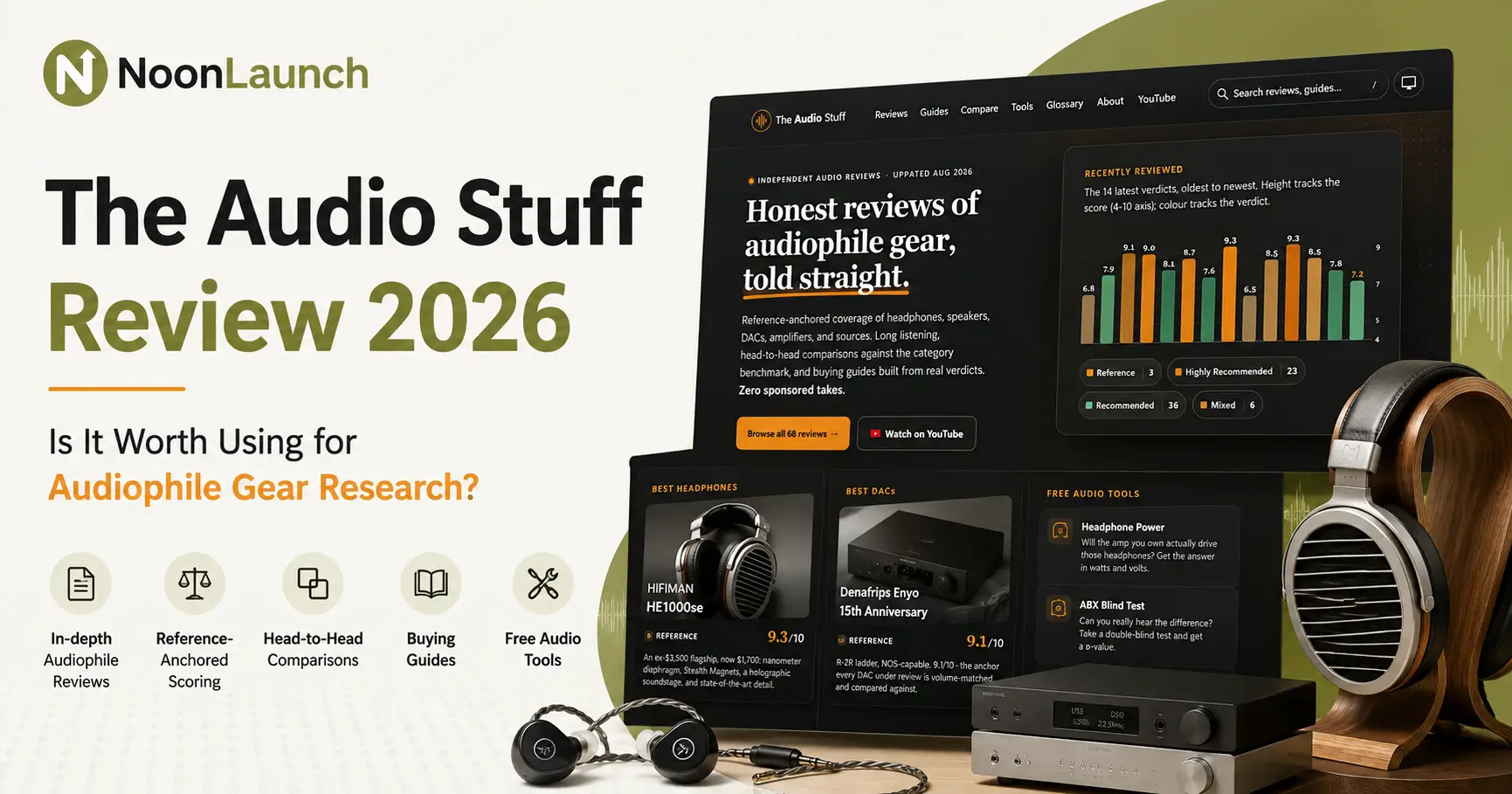
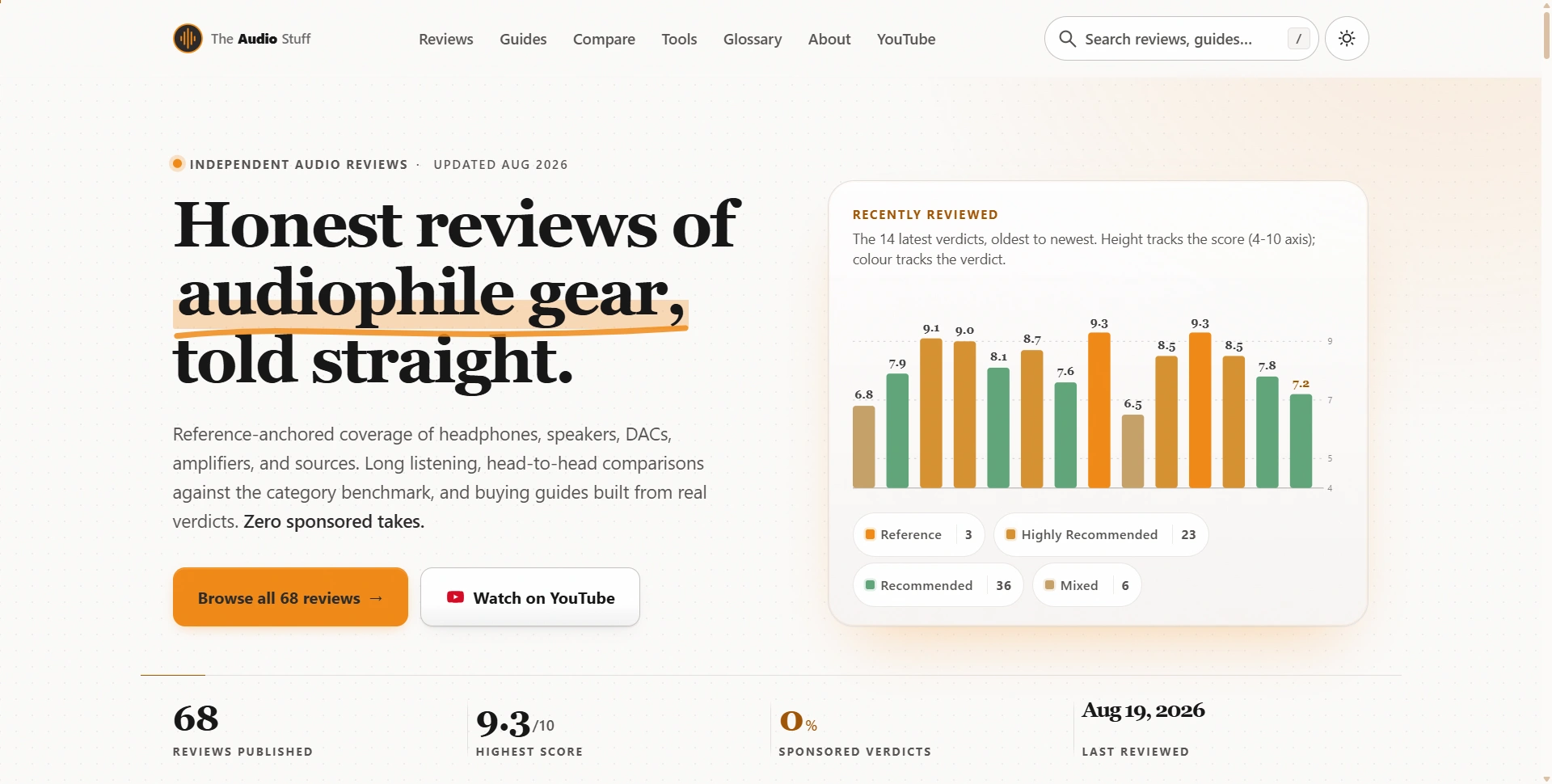
As of 2026, the platform has published 68 reviews across seven audio categories, alongside 37 head-to-head comparisons, 11 buying guides, 16 free audio tools, and 315 glossary definitions. Its highest published score is 9.3/10, while sponsored verdicts are listed at 0%.
So, how good is The Audio Stuff in 2026, and is it worth using before your next audio purchase?
Let's take a closer look.
What Is The Audio Stuff?
The Audio Stuff is an independent audiophile and hi-fi product research platform covering headphones, speakers, DACs, headphone amplifiers, speaker amplifiers and preamps, sources, and accessories.
Its approach is different from a traditional product-review blog.
Products are tested through extended listening, compared against a published reference list, evaluated using a standardized 0–10 scoring framework, and then turned into reviews, comparisons, and buying guides. The platform also provides browser-based audio tools, an audiophile glossary, and YouTube companions for its written reviews.
The central idea is simple:
Help people figure out which audio product is actually worth buying for their budget, system, and listening preferences.
That makes The Audio Stuff particularly relevant to people who are already researching a purchase rather than casual visitors looking for entertainment.
If you're searching for headphone reviews, DAC reviews, speaker reviews, or headphone amplifier reviews, the site's category structure makes it relatively easy to move from general research toward a specific buying decision.
You can browse The Audio Stuff's reviews to explore the full catalogue.
The Audio Stuff's Reference-Anchored Review Methodology
One of the most interesting aspects of The Audio Stuff is its scoring methodology.
Rather than giving a product a score based entirely on a reviewer's overall impression, every verdict is built from five weighted scoring axes:
Scoring area | Weight |
|---|---|
Tonality | 30% |
Technicalities | 25% |
Build & ergonomics | 15% |
System fit | 15% |
Value | 15% |
This matters because audio reviews are inherently difficult to standardize. Personal preference plays a role, but The Audio Stuff attempts to reduce inconsistency by defining what contributes to the final score.
Tonality considers frequency balance, bass extension and control, and treble behavior.
Technicalities cover areas such as detail retrieval, soundstage, imaging, dynamics, transient response, and decay.
Build and ergonomics consider materials, fit, comfort, finish, and everyday reliability.
System fit looks at practical compatibility, including drive requirements, room behavior, and source pairing.
Finally, value considers how the product performs relative to other products in the same price tier.
The result is intended to make scores easier to interpret across different products.
Why the Reference Chain Matters
The site's biggest differentiator is arguably its reference chain.
Instead of reviewing every product in isolation, The Audio Stuff uses a fixed reference system. The idea is that products can be compared against something known rather than judged entirely on their own.
This is particularly useful for questions like:
Is this headphone actually an upgrade?
Is this DAC worth the extra money?
How does this amplifier compare with another model?
Is the more expensive product actually better?
Which product makes more sense for my system?
The platform's reference-chain philosophy is designed to make those comparisons more meaningful.
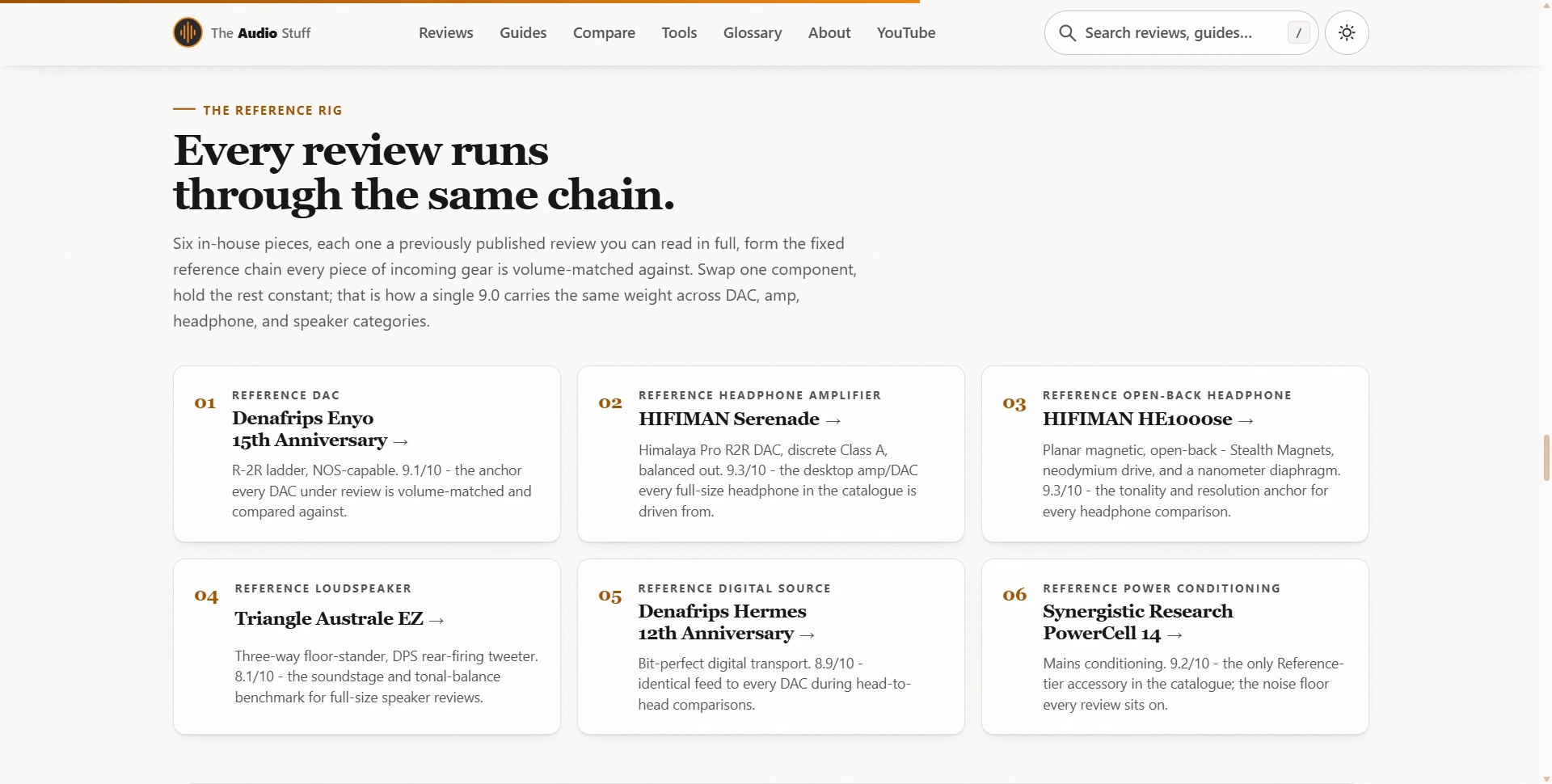
For an audio buyer, this is important because a standalone 9/10 doesn't tell you much unless you understand what that 9/10 means relative to other products.
The Audio Stuff attempts to solve that by creating a common framework.
Are The Audio Stuff Reviews Independent?
This is probably one of the most important questions to ask about any affiliate-based audio gear review website.
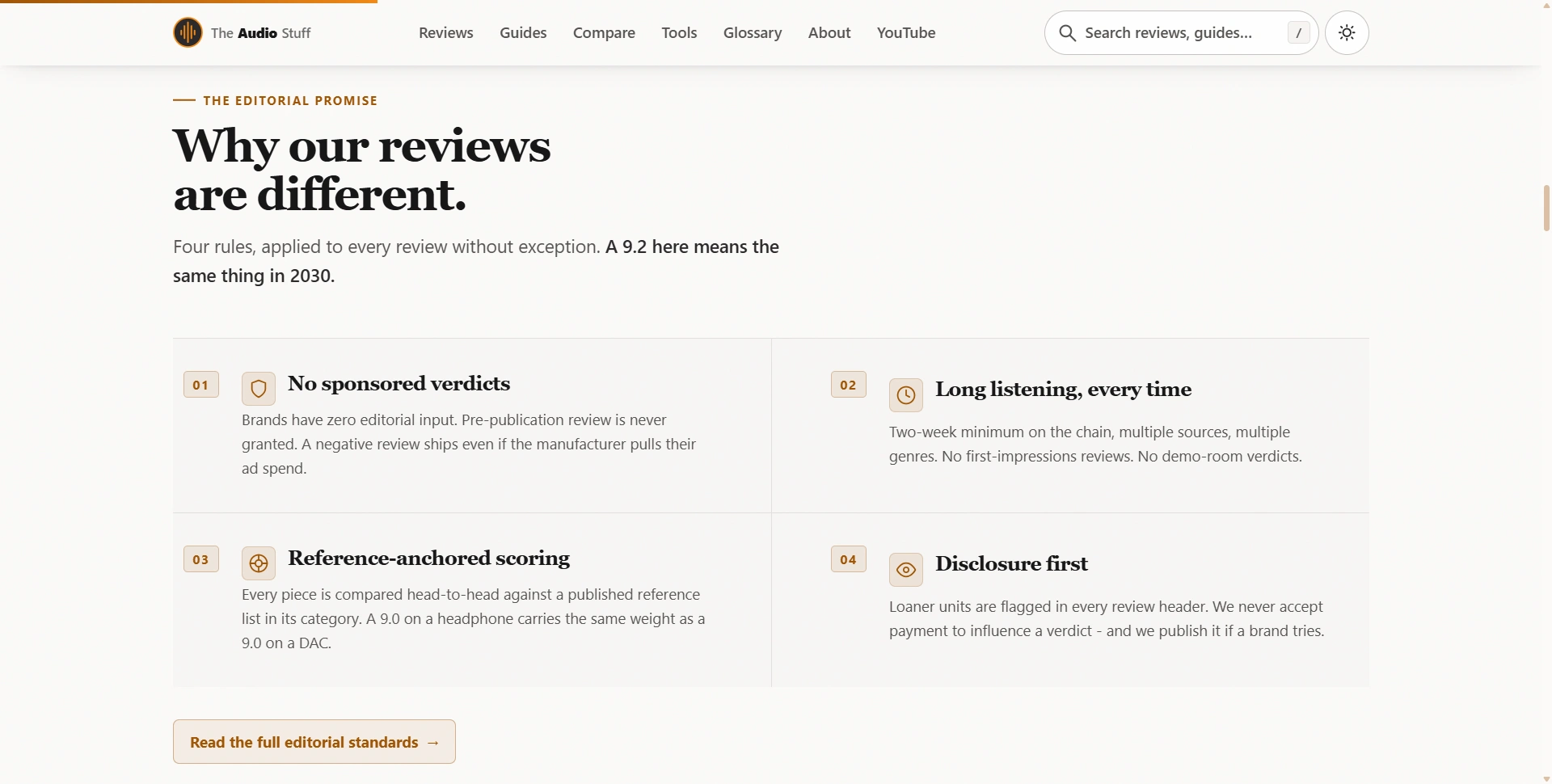
The Audio Stuff openly states that affiliate links can exist, but they do not determine product scores or verdicts. The platform also states that brands do not get editorial control over reviews.
Its editorial principles specifically include:
No sponsored verdicts
No manufacturer-controlled reviews
No pre-publication approval
No first-impression reviews
No demo-room verdicts
No changing scores because a brand advertises
No paid ghost-written placements
The site also says products can be supplied as loaners, with those units disclosed, while editorial verdicts remain independent.
That distinction is important.
Affiliate monetization itself isn't necessarily a problem. The more important question is whether commercial relationships can influence the editorial recommendation.
According to The Audio Stuff's published methodology, the answer is no.
How Long Does The Audio Stuff Test Audio Gear?
Another interesting part of the methodology is the emphasis on extended listening.
The platform states that reviews involve a minimum of two weeks of listening, rather than relying on quick first impressions.
That approach makes sense for audiophile equipment.
A product can sound impressive during a short demonstration and become less appealing after several hours or days. Comfort, fatigue, system compatibility, tonal balance, and long-term usability can all change how you feel about a product.
The Audio Stuff therefore positions its reviews around longer-term evaluation rather than a five-minute listening session.
For buyers researching expensive equipment, that can make the reviews more useful than a quick "first impressions" article.
Audio Gear Reviews Across Seven Categories
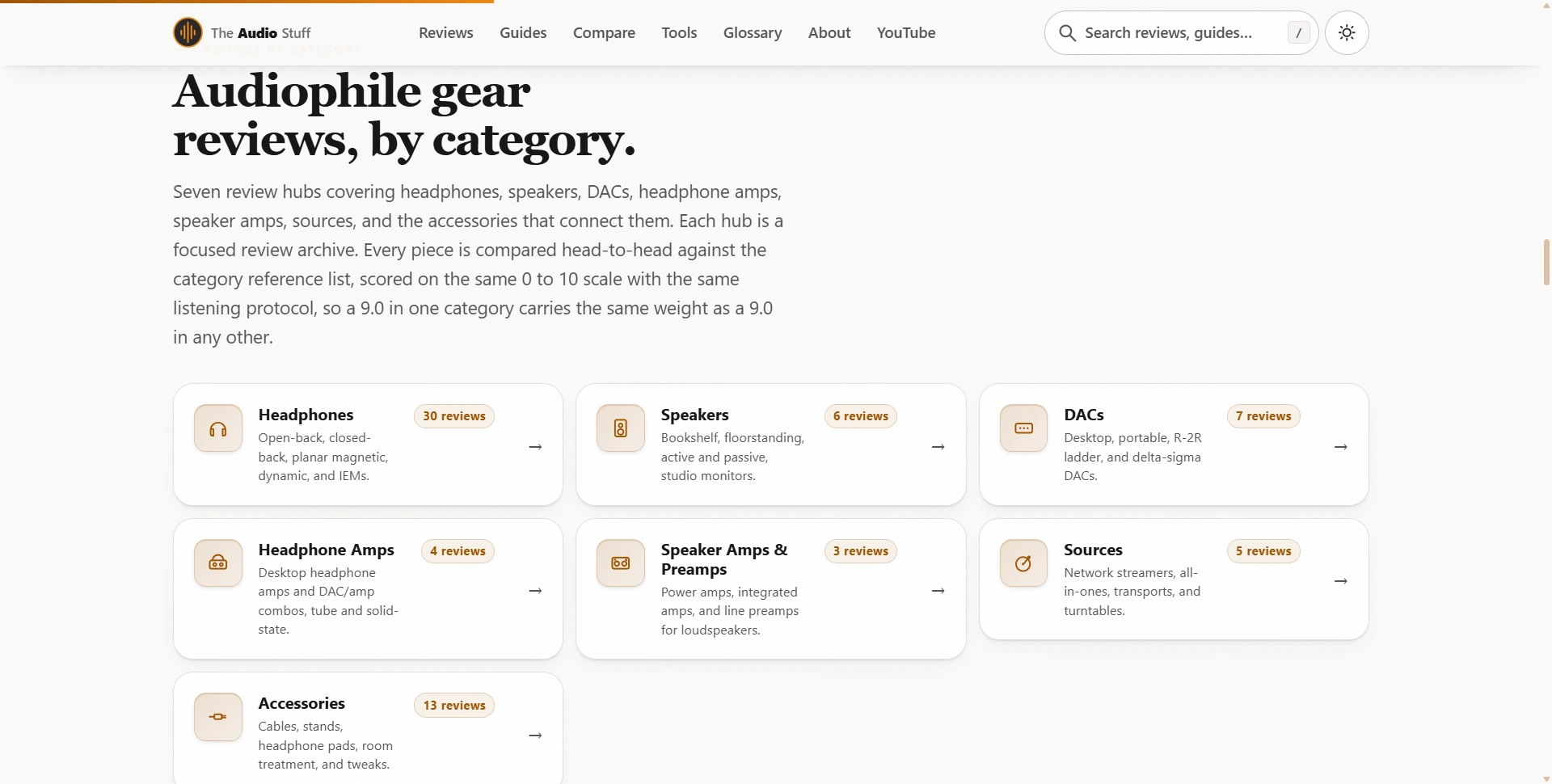
The Audio Stuff currently covers seven major categories:
Headphones
Speakers
DACs
Headphone amps
Speaker amps and preamps
Sources
Accessories
This gives the platform coverage across most of the typical hi-fi upgrade journey.
For example, someone might start by researching the best headphones, then realize they need a more capable headphone amplifier. Another reader might be upgrading their DAC and eventually start researching sources or power equipment.
Because these categories exist within the same review system, readers can move between them instead of treating every purchase as a completely separate research project.
The Audio Stuff Buying Guides
If you don't know which products to research in the first place, the site's buying guides are probably the best place to start.
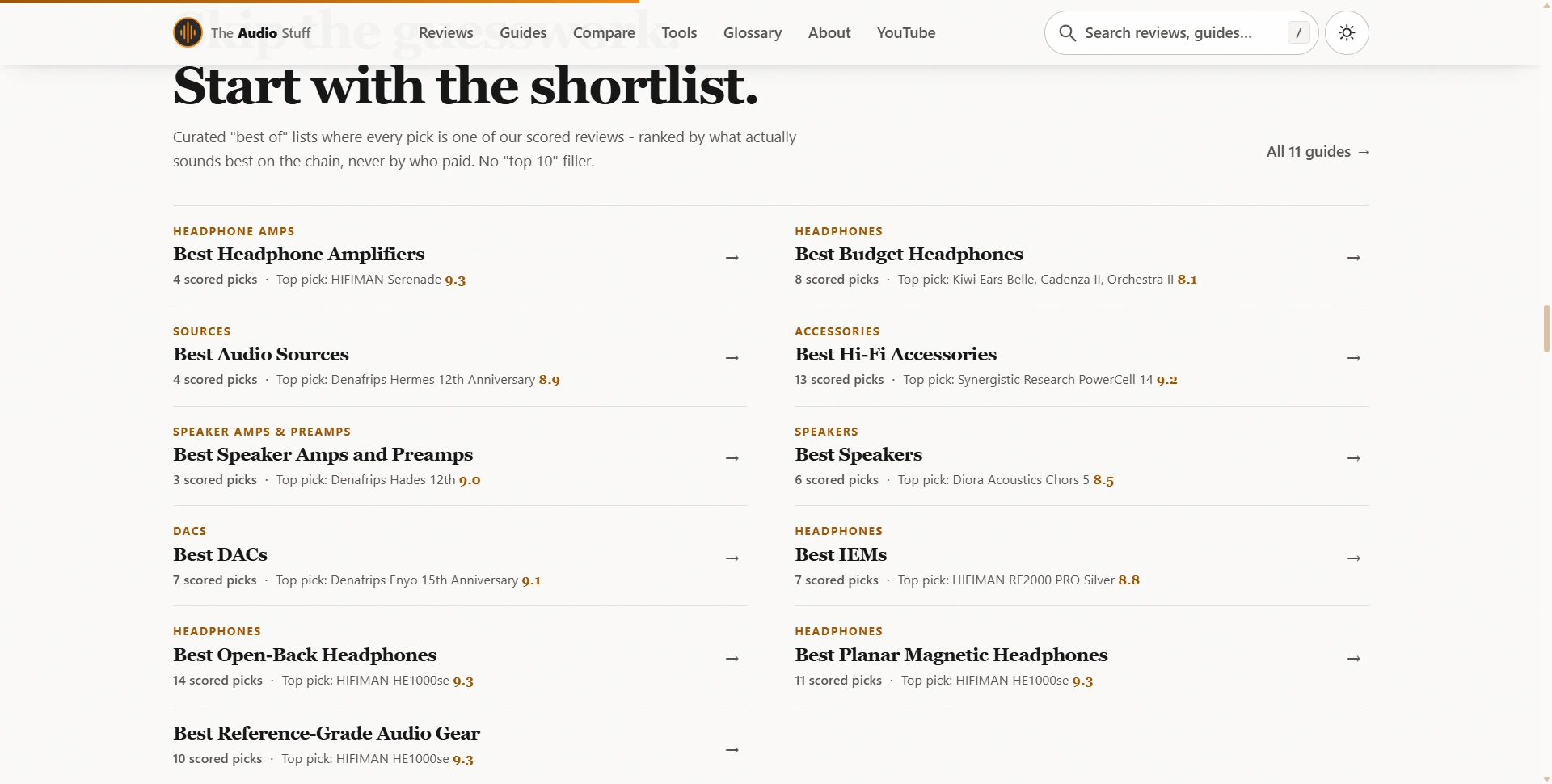
The Audio Stuff currently has 11 buying guides, built from products that have already gone through its review and scoring system.
That creates an important distinction from generic "best products" articles.
Instead of starting with a list of dozens of products and trying to rank them from specifications, the site's guides are intended to turn existing reviews into curated shortlists.
You can explore The Audio Stuff buying guides when you already know the category but aren't sure which products deserve your attention.
Typical search intents such as best headphones, best DAC, best headphone amplifier, best speakers, or best audiophile gear under $500 can naturally lead into this type of content.
The advantage is that the shortlist is connected to the underlying review system.
Head-to-Head Audio Gear Comparisons
Sometimes you don't need 20 reviews.
You just need to know which of two products you should buy.
That's where The Audio Stuff's comparison section becomes particularly useful.
The platform has 37 head-to-head comparisons, allowing readers to evaluate products against each other using the same broader methodology.
You can browse the audio gear comparisons when you're stuck between two products.
This addresses one of the most common buyer questions:
"Which one is better?"
But instead of simply declaring a winner, the comparison approach can highlight the score difference and the relevant trade-offs.
That's especially valuable for expensive purchases where the difference between two products may be relatively small, while the price difference can be significant.
Free Audio Tools Make The Platform More Useful
The Audio Stuff isn't only a review website.
It also offers 16 free browser-based audio tools, including calculators, analyzers, testing tools, and practical utilities.
Examples shown on the platform include:
Headphone Power calculator
ABX Blind Test
FLAC & Hi-Res Checker
Online Equalizer
Room Modes visualizer
Help Me Choose audio finder
These tools are useful because they solve practical problems that arise during the buying process.
For example, someone wondering "Will this amp drive my headphones?" can use a calculator instead of relying entirely on forum discussions.
You can explore the free audio tools directly.
The Audiophile Glossary Helps Beginners
Audiophile terminology can be intimidating.
Terms such as tonality, soundstage, imaging, R-2R, impedance, dynamics, planar magnetic, and transient response aren't always obvious to someone buying their first serious piece of audio equipment.
The Audio Stuff addresses this with a 315-term audiophile glossary.
You can browse the audiophile glossary when you encounter an unfamiliar audio term.
This also makes the platform more accessible to beginners without removing the technical depth that experienced audiophiles expect.
The Audio Stuff vs Traditional Audio Review Websites
The biggest difference isn't necessarily that The Audio Stuff has more reviews.
It is the system connecting the reviews.
A typical audio research journey might look like this:
Google → YouTube → Reddit → manufacturer specifications → retailer reviews → multiple review websites → confusion.
The Audio Stuff attempts to consolidate more of that journey into:
Review → reference score → comparison → buying guide → tools → purchase decision.
Its positioning is therefore less about replacing every other source of information and more about providing a consistent research framework for people who want to make a purchase decision.
That makes it particularly appealing to serious music listeners and audiophiles who care about methodology rather than simply looking for the most popular product.
Is The Audio Stuff Worth Using in 2026?
For someone researching an audio purchase, yes, The Audio Stuff is worth adding to your research process.
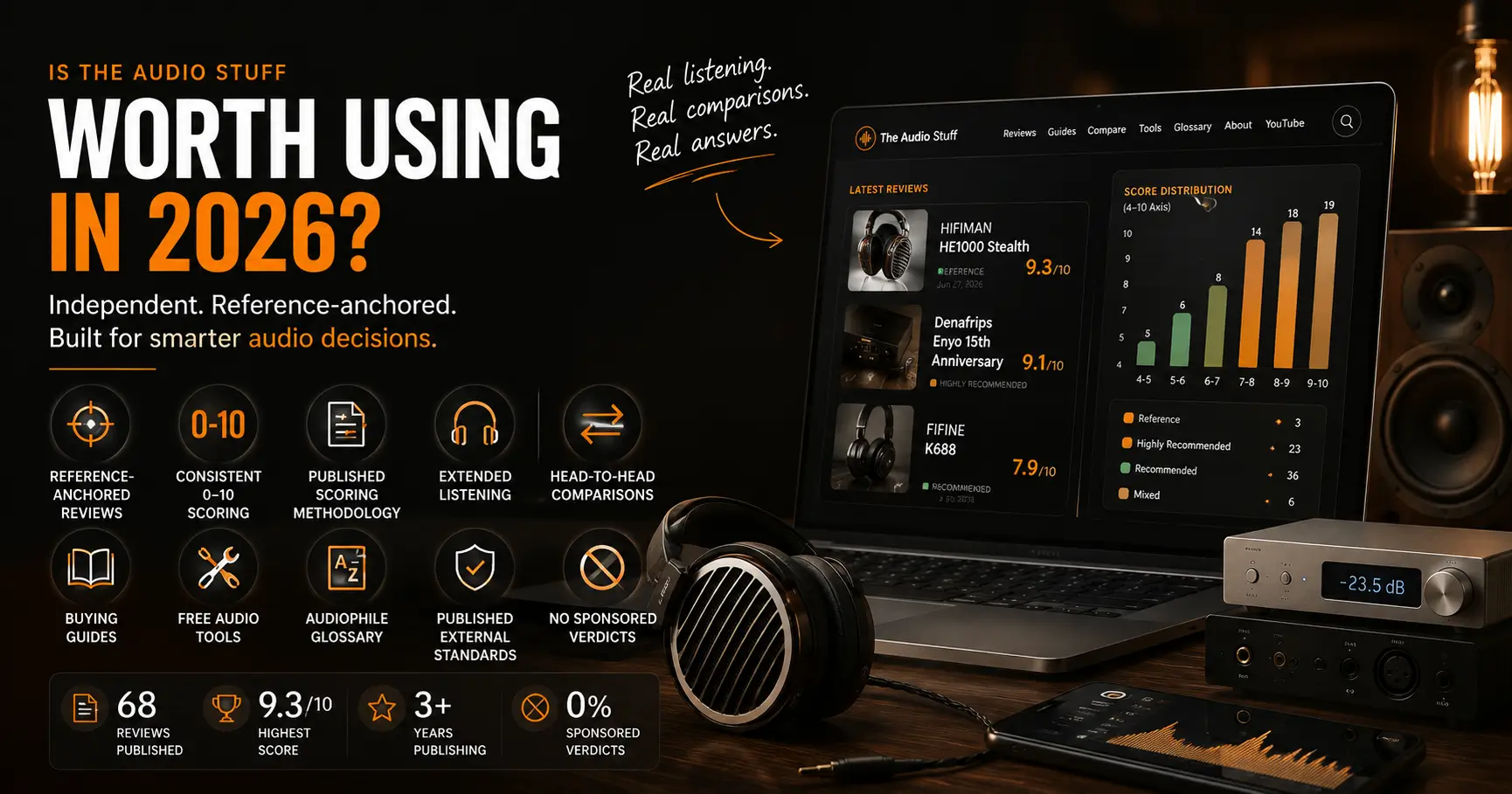
Its strongest advantages are the combination of:
Reference-anchored audio reviews
Consistent 0–10 scoring
Published scoring methodology
Extended listening
Head-to-head comparisons
Buying guides
Free audio tools
Audiophile glossary
Published external standards
No sponsored verdicts
The platform has also accumulated enough content to make the system increasingly useful. Each new review can become part of future comparisons, guides, recommendations, search results, and other content.
However, it shouldn't necessarily be your only source of information.
Audio is subjective, and different listeners have different preferences. The Audio Stuff itself positions its methodology as a consistent framework, not as an absolute replacement for every personal opinion or measurement resource.
For major purchases, it makes sense to combine a structured review with measurements, community discussions, manufacturer specifications, and your own listening preferences.
Final Recommendation!
The Audio Stuff stands out because it isn't trying to be another generic audiophile gear review website.
Its core idea is more interesting: turn audio reviewing into a consistent research system.
With 68 published reviews, seven categories, 37 comparisons, 11 buying guides, 16 free tools, 315 glossary definitions, a published scoring framework, and a reference-chain methodology, the platform has developed beyond a simple collection of product reviews.
The biggest strength is the connection between everything.
Reviews create scores. Scores create comparisons. Comparisons create buying guides. Tools help users understand their systems. The glossary helps users understand the terminology. YouTube extends the reviews into video.
That creates a useful research loop for people who are tired of conflicting opinions and marketing-heavy product recommendations.
If you're currently asking "Which headphones should I buy?", "Is this DAC worth the money?", "Which amplifier is better?", or "Is this actually an upgrade?", The Audio Stuff is a useful place to start your research.
Your next audio upgrade deserves a straight answer.
Try The Audio Stuff today.