Trustpilot Review 2026: Is It Worth Using for Your Startup?
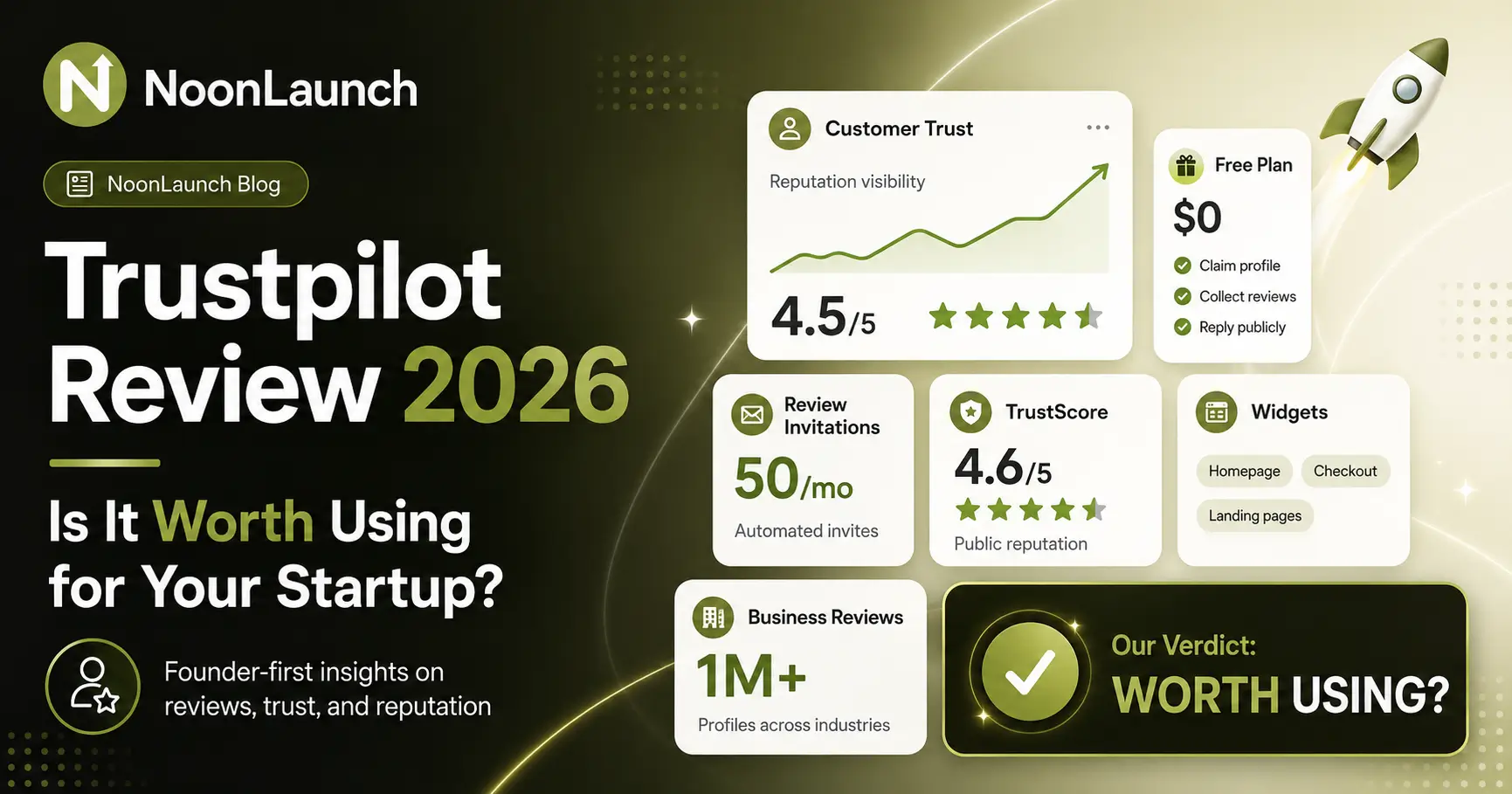
Trustpilot is one of the largest public review platforms for businesses. It helps companies collect customer reviews, build a TrustScore, respond to feedback, show review widgets, and create a third-party reputation profile buyers can check before purchasing.
In 2026, Trustpilot still offers a free business plan. The Free plan includes a claimed company profile, 50 automated review invitations per month, review replies, review flagging, and a review collection widget. Paid plans start at $99 per month per domain, billed annually, with higher tiers adding more invitations, widgets, integrations, analytics, customization, and AI-related tools. (Trustpilot Business)
Our verdict: Trustpilot is worth claiming for startups with real customers. The free plan is enough to start building legitimate social proof. Paid plans make more sense once reviews influence conversions or reputation.
What Is Trustpilot?
Trustpilot is an open online review platform launched in 2007. Consumers can review businesses they have genuinely interacted with, while companies can claim profiles, respond to reviews, invite customers to leave feedback, and use review data in marketing and customer experience.
Trustpilot currently reports more than 361 million reviews, and its business pricing page says more than 1.17 million businesses globally have reviews on the platform. Trustpilot also says more than 200,000 reviews are written daily.
Unlike G2, which focuses on B2B software evaluation, Trustpilot covers SaaS, ecommerce, agencies, consumer apps, financial services, online platforms, and local businesses.
For founders comparing review channels, see NoonLaunch's guide to 16 review sites to build startup credibility fast.
How Does Trustpilot Work for Businesses?
A Trustpilot profile can exist before a company actively manages it because consumers can create a profile by reviewing a business URL. A company can then claim that profile.
Once claimed, the business can complete company information, respond publicly to feedback, flag content that appears to violate Trustpilot's rules, and invite customers to leave reviews.
Trustpilot is an open platform, so businesses cannot stop genuine customers from reviewing them or delete negative reviews simply because they disagree. (Trustpilot)
Its guidelines require invitations to be fair, neutral, and unbiased. Businesses should not selectively invite only happy customers or offer incentives for positive reviews. (Trustpilot)
What Do You Actually Get From Trustpilot?
First, you get a public company profile. Buyers can search your business, see your TrustScore, read customer experiences, and evaluate how your company responds to praise or criticism.
Second, you get social proof. Genuine reviews can reduce uncertainty when a prospect is deciding whether your startup is credible.
Third, you can actively collect reviews. Trustpilot's Free plan allows 50 automated invitations per month. Higher plans increase that limit to 100, 300, 1,000, or unlimited invitations. (Trustpilot Business)
Fourth, businesses can reply publicly to reviews. This matters when something goes wrong because future prospects can see how the company handles customer problems.
Fifth, Trustpilot offers website widgets and marketing assets. Depending on your plan, these can display TrustScore, stars, reviews, or testimonials on important conversion pages.
Finally, reviews create customer intelligence by showing what customers value, where onboarding fails, and which objections appear often.
Who Should Use Trustpilot?
Trustpilot is a strong fit for startups that already have customers and need visible third-party trust.
SaaS founders can use it to show that real users have purchased and used the product. Ecommerce companies are particularly well suited because buyers often check reviews before purchasing.
Agencies, consultants, online services, marketplaces, consumer apps, subscription businesses, and local businesses can also benefit because reputation directly affects conversion.
Trustpilot becomes especially useful when prospective customers search queries such as "[brand] reviews," "is [brand] legit," "[brand] complaints," or "[brand] Trustpilot."
It is less useful for a pre-launch startup with no customers, where distribution is the bigger problem.
Trustpilot Pricing in 2026
Trustpilot currently offers Free, Starter, Plus, Premium, and Enterprise plans. (Trustpilot Business)
Plan | Starting price | Review invitations |
|---|---|---|
Free | $0 | 50 per month |
Starter | $99/month per domain | 100 per month |
Plus | $319/month per domain | 300 per month |
Premium | $799/month per domain | 1,000 per month |
Enterprise | Contact sales | Unlimited |
Pricing is generally per domain and billed annually. Initial paid contracts are normally 12 months.
Starter is designed for small businesses with up to $5 million in revenue and adds widgets, integrations, marketing assets, and profile customization. Plus increases invitations, widgets, users, integrations, and branding options. Premium adds richer dashboards, testimonial widgets, analytics, and additional review management features. (Trustpilot Business)
Is Trustpilot's Free Plan Enough?
For many startups, yes.
If you are collecting your first reviews, there is little reason to start by paying hundreds each month.
Claim the free profile, complete the company information, activate review invitations, respond to reviews, and learn whether prospects actually visit or mention your Trustpilot page.
Upgrade when there is a clear reason, such as needing more invitations, widgets, integrations, or analytics.
Can You Remove Negative Trustpilot Reviews?
Not simply because they are negative.
Trustpilot lets businesses flag reviews that may breach its rules, including fake reviews, spam, harmful content, personal information, or reviews that clearly concern another business.
However, disagreement with a review or dislike of its rating is not a valid reason for removal. Trustpilot's June 2026 business guidelines state that genuine critical reviews can remain online even when the company disputes the customer's account.
That makes public responses important. A professional reply to criticism can demonstrate how your company handles problems.
Is Trustpilot Good for SEO and AI Search?
Trustpilot can support branded search and online entity visibility, but founders should not reduce its value to backlinks.
A Trustpilot profile can appear when someone searches for your company reviews, giving prospects another source of reputation information. Customer-generated content also creates associations between your brand, products, service quality, strengths, complaints, and customer experiences.
That matters as buyers increasingly use AI tools to research companies. Trustpilot now positions review data around AI search and offers AI search analytics in some plans.
However, a Trustpilot profile does not guarantee Google rankings, rich results, ChatGPT recommendations, or AI citations.
The real benefit is an independently generated reputation footprint. Combine it with launch pages, directory listings, relevant mentions, and backlinks. NoonLaunch's guide on how to build backlinks through a product launch covers another part of that strategy.
Trustpilot Pros and Cons
Pros:
Free business profile
50 monthly review invitations on Free
Large consumer-facing review platform
Public TrustScore and feedback
Ability to respond to reviews
Website review widgets
Useful branded search presence
Strong social proof for unfamiliar businesses
Applicable beyond B2B SaaS
Cons:
Negative reviews are public
Businesses cannot remove genuine criticism
Paid plans become expensive quickly
Paid contracts generally require annual commitment
Each domain can affect pricing
Genuine review collection takes time
A strong TrustScore cannot compensate for poor service
Trustpilot vs G2 vs NoonLaunch
Trustpilot, G2, and NoonLaunch solve different problems.
Trustpilot is primarily a business reputation and customer review platform. It is useful when prospects need reassurance that a company is legitimate and customers have had real experiences.
G2 is more focused on B2B software discovery, category comparisons, buyer research, and software reviews.
NoonLaunch operates earlier in the customer journey. It helps founders launch products, gain discovery, build initial social proof, and create another permanent product presence. Founders can launch for free or view the current Premium option on NoonLaunch pricing.
The sequence is simple: launch, get users, deliver a good experience, then ask real customers for honest reviews.
Trustpilot Review 2026: Final Verdict
Trustpilot is worth using in 2026 if your startup already has customers and trust affects whether prospects buy.
Start with the free business profile. Complete every useful company field, invite customers using neutral language, respond professionally to reviews, and make review collection part of the customer journey rather than a one-time campaign.
Do not rush into a $99, $319, or $799 monthly plan unless you understand what the additional invitations, widgets, integrations, analytics, or marketing features will do for your business.
For an early-stage startup, Trustpilot should follow customer acquisition, not replace it.
First create distribution. Launch on relevant platforms, engage your audience, and get real people using the product. Then convert those experiences into durable third-party proof.
If you are still at that launch stage, submit your product to NoonLaunch and create another discovery surface before building out your review strategy.