G2 Review 2026: Is It Worth Listing Your SaaS There?
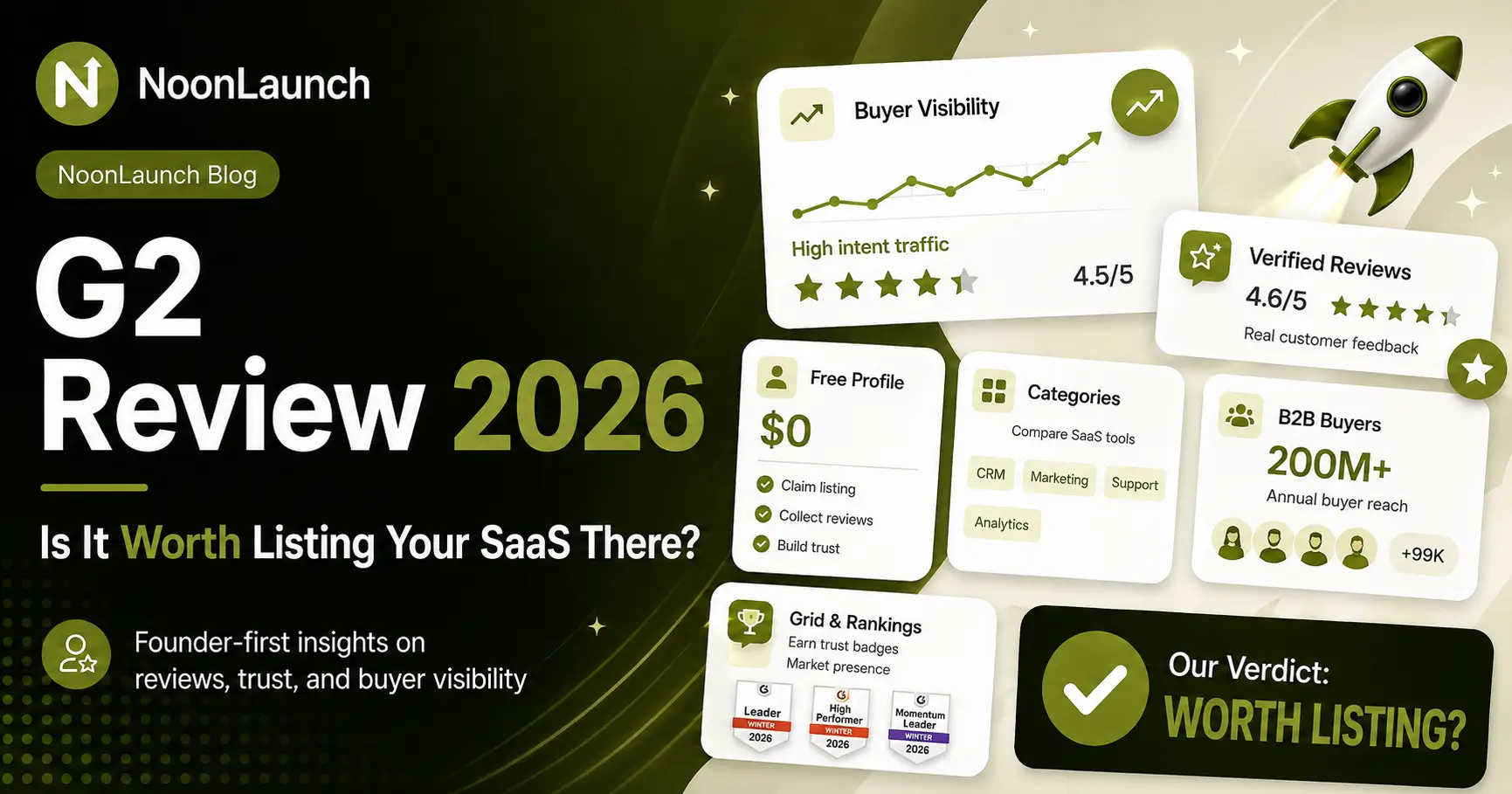
G2 is one of the largest B2B software review and discovery marketplaces. It is not a launch-day platform like Product Hunt, Uneed, Microlaunch, or NoonLaunch. Instead, G2 helps software companies create a persistent product profile, collect verified customer reviews, appear in software categories and comparisons, build social proof, and get discovered while buyers evaluate tools.
In 2026, companies can claim a basic G2 profile for free. G2's Starter plan is currently $299 per month or $2,999 for the first year, while Professional and Enterprise pricing requires contacting sales.
Our verdict: most serious B2B SaaS companies should claim the free G2 profile once they have real users. Early-stage founders do not need to pay immediately. Build an accurate profile and genuine reviews first, then consider paid G2 when buyer traffic and review volume justify it.
What Is G2?
G2 is a B2B software marketplace where buyers discover, compare, and review software and services.
G2 says its ecosystem serves more than 200 million annual buyers and includes more than 200,000 products and services across 2,000+ categories. The company also reported surpassing 3 million reviews.
Unlike a traditional startup directory, G2 is structured around software evaluation. Product pages can include descriptions, features, pricing, screenshots, integrations, categories, competitor comparisons, and customer reviews.
That makes G2 especially relevant after your SaaS has customers who can genuinely review it.
How Does Getting Listed on G2 Work?
If your product is not already on G2, you can request a new profile. G2 says its research team generally verifies new submissions within three to five business days and places products in an appropriate category.
After the profile exists, your company can claim it. G2 says claim requests are normally reviewed within another one to three business days.
A free profile lets you manage core product information and collect reviews. Profiles can contain your logo, description, categories, supported languages, features, screenshots, pricing, and other information buyers need when comparing products.
This is different from launching a startup. G2 is designed to become an ongoing buyer-evaluation asset.
What Do You Actually Get From G2?
The biggest value of G2 is third-party validation.
First, you get a public product profile where prospects can research your software outside your own website.
Second, you can collect customer reviews. G2 uses reviewer authentication, moderation, conflict-of-interest checks, and labels for validated, current-user, and incentivized reviews.
Third, you gain comparison visibility. Buyers use G2 while deciding between competing products, which can help your brand enter a shortlist.
Fourth, reviews become social proof. Eligible companies can also earn G2 badges that can support landing pages, sales materials, and campaigns.
Fifth, established products can qualify for G2 Grid reports. G2 says products generally need at least 10 approved recent reviews to appear on a category Grid.
Finally, your profile creates another structured source connecting your brand with its category, features, pricing, competitors, and customer sentiment.
Who Should List Their Product on G2?
G2 is strongest for B2B software companies with real customers.
SaaS products, AI software, developer tools, CRM platforms, marketing software, HR tools, finance products, analytics software, cybersecurity tools, and collaboration platforms are strong candidates.
G2 becomes especially useful when prospects already compare you with alternatives or ask for independent customer reviews.
It is less urgent for a pre-launch startup with zero users. You cannot build meaningful customer proof before customers exist.
At that stage, prioritize distribution and early users first. NoonLaunch's guide on how to launch your product and get your first 100 users is a better starting point.
Once customers start using the product successfully, add G2 to your credibility and review strategy.
How Do G2 Reviews Work?
G2's review process is a major reason founders use the platform for credibility.
G2 says published reviews go through moderation. Reviewers must authenticate themselves, and screenshots can be used to validate that someone is a current user.
Incentivized reviews are allowed, but they are labeled as incentivized. G2's community guidelines cap incentives at $100 and state that rewards cannot depend on whether the review is positive or negative.
Vendors cannot simply edit or remove customer reviews from their profile.
That creates a useful trade-off. Positive reviews provide credible social proof, while criticism gives prospects a more realistic picture of the product.
G2 Pricing in 2026
G2 currently offers Free, Starter, Professional, and Enterprise seller plans.
Plan | Current price | Best for |
|---|---|---|
Free | $0 | Startups building their first G2 presence |
Starter | $299/month or $2,999 first year | Small businesses investing in G2 |
Professional | Contact sales | Teams needing deeper review and visitor insights |
Enterprise | Contact sales | Larger companies managing multiple products |
The Free plan includes a basic profile, standard seller page, basic review collection, three profile users, and access to the Users Love Us badge when eligibility requirements are met.
Starter adds custom CTAs, an upgraded profile, branded campaigns, review credits, and broader badge licensing.
G2 currently states that Starter's annual first-year price is $2,999, while year-two pricing increases to $599 per month or $6,000 per year.
Is G2 Worth Paying For?
For many early-stage startups, not yet.
The free profile already lets you establish a presence and collect reviews. That is where most young SaaS companies should begin.
Paid G2 makes more sense when you have enough customers, review volume, and category demand for G2 to influence active buying decisions.
If your sales team can convert high-intent evaluation traffic, custom CTAs, upgraded profiles, visitor data, and buyer intent can justify the investment.
If you only have a handful of customers, spending thousands of dollars is harder to justify.
Build the proof first. Pay for amplification later.
Is G2 Good for SEO and AI Search Visibility?
G2 can support search visibility because its product pages create structured third-party information about software brands.
However, do not treat G2 primarily as a backlink purchase. G2 does not market its free profile as a guaranteed dofollow backlink product, and link attributes can change.
The stronger value is branded search visibility, category association, comparison pages, customer-generated content, and broader entity presence.
The AI-search angle is increasingly relevant too. G2 says it is widely cited across AI-first B2B software discovery, while its 2026 buyer research reports that eight out of ten software buyers use AI search during buying.
That does not guarantee AI recommendations, but accurate product information and genuine reviews on major marketplaces can strengthen your brand's online evidence.
G2 Pros and Cons
Pros:
Free product profile
Large B2B buyer audience
Verified customer reviews
Strong social proof
Category and competitor comparisons
Grid eligibility as review volume grows
Useful for buyer evaluation and branded discovery
Relevant third-party data for AI-era research
Cons:
Not a launch-day traffic platform
Needs real customers to become valuable
Paid plans are expensive for bootstrapped startups
Starter renewal pricing increases
Negative reviews are public
Advanced intent and analytics require paid plans
A listing does not guarantee leads or rankings
G2 vs Product Hunt vs NoonLaunch
G2, Product Hunt, and NoonLaunch solve different parts of startup distribution.
Product Hunt is strongest around launch-day awareness and maker-community discovery.
G2 is strongest later, when prospects compare software, read reviews, evaluate alternatives, and look for customer proof.
NoonLaunch sits closer to launch and discovery. Founders can launch for free, while the current $11 Premium Launch includes featured placement, permanent directory visibility, homepage exposure, newsletter mention, and a dofollow backlink.
The best approach is sequential.
Launch through relevant platforms, acquire real users, ask satisfied customers for honest reviews, and then strengthen G2 as evaluation becomes more important.
G2 Review 2026: Final Verdict
G2 is worth using in 2026 for B2B SaaS companies that have real customers and want stronger buyer trust, customer reviews, comparison visibility, and long-term software discovery.
Claim the free profile first. Complete every relevant product field. Make sure your category is accurate. Then create a steady process for asking real customers to leave honest reviews.
Do not pay thousands simply because G2 is a large marketplace. Upgrade when your category has meaningful buyer activity and you can connect the additional visibility or intent features to revenue.
Most importantly, understand where G2 belongs in your go-to-market sequence.
G2 is mainly an evaluation and trust channel. Launch platforms serve an earlier job by putting new products in front of founders, early adopters, and potential users.
Use both stages. If you want to get independent software review there's new player in the category, you can get independent software review from VegaReview as well.
Launch through relevant communities and platforms, build your first customer base, collect proof, and then establish review-site credibility.
When you are ready to start that launch process, submit your product to NoonLaunch and add another permanent discovery surface to your launch stack.