Peerlist Review 2026: Should Founders Launch Products on Peerlist?
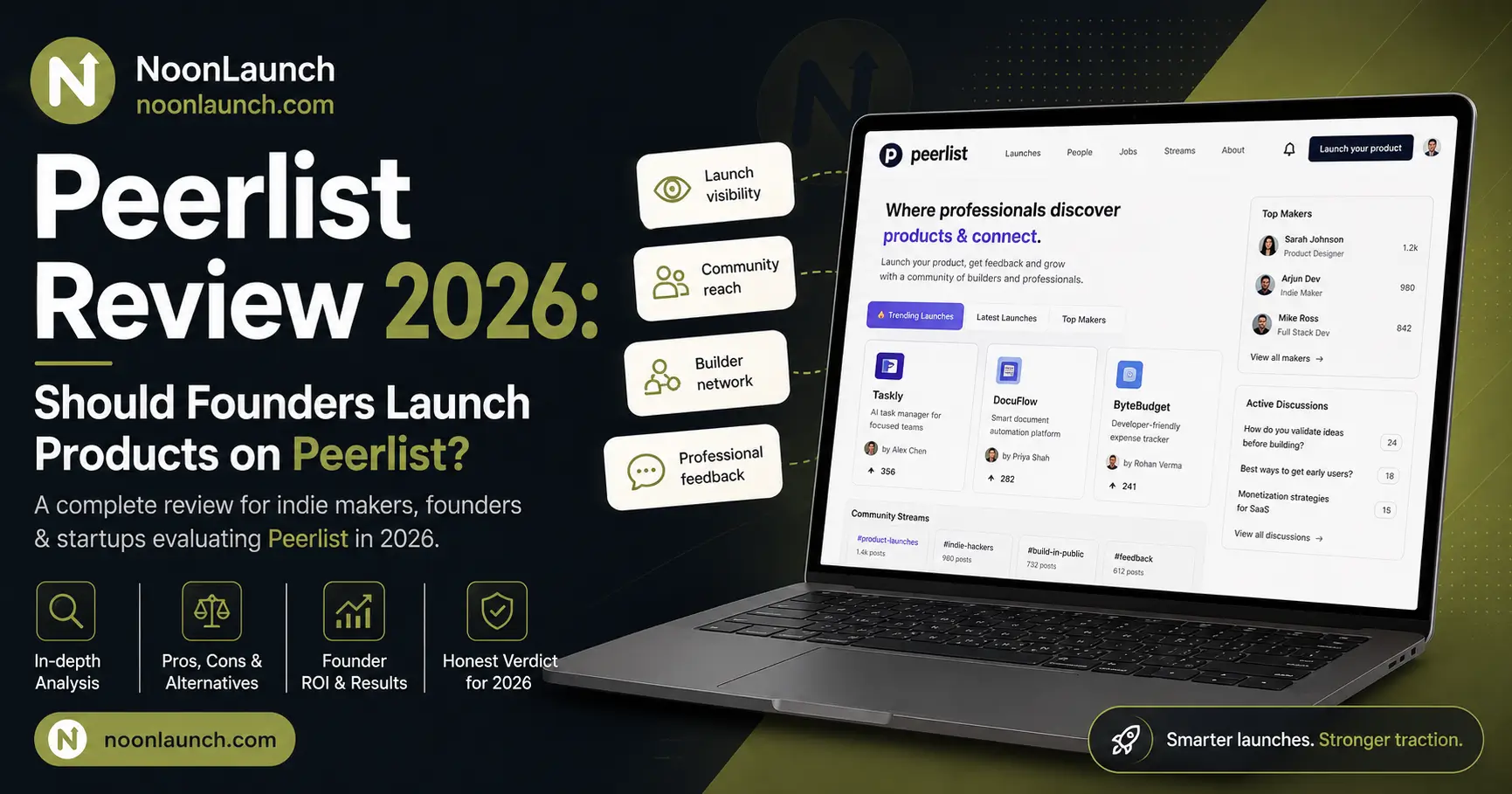
If you're a startup founder planning to launch a SaaS, AI tool, developer product, or startup in 2026, Peerlist deserves a place in your go-to-market (GTM) strategy.
While Product Hunt remains the most recognized launch platform, Peerlist has quietly become one of the fastest-growing communities for builders, developers, designers, and early adopters. It offers a focused audience, high-quality product discovery, and long-term visibility that can complement your launch efforts.
However, don't expect Peerlist alone to generate thousands of users overnight. Its real value lies in reaching the right audience, building credibility, earning backlinks, and becoming part of a broader launch and distribution strategy.
In this review, we'll explore how Peerlist works, who should launch there, how it compares with Product Hunt, and whether it's worth adding to your startup launch checklist in 2026.
What Is Peerlist?
Peerlist is a professional community built for people who create technology products.
Unlike traditional professional networking platforms, Peerlist focuses on builders rather than job titles. It allows users to showcase their work, discover products, explore jobs, connect with other professionals, and share launches with a community that is actively interested in technology.
Today, the platform attracts:
Startup founders
Indie hackers
Software engineers
Product managers
Designers
AI builders
Developer tool creators
Technical recruiters
For founders, this means your product is more likely to be seen by people who understand technology and are willing to try new tools.
Why Peerlist Matters for Product Launches in 2026
Over the past few years, startup distribution has changed significantly.
Founders no longer rely on a single launch platform. Instead, successful launches combine multiple channels, including:
Product Hunt
Peerlist
Hacker News
Reddit
X (formerly Twitter)
LinkedIn
Founder communities
Newsletters
Developer communities
Rather than replacing these platforms, Peerlist has become another important touchpoint for reaching early adopters.
Its community is smaller than Product Hunt, but it's also more focused. Instead of competing with hundreds of unrelated consumer apps every day, founders can present their products to an audience that genuinely enjoys exploring new technology.
How Does Product Launching Work on Peerlist?
Launching on Peerlist is straightforward.
You create a product page, add screenshots, describe your product, explain the problem it solves, and publish it for the community to discover.
A strong launch typically includes:
A compelling product description
High-quality screenshots
Demo videos
Product categories
Website links
Founder information
Clear value proposition
Once published, your launch becomes discoverable through Peerlist's community and product discovery sections.
Like most launch platforms, the quality of your listing directly influences engagement.
Who Should Launch on Peerlist?
Peerlist isn't designed for every business.
It performs best for products aimed at technical or digital audiences.
Examples include:
AI tools
SaaS platforms
Developer tools
APIs
Productivity software
Design tools
Open-source products
No-code platforms
Startup software
Chrome extensions
Technical communities
If your ideal customer spends time building software or exploring new technology, Peerlist is likely worth considering.
For products targeting local services or traditional offline businesses, other marketing channels may deliver better results.
What Kind of Audience Does Peerlist Attract?
One of Peerlist's biggest strengths is audience quality.
Unlike platforms where users browse casually, many Peerlist members are actively looking for:
New software
Productivity tools
AI applications
Developer utilities
Startup products
Open-source projects
Design resources
This makes the platform particularly attractive for founders launching products for other startups, developers, or technology teams.
While the audience size is smaller than mainstream social platforms, it is often more relevant.
For many founders, reaching 500 highly qualified users is more valuable than reaching 50,000 people with little interest in their product.
Can Peerlist Drive Traffic?
This is one of the most common questions founders ask.
The answer is yes but expectations matter.
Peerlist should not be viewed as a standalone traffic source capable of generating massive volumes of visitors overnight.
Instead, it works best as part of a broader launch strategy.
A successful product launch often combines:
Peerlist
Product Hunt
X posts
LinkedIn content
Founder newsletters
Reddit discussions
Community engagement
Email campaigns
When used together, these channels reinforce one another and increase your chances of sustained visibility.
Peerlist contributes by helping your product reach a relevant audience that is already interested in discovering new tools.
Can Peerlist Help with SEO?
Many founders overlook the long-term SEO value of launch platforms.
Although immediate traffic often receives the most attention, visibility in search engines can continue long after launch day.
A well-optimized product listing can:
Increase your brand's online presence
Create additional indexed pages
Earn referral traffic
Generate branded searches
Support your overall digital footprint
While Peerlist should not be treated as an SEO strategy on its own, it can strengthen your online visibility when combined with content marketing, PR, and other distribution efforts.
Peerlist vs Product Hunt: Which Platform Is Better for Startup Launches?
One of the biggest questions founders ask is whether they should launch on Peerlist or Product Hunt.
The better question is: Why choose only one?
Although both platforms help users discover new products, they serve slightly different purposes and attract different communities.
Feature | Peerlist | Product Hunt |
|---|---|---|
Primary Audience | Developers, designers, founders | Broad startup and tech audience |
Product Discovery | Curated and community-driven | High-volume daily launches |
Competition | Lower | Very high |
Community | Builder-focused | Startup ecosystem |
Product Categories | Tech-first | Broad technology products |
Launch Frequency | Lower volume | Hundreds of launches daily |
Long-term Visibility | Good | Good, but highly competitive |
Best For | Early-stage SaaS, AI tools, developer products | Public product launches and broad exposure |
Product Hunt remains the largest launch platform, but it has also become increasingly competitive. On many days, hundreds of products launch simultaneously, making it difficult for early-stage startups to stand out.
Peerlist offers a different experience. With fewer launches competing for attention, founders often have a better opportunity to reach an engaged audience interested in exploring new technology.
For most startups, the smartest strategy is to launch on both platforms rather than treating them as alternatives.
Pros of Launching on Peerlist
Every launch platform has strengths. Here are the areas where Peerlist performs particularly well.
1. Highly Relevant Audience
One of Peerlist's biggest advantages is audience quality.
Most visitors are builders themselves.
Instead of attracting casual browsers, the platform brings together developers, designers, product managers, startup founders, and early adopters who actively explore new tools.
If your product targets technical users, this audience is highly relevant.
2. Less Competition Than Product Hunt
Standing out is easier when fewer products launch each day.
While Product Hunt can feature hundreds of launches in a short period, Peerlist generally has lower launch volume.
This gives your product more opportunity to remain visible.
3. Better Long-Term Discoverability
Unlike social media posts that disappear within hours, your product listing remains available for future visitors.
People searching for products within Peerlist can continue discovering your startup long after launch day.
This creates ongoing exposure rather than a single-day marketing event.
4. Strong Community of Builders
Peerlist attracts people who enjoy trying new software.
Many users are founders themselves, making the platform valuable for:
Networking
Product feedback
Partnerships
Hiring
Community building
Early conversations with other builders often become just as valuable as traffic.
5. Complements Your GTM Strategy
Launching on Peerlist should not replace your existing marketing channels.
Instead, it strengthens them.
A successful launch usually combines multiple distribution channels that work together.
Peerlist fits naturally into this ecosystem.
Limitations of Peerlist
No platform is perfect, and founders should set realistic expectations.
Smaller Audience Than Product Hunt
Peerlist's community is growing, but it is still smaller than Product Hunt.
If your goal is maximum launch-day exposure, Product Hunt generally reaches a larger audience.
Not a Growth Engine by Itself
Launching on Peerlist will not automatically generate thousands of users.
Founders sometimes expect launch platforms to solve distribution.
In reality, they amplify a good launch, they don't replace one.
Without marketing before and after launch, results are usually limited.
Best for Technology Products
Peerlist performs best for products aimed at developers, startups, designers, AI professionals, and technical teams.
If your business serves local consumers, traditional retail, or non-technical industries, other marketing channels may produce stronger results.
How to Prepare Before Launching on Peerlist
The difference between a successful launch and an average one is usually preparation.
Here are several best practices to follow before publishing your product.
Build a Clear Landing Page
Visitors should immediately understand:
What your product does
Who it's for
Why it matters
How to get started
Avoid vague marketing language.
Focus on solving a specific problem.
Create High-Quality Screenshots
Good visuals dramatically improve engagement.
Show real product interfaces instead of promotional graphics whenever possible.
Help visitors imagine themselves using your product.
Record a Short Demo Video
Many founders underestimate the power of a simple demo.
A 60–90 second walkthrough explaining:
the problem,
the solution,
and the product experience
can significantly increase conversions.
Write a Strong Product Description
Your description should answer three questions immediately:
What is the product?
Who is it for?
Why should someone care?
Keep it concise and focused on outcomes rather than features alone.
Prepare for Feedback
Launch day isn't only about acquiring users.
It's also an opportunity to learn.
Pay attention to:
Feature requests
Bug reports
Questions
Objections
Common misunderstandings
These insights often shape your next product iteration.
Common Mistakes Founders Make
Many launches underperform because founders treat launch day as the finish line.
Instead, it should be viewed as the beginning of your distribution efforts.
Some common mistakes include:
Launching without an audience
Publishing poor screenshots
Writing generic product descriptions
Ignoring comments and feedback
Failing to promote the launch outside the platform
Expecting viral growth from a single listing
The most successful founders continue promoting their product long after launch day.
Should Peerlist Be Part of Your Go-to-Market Strategy?
Yes but not as your only distribution channel.
A modern GTM strategy relies on multiple touchpoints working together.
A typical launch stack might include:
Peerlist
Product Hunt
LinkedIn
X
Reddit
Hacker News
Email newsletters
Founder communities
Content marketing
SEO
Each platform reaches a different audience and reinforces the others.
Peerlist contributes by helping founders reach a community that actively explores new technology and values well-built products.
Ready to Launch Your Product?
Peerlist is an excellent platform for reaching developers, designers, and early adopters, but the most successful founders don't rely on a single launch platform. They distribute their products across multiple communities to maximize visibility, collect feedback, improve SEO, and acquire their first customers.
If you're planning your next launch, consider adding NoonLaunch to your launch strategy. Like Peerlist, it helps founders showcase new products, connect with an audience actively looking for innovative startups, and build early traction. Launching on multiple product discovery platforms gives your startup more opportunities to be discovered and creates a stronger distribution engine from day one.
Before you hit "Launch," make sure your checklist includes Peerlist, Product Hunt, Hacker News, LinkedIn, X, and NoonLaunch. Consistent distribution across relevant platforms often has a much bigger impact than relying on a single launch day for growth.