Product Hunt Review 2026: Is It Worth It Today?
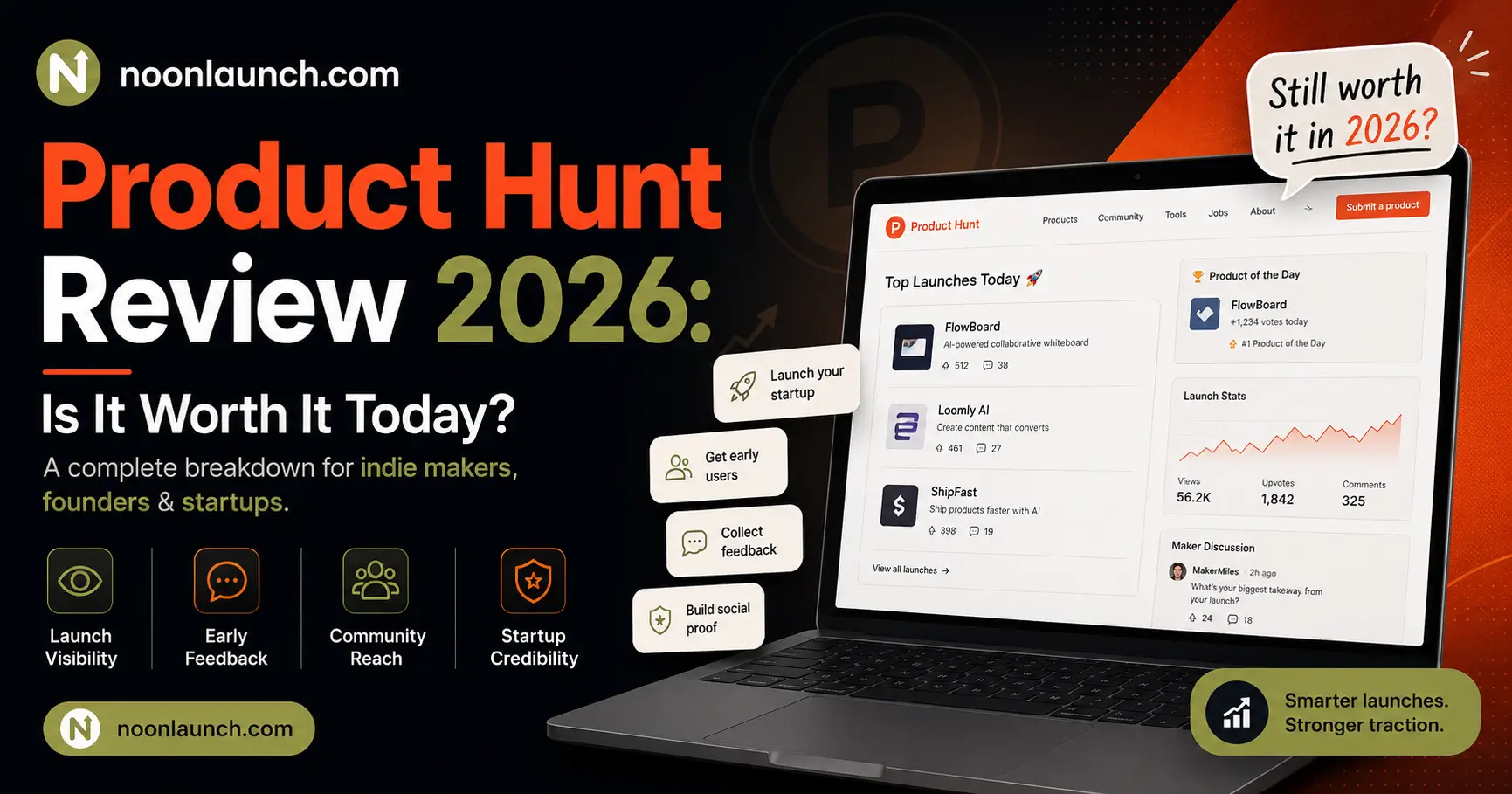
If you're looking for an honest Product Hunt Review 2026, you're probably asking one important question:
Is Product Hunt still worth launching on in 2026?
For more than a decade, Product Hunt has been one of the most popular platforms for discovering new software products. Thousands of startups, SaaS companies, AI tools, mobile apps, and developer products have launched there to gain visibility, attract early adopters, and receive valuable community feedback.
However, launching a product today is very different from what it was a few years ago. Founders now have access to more launch platforms, founder communities, newsletters, and social channels than ever before. Simply publishing your product is no longer enough to generate attention.
That raises an important question.
Can Product Hunt still drive meaningful traffic, users, and growth, or has it become just another startup directory?
The answer isn't a simple yes or no.
Product Hunt continues to be one of the most influential launch platforms for technology products, but success depends on your product category, launch strategy, community engagement, and what you expect from your launch.
In this comprehensive Product Hunt review, you'll learn:
What Product Hunt is and how it works
Who should launch on Product Hunt
Whether it's worth using in 2026
Its biggest strengths and limitations
How startups use Product Hunt to generate awareness and early users
By the end of this guide, you'll know whether Product Hunt deserves a place in your startup's go-to-market strategy.
TL;DR
If you're short on time, here's the quick answer.
Product Hunt remains one of the leading startup launch platforms in 2026.
It works best for SaaS products, AI tools, developer tools, mobile apps, and productivity software.
A successful launch can generate visibility, referral traffic, user feedback, and early adopters.
Ranking highly requires preparation, community engagement, and a coordinated launch strategy.
Product Hunt works best when combined with SEO, content marketing, social media, newsletters, and other distribution channels rather than being your only growth strategy.
Best for:
SaaS startups
AI startups
Developer tools
Browser extensions
Productivity software
Mobile applications
Less suitable for:
Local businesses
Traditional eCommerce stores
Offline services
Businesses targeting only non-technical audiences
What Is Product Hunt?
Product Hunt is a community-driven product discovery platform where founders launch new products for the public to discover, discuss, and support.
Every day, startups submit their latest software, AI applications, developer tools, browser extensions, mobile apps, and other technology products. Members of the community can explore these launches, upvote their favorites, leave comments, ask questions, and share feedback directly with founders.
Unlike a traditional business directory, Product Hunt focuses on newly launched products. The platform encourages discovery by showcasing fresh launches every day, making it easier for early adopters to find innovative software before it reaches the mainstream.
For founders, Product Hunt serves as a launch platform that helps introduce products to an audience already interested in testing new technology. For users, it acts as a curated discovery platform where they can explore trending products across different categories.
Today, Product Hunt is widely used by startup founders, independent makers, developers, marketers, investors, and technology enthusiasts looking to discover the next generation of software products.
Product Hunt Definition
Product Hunt is a product discovery platform where startups and makers launch new digital products to reach early adopters, collect user feedback, build visibility, and engage with a global technology community.
Unlike app stores or startup directories, Product Hunt emphasizes community interaction. Users don't just browse products—they vote, comment, ask questions, and help shape early discussions around new launches.
This combination of product discovery and community engagement has made Product Hunt one of the most recognized startup launch platforms in the world.
What Products Can You Launch on Product Hunt?
Product Hunt primarily focuses on digital products. While almost any technology product can be submitted, certain categories consistently perform better because they match the interests of the Product Hunt community.
Product Type | Why It Performs Well |
|---|---|
SaaS Products | The most common launch category with strong founder interest |
AI Tools | High demand and active community engagement |
Developer Tools | Popular among engineers and technical users |
Browser Extensions | Easy to understand and try immediately |
Mobile Apps | Frequently discovered by early adopters |
Productivity Software | Solves everyday problems for professionals |
Design Tools | Appeals to designers and creators |
Marketing Tools | Attracts marketers, agencies, and growth teams |
If your product solves a real problem for technology users, professionals, or businesses, Product Hunt can be an effective platform for introducing it to an engaged audience.
However, simply launching your product doesn't guarantee success. The quality of your product, your launch preparation, and your ability to engage with the community all play an important role in determining how much visibility your launch receives.
Who Should Use Product Hunt?
Product Hunt is designed for founders building digital products that solve real problems. If your target audience includes early adopters, developers, startup founders, marketers, or technology enthusiasts, Product Hunt can be an effective launch platform.
While many startups associate Product Hunt with SaaS products, the platform supports a wide range of software categories.
SaaS Startups
Software-as-a-Service companies are among the most active users of Product Hunt. Whether you're launching a CRM, project management platform, analytics tool, or workflow automation software, Product Hunt provides an opportunity to showcase your product to an audience actively looking for new business software.
Many SaaS founders use their Product Hunt launch to validate product-market fit, gather user feedback, and attract their first paying customers.
AI Startups
Artificial intelligence continues to dominate Product Hunt. AI writing assistants, coding copilots, design tools, automation platforms, customer support agents, and productivity tools frequently receive strong engagement from the community.
If your AI product solves a practical problem and offers a compelling user experience, Product Hunt can help generate awareness among early adopters who enjoy testing emerging technology.
Developer Tools
Developer-focused products have always been a strong fit for Product Hunt.
APIs, SDKs, cloud platforms, DevOps tools, open-source projects, testing platforms, and engineering utilities often receive quality feedback because many Product Hunt users come from technical backgrounds.
For developer-first companies, the platform provides an opportunity to reach users who understand the technical value of their product.
Mobile Applications
Product Hunt is also a popular launch destination for iOS and Android applications.
Productivity apps, finance apps, education platforms, health applications, and consumer utilities often gain visibility when they offer a unique experience or solve a common problem.
A successful launch can drive downloads, reviews, and valuable feedback during the early stages of growth.
Indie Makers
Independent developers and solo founders frequently use Product Hunt to validate new ideas before investing heavily in marketing.
Whether you're building a micro SaaS, browser extension, no-code tool, or side project, Product Hunt offers access to a community that enjoys discovering innovative products from independent creators.
Who Should Not Launch on Product Hunt?
Although Product Hunt is one of the largest startup launch communities, it isn't the right platform for every business.
You may see limited results if your business falls into one of these categories:
Local service businesses
Traditional retail or eCommerce stores
Restaurants and hospitality businesses
Offline service providers
Products targeting only non-technical audiences
Companies expecting immediate sales from a one-day launch
Product Hunt is built around discovering digital products. Businesses that rely primarily on local customers or traditional sales channels often achieve better results through local SEO, paid advertising, or industry-specific marketplaces.
Launching on Product Hunt should align with your audience—not simply because it's a well-known platform.
Is Product Hunt Worth It in 2026?
For most technology startups, the answer is yes.
Despite increased competition from founder communities, launch directories, newsletters, and social platforms, Product Hunt continues to attract founders, investors, developers, journalists, and early adopters looking for innovative products.
Its biggest advantage is visibility.
A successful launch can introduce your product to thousands of potential users within a single day while creating conversations that continue long after launch day.
However, expectations should remain realistic.
Launching on Product Hunt is unlikely to generate long-term growth on its own. Most successful startups combine their Product Hunt launch with SEO, content marketing, social media, email campaigns, influencer outreach, and community building.
Think of Product Hunt as a launch accelerator rather than a complete marketing strategy.
Founders commonly use Product Hunt to:
Introduce a new product to the market
Generate launch-day awareness
Collect customer feedback
Validate product-market fit
Build credibility and social proof
Drive referral traffic
Acquire early users
Improve future marketing campaigns through user insights
When supported by a broader go-to-market strategy, Product Hunt can become a valuable source of exposure and validation.
Top Benefits of Launching on Product Hunt
Every startup has different goals, but most founders launch on Product Hunt for similar reasons.
Increase Product Visibility
Product Hunt places your product in front of a community actively searching for new software. Unlike traditional advertising, users visit Product Hunt because they want to discover new products.
Reach Early Adopters
Early adopters play an important role in refining new products.
They are often willing to test new features, report bugs, suggest improvements, and become your first advocates if they enjoy the experience.
Collect Valuable Product Feedback
One of the biggest advantages of Product Hunt is direct interaction with users.
Comments often highlight usability issues, missing features, onboarding improvements, pricing concerns, and opportunities you may have overlooked before launch.
Build Brand Awareness
Even if your product doesn't finish at the top of the leaderboard, launching on Product Hunt increases your visibility within the startup ecosystem.
Founders frequently share their launches across LinkedIn, X, newsletters, Slack communities, and founder groups, extending the reach beyond Product Hunt itself.
Validate Market Interest
A successful launch provides valuable signals about how your target audience responds to your messaging, positioning, and product value proposition.
These insights can help shape future marketing campaigns and product development.
Why Is Product Hunt So Popular Among Startups?
Product Hunt has remained relevant because it offers more than product listings.
It combines discovery, community, and feedback into a single platform.
Several factors contribute to its continued popularity.
A large community of founders, developers, and early adopters
Daily exposure for newly launched products
Direct conversations between founders and users
Opportunities to receive valuable product feedback
Visibility among investors, journalists, and technology professionals
Strong reputation within the startup ecosystem
For many founders, launching on Product Hunt represents an important milestone. It provides an opportunity to introduce months of work to a community that appreciates new technology and actively supports product innovation.
Key Features That Make Product Hunt Popular
Product Hunt has remained one of the most trusted startup launch platforms because it offers more than a place to publish your product. Its community-driven approach helps founders receive visibility, feedback, and engagement throughout their launch.
Here are the features that make Product Hunt valuable for startups.
Daily Product Rankings
Every day, newly launched products compete for visibility on Product Hunt's homepage. Products receiving strong community engagement have a better chance of appearing higher in the daily rankings, exposing them to more users.
Community Upvotes
Registered users can upvote products they find useful or interesting. While upvotes influence rankings, meaningful engagement and community participation are equally important.
Comments and Discussions
One of Product Hunt's biggest strengths is direct interaction between founders and users. Founders can answer questions, collect feature requests, explain product decisions, and build relationships with potential customers.
Product Collections
Users can save products into collections based on different interests, making it easier for launches to receive continued visibility even after launch day.
Categories and Topics
Products are organized into categories such as AI, SaaS, Developer Tools, Productivity, Design, Marketing, Finance, and Education. This helps users discover products relevant to their interests while helping founders reach the right audience.
Featured Products
Exceptional launches may receive additional exposure through Product Hunt's homepage, newsletters, and curated collections. Although editorial selection isn't guaranteed, strong launches have more opportunities to gain extra visibility.
How Does Product Hunt Work?
Launching on Product Hunt is relatively simple, but achieving good results requires preparation and active participation.
Step 1: Create Your Product Listing
Before launch day, founders prepare their product page with a product name, tagline, description, logo, screenshots, videos, website link, and supporting assets. A clear value proposition helps visitors quickly understand what your product does.
Step 2: Publish on Launch Day
Once your product goes live, it becomes visible to the Product Hunt community. Visitors can explore your listing, upvote it, leave comments, and visit your website.
The first few hours often generate the highest level of engagement, making launch-day preparation important.
Step 3: Engage With the Community
Launching isn't a passive activity.
Successful founders actively reply to comments, answer questions, thank supporters, and participate in discussions throughout the day. Community engagement often has a greater impact than simply collecting upvotes.
Step 4: Continue Marketing After Launch
A Product Hunt launch should mark the beginning of your marketing efforts—not the end.
Share your launch across LinkedIn, X, newsletters, communities, and email campaigns. Continue publishing content, collecting feedback, and improving your product after launch.
Can Product Hunt Drive Traffic, Users, and Signups?
Yes—but results vary significantly from one product to another.
A well-prepared launch can generate referral traffic, newsletter subscribers, product signups, demo requests, and valuable customer conversations. Products that solve clear problems and communicate their value effectively often perform better than those relying solely on launch-day excitement.
However, founders should set realistic expectations.
Product Hunt is unlikely to become your largest acquisition channel. Instead, think of it as an opportunity to generate awareness and reach an audience already interested in discovering new products.
The quality of your launch depends on factors such as:
Product quality
Clear positioning
Attractive product page
Active community engagement
Existing audience support
Social promotion
Follow-up marketing
Many successful startups combine Product Hunt with SEO, content marketing, email outreach, partnerships, and social media to maximize long-term growth.
Does Product Hunt Help SEO and Backlinks?
Many founders wonder whether launching on Product Hunt improves SEO.
The answer is partially.
Product Hunt can generate referral traffic, brand awareness, and online mentions, all of which contribute to your overall digital presence. People may discover your product, reference it in blog posts, share it on social media, or mention it in newsletters.
However, Product Hunt should not be viewed as a backlink-building strategy alone.
The real SEO value comes from increased visibility, branded searches, media coverage, and additional opportunities to earn natural backlinks from other websites.
Launching solely for SEO is unlikely to deliver meaningful long-term results. Launch because you want users, feedback, exposure, and validation—not just links.
Pros and Cons
Pros | Cons |
|---|---|
Large startup community | High competition every day |
Excellent product visibility | Launch-day success isn't guaranteed |
Access to early adopters | Results vary by product category |
Valuable customer feedback | Requires significant preparation |
Strong brand awareness | Traffic may decline after launch |
Helps validate product-market fit | Not ideal for every business |
Product Hunt vs Hacker News
Feature | Product Hunt | Hacker News |
|---|---|---|
Primary Purpose | Product launches | Technical discussions and startup news |
Audience | Founders, makers, marketers | Developers, engineers, investors |
Best For | SaaS, AI tools, apps | Developer tools, open-source projects |
Community Interaction | Upvotes and comments | Discussion-first |
Product Discovery | Excellent | Moderate |
Technical Audience | Medium | Very High |
Both platforms can complement each other. Many startups launch on Product Hunt while also sharing their product through Hacker News to reach a broader audience.
Product Hunt vs Indie Hackers
Feature | Product Hunt | Indie Hackers |
|---|---|---|
Primary Focus | Product discovery | Founder community |
Best For | Launching products | Sharing startup journeys |
User Feedback | High | High |
Networking | Moderate | Excellent |
Long-Term Discussions | Limited | Strong |
Community Building | Moderate | Excellent |
Product Hunt is ideal for launch-day visibility, while Indie Hackers helps founders build relationships, share progress, and participate in ongoing discussions.
Best Practices for a Successful Product Hunt Launch
A successful Product Hunt launch begins long before launch day.
Follow these best practices to improve your chances of success:
Prepare your product page in advance.
Write a clear and compelling tagline.
Use high-quality screenshots and videos.
Explain your product's value in simple language.
Respond to every comment during launch.
Share your launch through email and social media.
Encourage genuine community participation.
Continue promoting your product after launch.
Collect feedback and improve your product.
Measure traffic, signups, and user engagement after launch.
Common Mistakes Founders Make
Many launches underperform because founders overlook basic launch preparation.
Common mistakes include:
Launching before the product is ready.
Writing unclear product descriptions.
Ignoring comments from the community.
Depending only on Product Hunt for traffic.
Asking for artificial upvotes.
Failing to promote the launch externally.
Neglecting follow-up marketing.
Expecting immediate revenue from launch day alone.
Avoiding these mistakes significantly improves your chances of building momentum after launch.
Is Product Hunt Still Active?
Yes.
Product Hunt remains one of the most active product discovery platforms for startups in 2026.
New AI tools, SaaS platforms, developer products, browser extensions, and productivity applications continue to launch every day. Founders still use the platform to introduce products, collect feedback, and connect with early adopters.
While competition has increased, Product Hunt continues to play an important role in many successful startup launch strategies.
Wrap-up
So, is Product Hunt worth it in 2026?
For most SaaS companies, AI startups, developer tools, and digital products, the answer is yes.
Product Hunt remains an excellent platform for generating launch-day awareness, collecting valuable feedback, and introducing your product to an engaged technology community. However, it shouldn't be your only growth channel.
The most successful founders combine Product Hunt with SEO, content marketing, social media, email marketing, founder communities, and additional launch platforms to maximize visibility.
If you're planning a product launch, consider publishing on Product Hunt alongside platforms like NoonLaunch. Launching across multiple platforms helps increase product discoverability, reach different audiences, build brand awareness, and diversify your distribution strategy. It also gives your startup additional exposure and an opportunity to earn a high-quality backlink as part of your long-term SEO efforts.