SaaSHub Review 2026: Is It Worth Listing Your SaaS There?
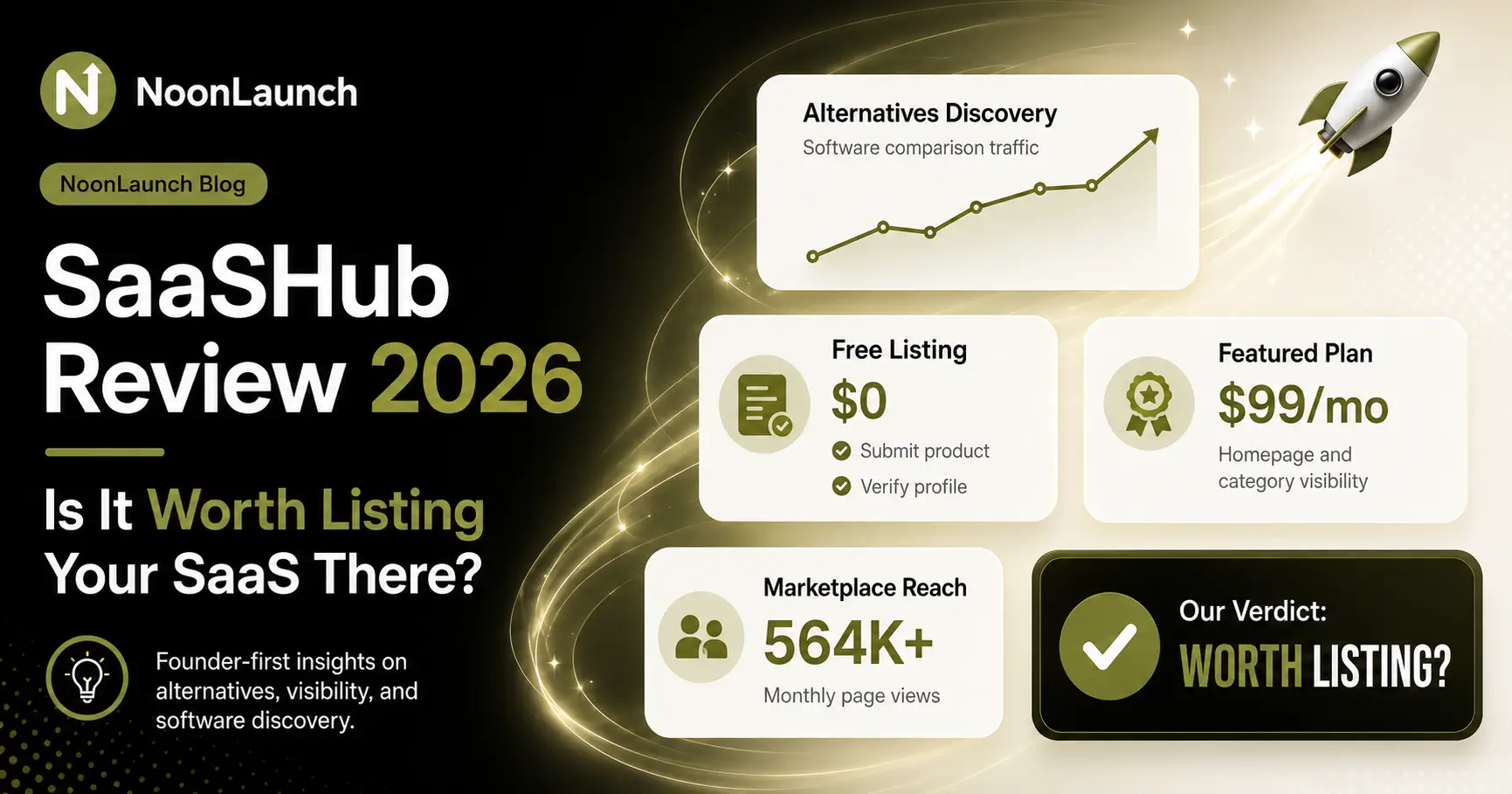
SaaSHub is an independent software marketplace that helps buyers discover software, compare alternatives, read reviews, and find products by category. For founders, it offers a free product submission and verification process, plus paid featured promotion for companies that want more visibility.
In 2026, SaaSHub's featured listing costs $99 per month and can be cancelled at any time. Featured products can appear on the homepage, alternative pages, category pages, comparison pages, and SaaSHub's newsletter. SaaSHub reports 564,000+ monthly page views and estimates 11 to 20 targeted referrals per month, without guaranteeing results.
Our verdict: SaaSHub is worth listing on if you run a SaaS product, AI tool, developer product, mobile app, or other released software. Start with the free listing and verify it. Consider the $99 featured plan only when referral traffic from software buyers is valuable enough to justify the monthly spend.
What Is SaaSHub?
SaaSHub is an independent software discovery marketplace operating since 2014.
Its main purpose is to help users find software alternatives while helping vendors improve their online presence. Instead of a launch-day leaderboard, SaaSHub organizes products around categories, alternatives, comparisons, reviews, votes, and software discovery signals.
This makes SaaSHub especially relevant when someone searches for an alternative to a product they already know.
How Do You Submit a Product to SaaSHub?
Submitting a product to SaaSHub is free, but every submission goes through approval.
SaaSHub accepts SaaS, IaaS, PaaS, most software products, mobile apps, and established online services. Products that have not launched yet are rejected, as are simple waiting-list landing pages, software development agencies, products hosted only on free subdomains, and products that are not available in English.
The submission form asks founders to add relevant categories and competitors. SaaSHub recommends identifying competitors so the platform can understand where your software belongs.
After approval, verify the listing using a company email address or SaaSHub's other verification methods.
What Do You Actually Get From a SaaSHub Listing?
The first benefit is a public software profile. This creates another third-party page connecting your brand with its description, pricing, categories, competitors, reviews, screenshots, features, and website.
Second, SaaSHub can place your product in alternative lists, one of its most useful discovery mechanisms because users often arrive while comparing existing software.
Third, products can appear inside relevant category pages covering areas such as CRM, productivity, marketing, developer tools, finance, HR, and ecommerce.
Users can also review products, vote, comment, and interact with listings. SaaSHub aggregates external reviews and social mentions where available.
Verified products receive extra visibility through a green badge and highlighted placements on competitor pages, category pages, and the homepage.
Verified vendors also get access to SaaSHub Submit, a free tool with more than 100 software directories and communities.
Who Should List Their Product on SaaSHub?
SaaSHub is best suited to products that already exist and compete within a recognizable software category.
B2B SaaS founders are a strong fit because buyers often compare several tools before choosing one. SaaSHub can place smaller products beside larger competitors through alternatives and category pages.
Usable AI products, developer tools, APIs, monitoring software, ecommerce tools, finance applications, HR software, design products, and mobile apps can also fit well.
SaaSHub is not suitable for a startup that only has a waitlist because unreleased products are rejected.
If you still need your first customers, see NoonLaunch's guide on how to launch your product and get your first 100 users.
What Is SaaSHub Product Verification?
Verification is one of SaaSHub's most useful free features.
Once a product is approved, a vendor representative can verify ownership and gain control over the listing. SaaSHub then sends quarterly reminders asking the vendor to confirm that product details are still accurate.
Verified listings receive a green verification badge. SaaSHub also says verified products can appear in highlighted sections on competitor pages, category pages, and the homepage.
Founders should not stop after submitting. Claim the listing, update the description, categories, logo, pricing, and competitors, then keep the profile verified.
SaaSHub Pricing in 2026
Product submission and verification are free.
The main paid option is a Featured Product Listing at $99 per month, with no long-term contract.
Featured products receive homepage promotion, sponsored positions on relevant alternative and category pages, comparison-page exposure, screenshots inside lists, and weekly newsletter inclusion.
SaaSHub reports more than 27,700 newsletter subscribers and currently estimates 11 to 20 targeted referrals per month for a featured product. Those numbers are estimates based on historical data, not a traffic guarantee.
SaaSHub uses a flat monthly promotion fee rather than PPC pricing.
Is the $99 SaaSHub Featured Listing Worth It?
For many early-stage founders, start free. A verified listing already gives you a product presence, category association, competitor connections, and discovery opportunities.
The $99 featured plan becomes more interesting when one qualified customer is worth substantially more than $99. Paid placements appear around competitors, alternatives, comparisons, and relevant categories, so visitor intent can be stronger than generic ad traffic.
SaaSHub estimates only 11 to 20 targeted referrals per month, so low-LTV products may struggle to justify the cost. Higher-value SaaS products have a clearer case for testing it.
Use tracking parameters, measure referred trials or demos, and calculate actual customer acquisition cost before keeping the subscription long term.
Is SaaSHub Good for SEO and AI Search Visibility?
SaaSHub can support SEO and entity building, but it is not a guaranteed ranking shortcut.
A detailed product page gives search engines another source connecting your brand with categories, competitors, features, reviews, pricing, and alternatives. Alternative pages can also expose your product when people search for competitors.
Those third-party associations may also support AI discovery because AI systems often synthesize multiple sources when describing or comparing software.
No SaaSHub listing guarantees Google rankings or AI recommendations. The useful strategy is consistent information across relevant product databases, launch platforms, review sites, directories, and your own website.
SaaSHub Pros and Cons
Pros:
Free product submission
Free verification
Competitor alternative pages
Software category visibility
Reviews, votes, and social mentions
Verified product badge
Free SaaSHub Submit directory tool
Featured plan targets software buyers
Flat $99 monthly promotion with no contract
Weekly newsletter promotion for featured products
Cons:
Products must already be released
Submissions require approval
Featured promotion costs $99 every month
Paid traffic volume is not guaranteed
SaaSHub estimates only 11 to 20 featured referrals monthly
Competitive categories can favor established products
A listing alone will not create a complete SEO strategy
SaaSHub vs Capterra vs Product Hunt vs NoonLaunch
These platforms solve different parts of product distribution.
SaaSHub is strongest for alternatives, software discovery, category browsing, and ongoing comparison traffic.
Capterra focuses on business software research, reviews, category comparison, and paid buyer acquisition.
Product Hunt centers on launch-day attention and community engagement.
NoonLaunch is built for launch and discovery. Products can launch free, while Premium adds featured placement, permanent directory visibility, newsletter exposure, and a dofollow backlink. See NoonLaunch pricing.
You do not need to choose only one. Launch first, then build permanent discovery and review profiles across relevant platforms.
SaaSHub Review 2026: Final Verdict
SaaSHub is worth using in 2026 if you have a released SaaS product, AI tool, developer product, mobile application, or other software that competes within an established category.
The free submission makes the initial decision easy. Submit the product, identify relevant competitors, choose accurate categories, verify ownership, and keep the information updated.
Do not pay $99 per month immediately without a clear business case. Featured promotion is most attractive when a small number of high-intent referrals can justify the cost.
Treat SaaSHub as an ongoing discovery channel, not a launch-day replacement. Its alternatives and category pages can keep introducing your product to buyers after submission.
A stronger strategy combines both stages: launch, collect users and feedback, then establish listings across relevant software marketplaces and review platforms.
If you are still preparing your product launch, submit your product to NoonLaunch and add another permanent discovery surface to your launch stack.