TinyLaunch Review 2026: Pricing, Backlinks & Is It Worth It?
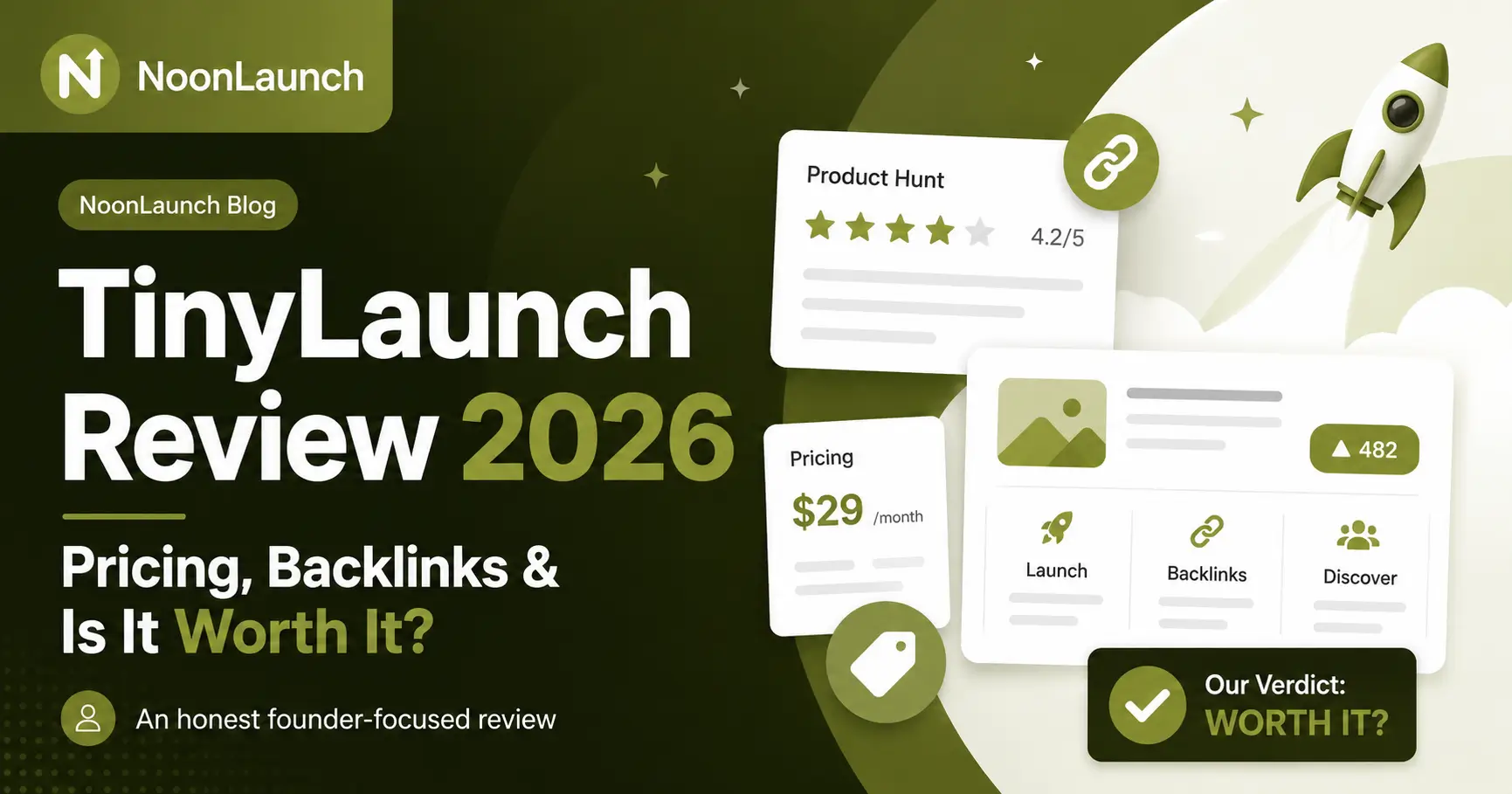
TinyLaunch is a legitimate product launch platform for SaaS founders, indie hackers, AI startups, makers, and bootstrapped teams looking for another place to launch a product, gain visibility, collect community votes, build social proof, and potentially earn a high-authority backlink.
In 2026, TinyLaunch offers a free Standard Launch and a $39 Premium Launch.
With the free option, your product can appear in TinyLaunch's launch competition and potentially earn a Top 3 badge and backlink if it ranks highly enough. Premium Launch skips the normal queue, gives the product additional placement, and includes a guaranteed high-authority backlink.
Our verdict: TinyLaunch is worth adding to your launch stack if you are already launching a SaaS, AI tool, developer product, or online startup. However, we would not rely on TinyLaunch, or any single launch platform, to generate your entire launch outcome.
The stronger strategy is to launch across several relevant surfaces, including Product Hunt, TinyLaunch, NoonLaunch, startup directories, founder communities, and your own social channels.
What Is TinyLaunch?
TinyLaunch is a startup discovery and product launch platform created to help founders put new products in front of potential users.
Founders submit products to TinyLaunch, enter a launch competition, receive community votes, compete for ranking positions, and potentially earn additional exposure, badges, and backlinks.
TinyLaunch therefore sits somewhere between:
a startup directory,
a Product Hunt-style launch platform,
and a backlink/discovery channel for early-stage startups.
The platform is particularly relevant to bootstrapped founders because the launch itself does not require a large advertising budget or an existing audience.
TinyLaunch currently says it is trusted by more than 30,000 users worldwide and continues to show active launches, Premium products, vote counts, winners, and historical launch archives.
For someone researching "TinyLaunch review 2026," the important question is therefore not whether TinyLaunch exists.
It does.
The real question is:
What exactly do you get from launching there, and is it worth adding to your launch strategy?
How Does TinyLaunch Work?
TinyLaunch uses a community launch and ranking system.
You first submit your product with information such as its name, description, website, category, and visual assets.
Your product then participates in a launch.
Visitors can discover products and vote for the launches they like. Products compete for ranking positions, with the highest-performing launches receiving additional recognition.
The basic process looks like this:
Submit your product → enter the launch → get discovered → collect votes → compete for Top 3 → earn additional exposure and potential backlink benefits.
TinyLaunch offers two ways to do this.
Standard Launch
The Standard Launch is free.
Your product enters TinyLaunch's regular launch queue and participates in the normal competition.
If your product performs strongly enough to reach the Top 3, TinyLaunch offers additional benefits including a winner badge and backlink opportunity.
This makes the free option useful for founders who want additional launch distribution without spending money.
Premium Launch
TinyLaunch Premium currently costs $39 per launch.
Premium products skip the standard queue and receive additional exposure during the launch.
The biggest difference is that Premium also includes a guaranteed high-authority backlink, rather than requiring your product to finish in the Top 3 to qualify for one.
For founders primarily interested in the backlink and additional visibility, Premium removes some of the uncertainty of the free launch.
What Do You Actually Get When You Launch on TinyLaunch?
This is the most important part of the TinyLaunch review.
You are not simply submitting your URL to another directory.
Depending on which launch option you choose and how your product performs, TinyLaunch can provide several different outcomes.
1. A public product launch page
Your startup receives a page on TinyLaunch where visitors can discover your product and click through to your website.
That creates another branded web presence for your company outside your own domain.
For a newly launched startup with very little search visibility, these third-party product pages can help establish a broader online footprint.
2. Launch-day visibility
Your product can appear alongside other active launches.
That gives you exposure to people already browsing new SaaS products, AI tools, developer products, and startup launches.
TinyLaunch should therefore be viewed as an additional distribution channel, rather than simply an SEO directory.
3. Community votes
Users can vote for products during their launch.
Votes provide two potential benefits.
First, they can improve your position within TinyLaunch's launch competition.
Second, they create visible social proof around your product.
Even small amounts of third-party engagement can be useful for a startup that has just launched and otherwise has little public validation.
4. A Top 3 badge
Products that perform strongly in the launch competition can earn a Top 3 badge.
Founders can use launch badges as external proof that their product performed well within a startup community.
That can later be reused on a website, launch announcement, social post, or other marketing asset.
5. A backlink
This is one of TinyLaunch's most prominent benefits.
TinyLaunch currently promotes a DR 72+ backlink opportunity.
For Standard Launches, backlink benefits are tied to finishing in the Top 3 and meeting TinyLaunch's badge-link conditions.
Premium Launches include a guaranteed high-authority backlink.
However, founders should understand what that means.
Domain Rating is an Ahrefs metric, not a Google ranking factor.
A relevant backlink from an established website may contribute to your broader backlink profile, but one DR 72 link does not guarantee higher Google rankings, higher Domain Rating, or more AI citations.
Treat the backlink as one useful SEO asset, not an SEO strategy by itself.
6. Another discovery surface that can keep working after launch
Perhaps the most overlooked benefit of launch platforms is that the value does not always end when launch day finishes.
A public product page creates another place where:
users can discover your startup,
search engines can associate your brand with your category,
AI systems may encounter information about your product,
people researching your company may find third-party context,
and referral traffic can continue to reach your website.
That long-tail discovery value is one reason founders should consider launching on more than one credible platform.
Who Should Launch on TinyLaunch?
TinyLaunch is best suited to founders launching internet-based products that can be understood and tried relatively quickly.
The strongest fits include:
SaaS founders
If you are launching a new SaaS product, TinyLaunch gives you an additional place to show the product to people already interested in discovering new software.
That is particularly useful for bootstrapped SaaS founders who cannot justify large launch advertising budgets.
AI startup founders
AI tools are a strong fit for startup discovery platforms because new products are constantly entering the market and users actively look for new solutions.
If you have launched an AI writing tool, AI video product, coding assistant, agent, automation product, or similar software, TinyLaunch can be another relevant distribution surface.
Indie hackers and solo founders
TinyLaunch is especially suitable for founders who are handling distribution themselves.
You do not need a PR agency or a large marketing department to submit and launch your product.
Most of the assets needed, including product description, screenshots, tagline, logo, and URL, are assets you will probably already have prepared for the wider launch.
Developer-tool founders
Developer tools, APIs, no-code products, open-source tools, and technical SaaS products can also benefit because the TinyLaunch audience already has a startup and technology orientation.
Micro-SaaS and side-project builders
TinyLaunch can make sense even if your project is small.
A micro-SaaS founder may care more about acquiring the first few users, getting a relevant backlink, and creating third-party validation than generating thousands of launch-day visitors.
Founders launching alongside Product Hunt
This may be the strongest use case.
If you are already preparing a Product Hunt campaign, most of the work needed for TinyLaunch has effectively already been completed.
You already have:
screenshots,
product descriptions,
launch copy,
positioning,
social assets,
a launch date,
and people you are notifying.
Adding another relevant launch platform increases distribution without requiring another complete marketing campaign.
Who Probably Shouldn't Rely on TinyLaunch?
TinyLaunch is less suitable if you expect a single directory or launch platform to solve your entire customer-acquisition problem.
It is not a replacement for:
understanding your ICP,
building strong positioning,
founder-led distribution,
SEO,
outbound,
community marketing,
paid acquisition,
or ongoing content.
It is also less relevant for offline businesses or highly enterprise-focused products where the buyer journey requires procurement, sales teams, or months-long evaluation.
The platform is strongest for internet products that users can discover, understand, and visit immediately.
TinyLaunch Pricing in 2026
TinyLaunch currently has two primary launch options.
Feature | Standard Launch | Premium Launch |
|---|---|---|
Price | Free | $39 per launch |
Product launch page | Yes | Yes |
Homepage visibility | Yes | Yes |
Standard queue | Yes | Skipped |
Community voting | Yes | Yes |
Top 3 badge | If ranked Top 3 | If ranked Top 3 |
High-authority backlink | Top 3 qualification | Guaranteed |
Extra Premium visibility | No | Yes |
TinyLaunch also offers separate promotional products, including featured placements and a larger startup-directory submission service.
For most founders, though, the real purchasing decision is much simpler:
Should I use the free launch, or pay $39 for Premium?
Is TinyLaunch Premium Worth $39?
TinyLaunch Premium can be worth $39 if you care about guaranteed backlink access, faster launch placement, and additional visibility.
The value is easiest to understand by separating two types of founders.
If your priority is simply:
"I want to test TinyLaunch and see what happens,"
use the free launch.
If your priority is:
"I'm already running a serious launch and want the backlink plus additional placement without depending on a Top 3 finish,"
the $39 Premium option becomes easier to justify.
What you should not expect is guaranteed customer acquisition.
Paying $39 does not mean TinyLaunch can promise 50 signups or five paying customers.
The Premium purchase primarily reduces uncertainty around placement and backlink benefits, not business outcomes.
Does TinyLaunch Actually Help With SEO?
Potentially, but keep expectations realistic.
A backlink from a relevant website can contribute to your site's overall backlink profile.
A TinyLaunch product page also creates another web document connecting:
your brand + product category + description + website.
Those signals can be useful within a larger SEO and brand-discovery strategy.
However:
launching on TinyLaunch does not automatically increase your Google rankings.
SEO performance depends on your site quality, content, relevance, backlinks, internal architecture, competition, technical health, and many other factors.
The same principle applies to GEO and AI search.
Creating consistent, authoritative third-party mentions of your company can help expand your online entity footprint, but one launch listing will not suddenly make ChatGPT or other AI engines recommend your product everywhere.
Use launch platforms as part of the foundation.
TinyLaunch Pros and Cons
Pros | Cons |
|---|---|
Free Standard Launch | Free backlink isn't guaranteed |
Active launch format | Top 3 required for some free benefits |
Community voting | Smaller reach than Product Hunt |
Winner badges and social proof | Traffic isn't guaranteed |
Premium guarantees backlink | Premium costs $39 |
Relevant startup audience | DR should not be confused with Google authority |
Easy addition to an existing launch | Still requires your own distribution |
Creates another product discovery page | One listing won't transform SEO alone |
TinyLaunch's strongest advantage is that founders can get more than a static directory submission.
Its main weakness is that, as with every launch platform, the result depends heavily on the product and the founder's broader distribution strategy.
TinyLaunch vs Product Hunt vs NoonLaunch
TinyLaunch does not need to replace Product Hunt to be worthwhile.
Product Hunt remains the much larger and more established startup launch community.
TinyLaunch provides a smaller launch environment with a particularly visible backlink proposition.
NoonLaunch provides another option for founders who want a low-cost way to add an additional launch and permanent discovery surface.
NoonLaunch currently offers a free launch and an $11 Premium Launch. Premium includes featured launch-day placement, a permanent directory listing, homepage spotlight, newsletter visibility, and a dofollow backlink.
Platform | Best for | Free option | Premium launch |
|---|---|---|---|
Product Hunt | Large launch-day maker audience | Yes | Core launch is free |
TinyLaunch | Launch competition + backlink opportunity | Yes | $39 |
NoonLaunch | Affordable launch + permanent discovery + backlink | Yes | $11 |
The better question isn't necessarily:
"Which one should I choose?"
For a serious startup launch, the better question is:
"Which relevant platforms can I add to my launch stack?"
Product Hunt can provide one audience.
TinyLaunch can provide another discovery surface and backlink opportunity.
NoonLaunch can provide another launch surface, permanent listing, and backlink.
Then founder-led distribution through X, LinkedIn, Reddit, communities, email, and relevant directories expands the campaign further.
That is how distribution compounds.
TinyLaunch Review 2026: Final Verdict
Yes, TinyLaunch is worth considering in 2026, particularly for SaaS founders, AI startup founders, indie hackers, developer-tool makers, and bootstrapped teams that are already preparing a broader product launch.
The free Standard Launch makes it easy to test TinyLaunch without financial risk.
If your product reaches the Top 3, you can receive additional social proof and backlink benefits.
The $39 Premium Launch makes more sense for founders who want additional placement and a guaranteed backlink without depending on their final ranking.
But TinyLaunch should not become your entire launch strategy.
Launching a product is fundamentally a distribution problem.
Every credible platform where your ICP may discover your startup gives you another opportunity to earn:
visitors,
users,
backlinks,
branded search,
founder relationships,
feedback,
social proof,
and long-term discoverability.
So if you're preparing a launch in 2026, our recommendation is simple:
Use TinyLaunch if it fits your product, but don't stop there.
Launch on Product Hunt.
Launch on relevant startup communities.
Submit to useful directories.
Distribute through your own audience.
And add NoonLaunch to the stack as another low-friction launch and discovery channel.
Already launching? Submit your product to NoonLaunch for free, or choose the $11 Premium Launch for featured placement, permanent directory visibility, and a dofollow backlink.